
Download and print as a PDF (469kB pdf)
Valvular Heart Disease
Your heart is a muscle which pumps blood to your lungs and around the rest of your body. There are four valves in your heart.
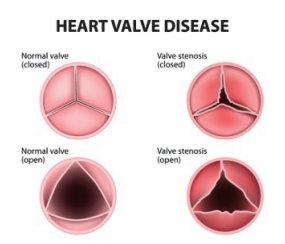
Normally, these valves open to let blood flow through or out of your heart, and then shut to keep it from flowing backwards.
If your valve is diseased or damaged this can affect the flow of blood to your heart in two ways.
- If the valve does not open fully, it will obstruct the flow of blood. This is called valve stenosis.
- If the valve does not close properly, it will allow blood to leak backwards, in the wrong direction. This is called valve incompetence or regurgitation.
What Are the Symptoms?
The symptoms of valvular disease vary depending on which valve is affected, they may include:
- Tiredness or breathlessness when exercising
- Palpitations or feeling like your heart is racing
- Chest pains or angina
- Spells of dizziness and fainting, this can happen if the obstruction is severe
The back pressure (the effect of blood flowing backwards) can also cause shortness of breath and swelling of the ankles and legs.
Transcatheter aortic valve implantation (TAVI)
For some people one way of treating their heart problem is to insert a new aortic valve percutaneously (through an artery via the skin). A catheter is a thin hollow tube. Access to the heart will be through a catheter in the artery in the wrist, and a larger catheter in the artery on the groin.
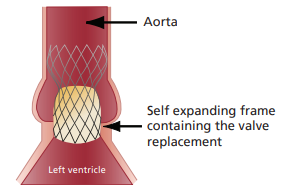
The new aortic valve is passed through the catheter in your groin under Xray guidance. Once the catheter reaches your heart, it is positioned in the opening of your aortic valve. The new valve either expands by itself or is expanded using a balloon. The cardiologist will close the puncture site with a device that seals your artery.
TAVI procedures are generally performed under local anaesthetic with or without sedation. Your consultant will discuss the best option with you.
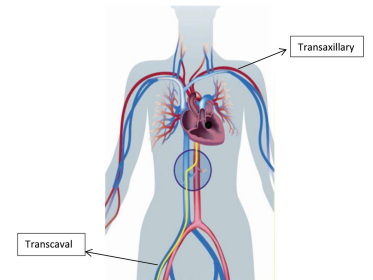
For some patients, TAVI will be done under general anaesthesia especially if the approach from the artery in the leg is not possible and the valve may need to be implanted from the artery around the shoulder (Transaxillary TAVI) or through a vein in the leg (Transcaval TAVI).
What is the new valve?
Your new valve will be made out of either Porcine (Pig) or Bovine (Cow) pericardium which is cut into shape and then sewn into a metallic frame which can be squeezed into a small catheter. We use several different valve types, depending on your anatomy. Some valves are put in with a balloon and others are self expanding.
What are the risks and benefits?
The TAVI procedure has a success rate of more than 98%. It can help reduce your symptoms of shortness of breath, chest pain, dizziness and fainting.
However, as with any heart procedure there are risks, and they vary from person to person. This will be discussed by your cardiologist when you come for your appointment at the clinic and again when you come to sign the consent form on the day of your procedure.
Some patients may need a Permanent Pacemaker after the TAVI as the new valve can squash the electrical conduction system of the heart. If this is the case for you, we will usually put in a pacemaker on the same day of your TAVI or first few days following your TAVI.
Before the procedure
You should already have had an echocardiogram (ultrasound scan of the heart) and a CT scan.
While you are awaiting your procedure, we strongly recommend arranging a dental check-up. Please ensure any necessary dental work is completed well before your TAVI procedure date as this helps reduce the risk of infection spreading from the teeth or gums to the new valve.
You may be approached by the cardiac research nurses about taking part in a research trial.
Prior to your admission, you will be asked to stop taking:
- Metformin for 2 days prior
- Warfarin, apixaban, rivaroxaban, edoxaban, dabigatran for 3 days prior
- Insulin should not be taken on the day of your procedure. If you are taking long-acting insulin at night, take as usual.
- All the other medications you can continue taking unless instructed by your doctor.
You will be asked to bring all of your medications in their own packs. Also, bring toiletries, dressing gown, pair of slippers. Due to limited space in the ward, we suggest you do not bring too many things with you.
You may be asked to come in the evening before or on the day of the procedure. The ward team will take blood samples and do an electrocardiogram (ECG) before your procedure. You will not be able to eat or drink for six hours before your procedure. You are allowed to have sips of still water until you are taken for the procedure.
If you need help with transport going to the hospital, please contact the cardiology bookings team.
Please note that we do not have on-site lodging facilities for patient’s companions. As a result, we kindly ask that you make your own arrangements for accommodation during your stay in the area. We appreciate your understanding and cooperation in this matter.
After the procedure
The procedure lasts approximately one and a half hours. We will close the puncture site in your groin with a device that seals the artery. The nurse looking after you will regularly inspect your groin, check your blood pressure and check the pulses in your feet.
We will observe your heart rhythm on a cardiac monitor overnight. If all is well, you will be able to sit up on return to ward and get out of bed around 4 to 6 hours after the procedure.
While you are in the Cardiac Care Unit (CCU) it may not always be possible to care for you with other patients who are the same sex as you because we will be using specialised equipment as part of your care. However we provide substantial screening around your bed, to preserve your privacy and dignity.
Before you go home we will review your medication. You may need to take Aspirin to start with and we will review this in clinic.
Going home
If there have not been any problems, you should be able to go home the day after the procedure. If you are sent home on the same day of your procedure, the Structural Heart Nurse will call you the next day to check on you.
We recommend that you have someone who can stay with you for up to 2 days following discharge to help with recovery. You may need support over the next 1 to 2 weeks while recuperating.
Recovery at home will continue at different rates for each person. It may take a few weeks or months to feel the maximum benefits following the TAVI procedure.
If you expect problems organising your own transport home, please let ward nurses know as soon as you get admitted.
We kindly encourage all patients, especially those living outside the Sussex area, to organise their own transport home wherever possible.
Wound care
It is normal for your groin to feel tender for a few days after the procedure. A bruise may develop with discolouration down as far as your knee.
The wound may be covered in a clear film dressing. This can be peeled off when you get home. The wound area should be kept clean and dry. We also advise you to avoid hot baths for 48 hours after discharge as this may encourage bleeding.
Be advised
If you develop a hard tender lump under the skin around the wound, please contact CCU Telephone 01273 696955 extension 64484. This may be the result of a collection of blood under the skin.
In the highly unlikely event of your wound starting to bleed, lie down and get a family member or friend to apply pressure to the incision on your groin. If the bleeding does not stop in 10 minutes, call 999.
Activity
We advise you not to do anything strenuous for the first week after returning home. Avoid lifting heavy objects (e.g. shopping, suitcases) excessive pulling and pushing (e.g. cutting the grass, digging the garden, shovelling and vacuum cleaning).
Give yourself a week or two to get your strength back before returning to your everyday activities. A good starting point is to take regular walks on a daily basis. You don’t have to avoid climbing stairs or walking up hills; just take them slowly and steadily at first.
After a couple of weeks you should be back doing the things you used to do. Hopefully you will find that you can do more than you could before.
Returning to work
This will depend on many factors such as the overall state of your health and the type of work that you do.You may like to discuss this in more detail with your cardiologist or GP.
If you require a fit note, please ask the ward team before your discharge.
Travel
Government rules say that you are not allowed to drive for 2 weeks following your TAVI procedure. You don’t need to let the DVLA know unless you hold a commercial license, but we do advise you to tell your insurance company to avoid problems with any claims you may make in the future.
It’s safe to fly 2 weeks after your TAVI, although its best to check with your airline as each has its own procedure.
Dentist
- Brush at least twice a day and floss daily.
- Visit your dentist regularly, usually every 6 months to a year, to ensure you teeth and gums are healthy.
- Please notify your dentist that you have a prosthetic valve (TAVI) before any treatment.
- You will likely require antibiotics before high-risk dental work (such as cleanings, extractions, or gum tissue manipulation) to prevent infection.
- If you develop a gum abscess or a toothache, see your dentist immediately.
Hospital follow up
You will have a follow up appointment with the structural heart nurse specialist after 6 to 8 weeks. Thereafter you will return to the care of your referring hospital, if you live outside the Brighton area.
If you have any questions, queries or concerns please do not hesitate to contact our Structural Heart Specialist Nurses.
 Telephone
07769 286982
Telephone
07769 286982
 Email
[email protected]
Email
[email protected]
Useful telephone numbers and websites
Cardiology Booking Team
01273 696955
Ext. 64462
Structural Heart Nurse Specialist
07769 286982
Cardiac Care Unit
01273 696955
Ext. 64484
Cardiac Research Team
01273 696955
Ext. 64049
NHS Dental Service
To view the procedure video, you can access it on:
Explain my ProcedurePassword: uhs1410
or scan:

This leaflet is intended for patients receiving care in Brighton and Hove and Haywards Heath.
The information in this leaflet is for guidance purposes only and is in no way intended to replace professional clinical advice by a qualified practitioner.
Today’s research is tomorrow’s treatments. That’s why UHSx is proud to be a research-active Trust. Find out how you can get involved.
Visit our website www.uhsussex.nhs.uk/research-and-innovation/information-for-patients-and-public or scan the QR code: 