
Download and print as a PDF (313kB pdf)
What is a soft tissue injury?
There are many different soft tissues including ligaments, muscles, tendons, cartilage and nerves. Injury to any of these tissues can result in pain and inflammation.
The type of tissue injured and severity of the injury will affect how long it takes to heal. Healing times vary up to 6 to 8 weeks, or longer for severe injuries.
What can I do to help the healing process?
Rest
Pace your activity and have regular rest breaks. Initially try to avoid painful
activities until your hand or wrist is feeling stronger and the pain has begun to
settle.
Do not completely stop moving the joint, as total rest can cause stiffness and slow recovery.
Ice
In the early days following an injury, ice can be applied to help reduce pain.
To avoid an ice burn, an ice pack should be applied through a wet towel. Apply the ice for approximately 20 minutes. This can be repeated every 2 to 3 hours.
Elevation
Elevating your arm will help to reduce the swelling, improve movement, and ease pain. You may chose to rest on cushions or wear a sling. Elevation is particularly helpful for hand and wrist injuries.
Pain Relief
Take regular pain relief to help you move and exercise your hand or wrist more easily. Your GP or Pharmacist can advise you on appropriate pain relief.
Heat
Applying a heat pack before exercising may be comfortable and help you to achieve more movement. However, if the injured area remains warm or hot it is better to continue using ice.
Exercise
It is very important that you keep your hand and wrist moving to help the healing process and to maintain your function. The following exercises will guide you through your full range of hand and wrist movements.
You should continue doing the exercises until you are pain free and your movement and function is back to your pre-injury level.
Wrist exercises
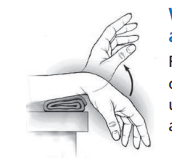
Wrist extension and flexion: forearm supported on a table, move hand up and down feeling a gentle stretch.
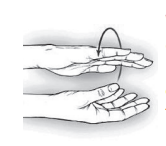
Wrist supination and pronation: elbow bent to 90 degrees, rotate your forearm, so that your palm faces up and then down.
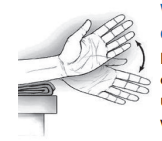
Wrist ulnar / radial deviation: forearm supported on a table, thumb upwards, move the wrist up and down.
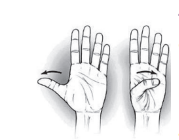
Thumb flexion and extension: begin with thumb positioned outward. Move the thumb across the palm and back.
Finger and tendon gliding exercises
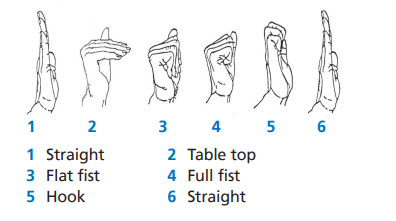
How often should I exercise?
Complete the exercises 3 to 4 times a day. Build up the repetitions of each exercise, for
example starting with 5 and increasing to 10 as the movement becomes less painful.
Do not
- Wear any rings on your fingers until the swelling has reduced.
- Immobilise (stop moving) your hand or wrist (unless advised to do so).
Do
- Take regular pain relief.
- Regularly exercise your hand/wrist.
- Use ice and elevation to reduce the swelling.
- Continue with light activities.
- Try to use your hand as normally as possible.
- Gradually reintroduce heavier activities as your pain allows
- Contact your GP if you are concerned about your recovery.
General support
• For general medical advice please use the NHS website, the NHS 111 service, walk-in-centres, or your GP.
• NHS website provides online health information and guidance.
• There are walk-in and urgent treatment services at Brighton Station, Crawley Urgent Treatment Centre, Lewes Victoria Hospital, Horsham Minor Injuries Unit and Bognor Regis War Memorial Hospital.
The information in this leaflet is for guidance purposes only and is in no way
intended to replace professional clinical advice by a qualified practitioner.
Today’s research is tomorrow’s treatments. That’s why UHSx is proud to be a research-active Trust. Find out how you can get involved.
Visit our website www.uhsussex.nhs.uk/research-and-innovation/information-for-patients-and-public or scan the QR code: 