
Orthoptic Department
Download and print as a PDF (273kB pdf)
What is this information about?
This information is about ‘Marcus Gunn jaw winking syndrome’ (MGJWS). It explains:
- what Marcus Gunn jaw winking syndrome is
- the causes of MGJWS and when it develops
- the appearance of MGJWS and signs which show a person may have it
- how the eyes and vision may be affected in people with MGJWS
- what treatment and support we may give people with MGJWS
Why have I been given this information?
You have been given this information because you, a family member, or someone you are a carer for, has been diagnosed with MGJWS.
Reading this information will help you to know what to expect from the condition and any treatment you may have for it.
What is Marcus Gunn jaw winking syndrome?
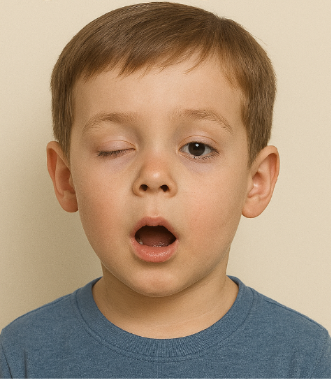
MGJWS is a condition which causes people to have a droopy eyelid (ptosis) which lifts when they move their jaw sideways. This means it is most often noticed when people are chewing or smiling. It can make people look as though they are winking.
It is named after Marcus Gunn, an eye-specialist doctor (ophthalmologist) who was the first person to recognise and describe it as a condition. A ‘syndrome’ is a group of symptoms which when they happen together show that a person is likely to have a certain underlying condition which causes them.
What causes some people to have MGJWS?
MGJWS develops in babies in the womb before they are born. It happens when some of the nerves which make muscles in the eyelid (levator muscle) and the jaw pterygoid muscle) move are not connected as they should be. This makes the eyelid and jaw move at the same time.
There is no way to prevent MGWJS from developing during pregnancy.
Is there anything which makes it more likely that a baby will develop MGJWS?
- For most people there is no obvious reason why they develop MGWJS. It can be an inherited (hereditary) condition passed down from a parent.
- Male and female babies are equally likely to develop it.
- MGJWS is likely to be the cause in around 5 in 100 (5%) of newborn babies who have a drooping eyelid.
Is MGJWS linked with any other eye conditions?
In people with MGJWS:
- just over half (around 50 to 60%) may:
- develop reduced vision (amblyopia)
- have ‘strabismus’. This is when the eyes are not pointing in the same direction and working together. Instead of looking at the same object, one or both eyes may turn in, out, up, or down. In MGWJS only one eye is likely to be affected in this way.
- have limited upward movement of their eye
- around a quarter (26%) may have one eye which is more long or short sighted than the other (anisometropia).
How might having MGWJS affect me or my child?
Most people with MGWJS only develop it in one eye. Symptoms include:
- droopy eyelid. This is usually mild to moderate and only affects one eye. The amount that people’s eyelids droop when the eyelid is in their usual resting position is different for everybody with MGWJS.
- ‘winking’. When the jaw muscle gets a ‘signal’ to move (for example if you chew or smile) the upper eyelid of the affected eye lifts upwards. It then returns rapidly to its lower position. This makes it look as though you are winking. The amount of ‘wink’ and other symptoms can appear worse when you are looking down. MGJWS is usually first noticed in babies as they are feeding.
- upper eyelid movement. This can happen when you are chewing, sucking, moving your jaw forward, clenching teeth or swallowing.
Having MGWJS may make people feel less confident because of the way they appear with their symptoms. This can affect how they are with other people (their social development). Children are likely to need support to help them to cope with this.
What treatment might I or my child need for MGJWS?
Most people do not need treatment for their MGJWS.
You may have treatment if:
- your eyelid droops a lot in its usual resting position. It may be possible to have an operation on the eyelid muscles that can improve how it looks.
- The orthoptist can refer you or your child to an ophthalmologist (surgeon who is a specialist in doing eye operations) who can talk with you about this operation and decide whether it is right for you or your child.
- you have problems with your vision related to MGWJS. These may be managed with glasses if they are right for you.
- If you have been given glasses but you still have reduced vision in one eye, we may give you an eye-patch or put eye-drops into your better seeing eye. This is called occlusion treatment and can improve the vision in your weaker eye.
Be aware
it is not possible to change the nerve connections that cause MGWJS so it cannot be ‘cured’.
How MGWJS affects a person’s eyelid movements is different for everyone and people are not affected in the same way.
Who can I contact if I need further information or support after I have read this information?
Contact your orthoptist. Please use the contact numbers below:
Contact Details
 St Richard’s Hospital Orthoptists
01243 831499
St Richard’s Hospital Orthoptists
01243 831499
Southlands Hospital Orthoptists
01273 446077
Sussex Eye Hospital Orthoptists
01273 664872
Princess Royal Hospital Orthoptists
01444 441881
Ext. 68305
The information in this leaflet is for guidance purposes only and is in no way intended to replace professional clinical advice by a qualified practitioner.
Today’s research is tomorrow’s treatments. That’s why UHSx is proud to be a research-active Trust. Find out how you can get involved.
Visit our website www.uhsussex.nhs.uk/research-and-innovation/information-for-patients-and-public or scan the QR code: 