
The information on this page is based on a leaflet developed by the National Institute for Health and Care Excellence (NICE) and NHS England and has been adapted for use by UHSussex under the Open Government Licence. The original information is based on the NICE guideline Intrapartum Care for Healthy Women and Babies. Some local information has been added to reflect maternity services at UHSussex.
Who is this information for?
This information is for healthy women, who expect to have a straightforward pregnancy and give birth between 37 and 42 weeks of pregnancy. This information should be used as part of a comprehensive personalised discussion with your midwife.
During your antenatal care, your midwife, and sometimes a doctor (obstetrician), will discuss your health with you. With information from you, they will assess your health and the health of your baby. You can decide what feels right for you. You can change your plans about where to have your baby at any stage if your pregnancy changes or you change your mind.
Planning where to have your baby is an important decision. Evidence shows that giving birth in the UK is generally very safe. You can choose where to have your baby and this information has been developed to answer some of the questions you may have about the availability and safety of all the options you should be offered. You can find out more about the safety of our maternity care at UHSussex here: Safe, high-quality care: Maternity services at UHSussex – University Hospitals Sussex NHS Foundation Trust
What choices do I have about where to give birth?
Your midwife should explain that you can choose to give birth at home, in a midwifery unit or in a hospital obstetric unit. There is more information about each option below and your midwife will explain which of the options are available to you. Wherever you choose to have your baby, you should be supported in your choice.
Midwifery units (sometimes called birth centres) are run by midwives. They can be in or next to a hospital with an obstetric unit (alongside) or in a different place (freestanding). At UHSussex, we have an alongside birth centre in St Richards Hospital, Chichester. We do not have a freestanding birth centre within UHSussex. Birth centres provide a comfortable environment which is more like being at home. They do not have the same medical facilities as a hospital obstetric unit but have clear processes for dealing with an emergency for you or your baby. This will include transfer to an obstetric unit if necessary.
Obstetric units (also called labour wards) have more medical facilities. Planning to have obstetric unit care is associated with an increase in the chance you will have an intervention.
You can change your plan and make a different choice at any stage before labour starts, and can come into a midwifery or obstetric unit once labour starts even if your original plan was for a home birth. However, it is more difficult to change your mind and choose to have a homebirth later in your pregnancy, so if this is something you think you might want, it is better to plan for it just in case.
You can discuss your individual circumstances and choices with your midwife at any time including, for example what would happen if you needed a transfer to an obstetric unit and the time it would take.
What does the research say?
Where can I choose to give birth:
At home
- At home you will be in a familiar place and feel comfortable in your own surroundings.
- A midwife will be with you for your labour and a maternity support worker, or second midwife will be there for the birth of your baby.
- You are more likely to see the same person throughout your care.
- If you or your baby needs to see a doctor, your midwife will call an ambulance, and you will be transferred to a hospital obstetric unit.
- Pain relief options may include a bath or birthing pool which you provide and gas and air (Entonox).
- You will be able to use your own facilities including toilet and bathroom.
In an alongside midwifery unit (birth centre)
- An alongside midwifery unit, which is usually ‘home-like’, is in a main hospital, but separate from the obstetric unit.
- A midwife will be with you for most of your labour and a maternity support worker or second midwife may also be there.
- You are more likely to see the same person throughout your care than you would in an obstetric unit.
- If you or your baby needs to see a doctor, you will be transferred to an obstetric unit on the same site. A neonatal unit is also available on site; these will differ in levels of care provided.
- Pain relief options may include a birthing pool (if available), gas and air (Entonox), or an opiate injection of pain relief.
- It is less likely that you will have to share toilet and bathroom facilities with other people.
In a hospital obstetric unit
- An obstetric unit is a hospital environment with a medical team (obstetricians, anaesthetists, neonatologists/paediatricians) and medical equipment.
- A midwife will be with you for most of your labour and a maternity support worker or second midwife may also be there.
- In many hospital settings, you are less likely to see the same person throughout your care.
- If you or your baby needs to see a doctor, your midwife will call a doctor who is available on site who will come to your room to see you. A neonatal unit is also available on site; these will differ in levels of care provided.
- Pain relief options may include gas and air (Entonox), an opiate injection of pain relief, a birthing pool (if available), and an epidural. Note: An epidural is only available in a hospital obstetric unit.
- You are more likely to have to share toilet and bathroom facilities with other people.
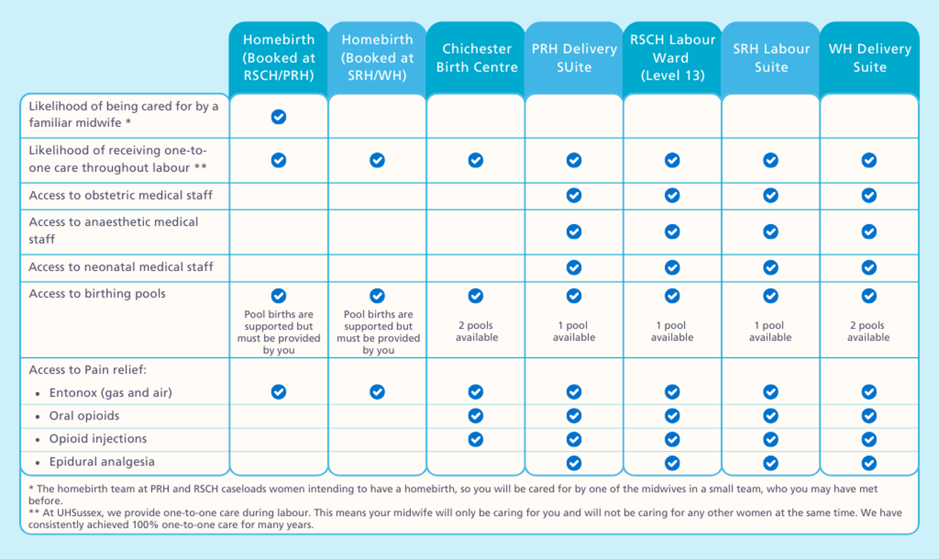
You can compare what is available at all the birth settings within UHSussex below:
What else do I need to know?
Some women like to have more detail about the benefits and risks of the choices they are making.
Very few mothers die or are injured as a result of birth, wherever they have their baby.
Few babies die or are injured as a result of the birth itself, wherever the baby is born.
Additional information on national statistics can be found in the sections below. These are about your chances of having a straightforward vaginal birth, transfers to a hospital obstetric unit (how often these are needed and for what reason) and what is meant by serious medical problems for your baby.
It is intended to help answer questions you may have about the research evidence that the recommendations are based on.
Your midwife or doctor can discuss this additional information with you, if you wish.
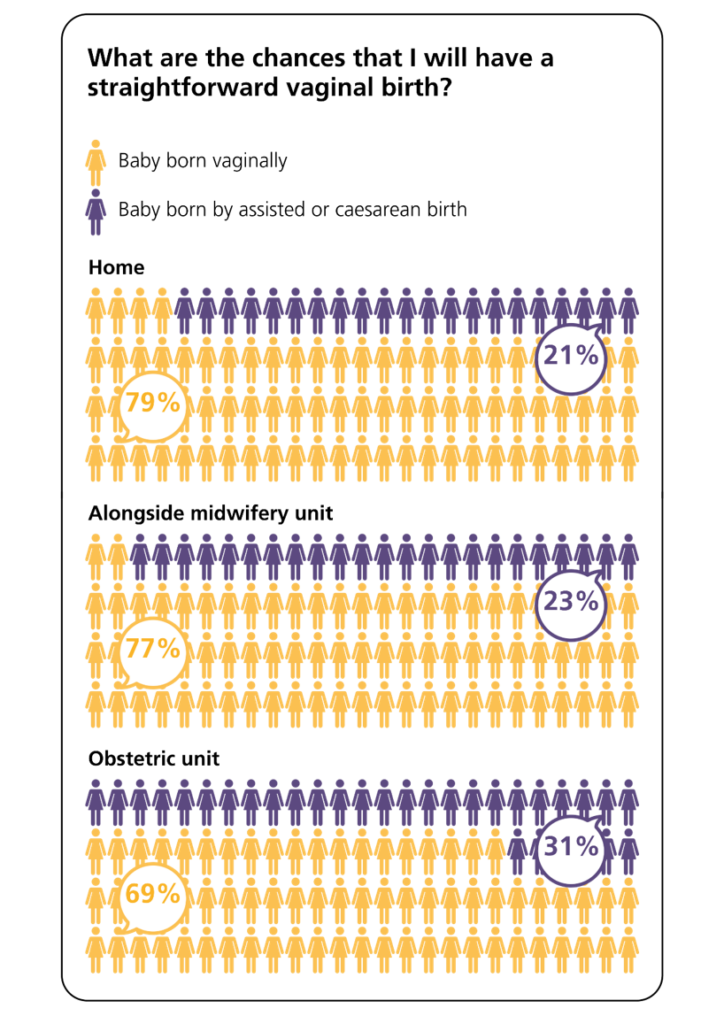
What are the chances that I will have a straightforward vaginal birth?
Women having their first baby
The chances vary depending on your individual circumstances, but the best available research evidence is shown in the table below.
The evidence in the tables below:
- Is about women who have not had a baby before, who were considered to be at low risk of complications prior to the start of labour. It relates to where women planned to have their baby, even if the birth eventually happened somewhere else. For example, if a woman planned to give birth out of hospital but transferred to hospital during labour and her baby was born by caesarean section, then that caesarean birth was recorded as being from wherever she had planned to give birth.
- The way women give birth in England has changed since this research was carried out, with caesarean birth rates increasing nationally. The national research and infographics in this booklet are still helpful for comparing different places of birth. To give you the most up to date information, we have also included data from UHSussex maternity services for 2025, showing the different types of births that took place locally. We hope this helps you compare the national evidence with what is happening in your local maternity service today.
Local births at UHSussex:
| UHSussex births in 2025 (not including planned caesarean births or inductions) | |
| Spontaneous vaginal birth | 54.2% |
| Instrumental birth (forceps or ventouse) | 25.1% |
| Emergency caesarean birth | 20.1% |
This table shows the different ways women having their first baby gave birth when labour started on its own. Women who had an induction of labour or a planned caesarean birth are not included. The data includes all births across UHSussex and is not broken down by planned place of birth (for example, home birth, birth centre or labour ward).
| Rates of spontaneous vaginal birth, transfer to an obstetric unit and obstetric interventions for each planned place of birth | Proportion of incidences with women having their first baby | ||
| Home | Alongside midwifery unit | Obstetric unit | |
| Spontaneous vaginal birth | 79.4%* | 76.5% | 68.8%* |
| Transfer to an obstetric unit | 45.0%* | 40.2% | 1.0%** |
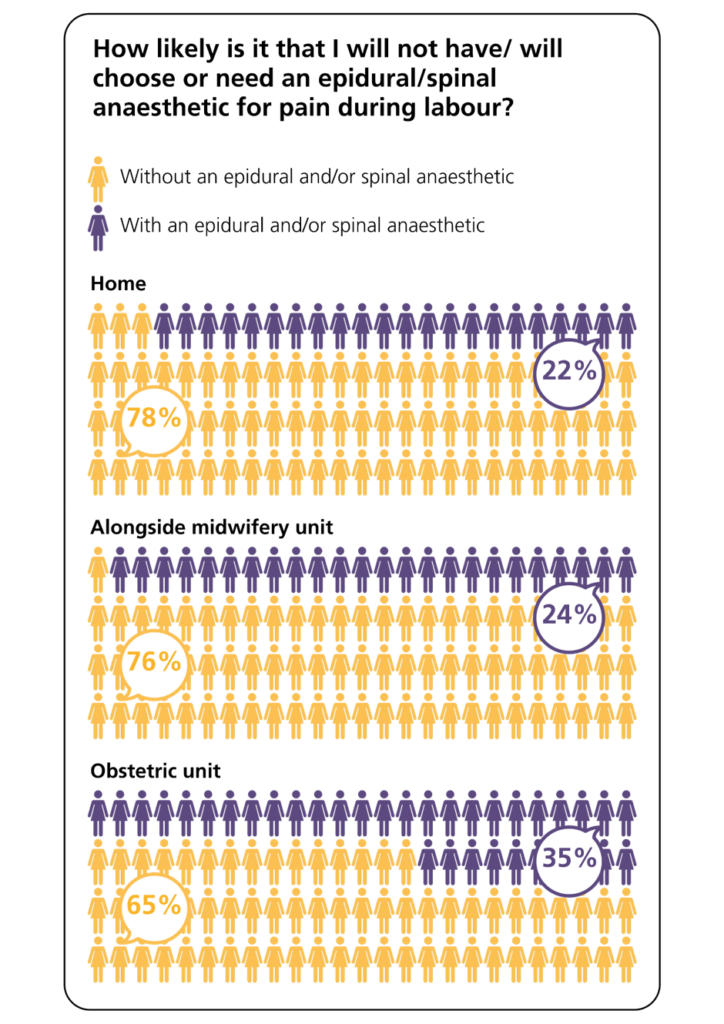
| Regional analgesia (epidural and/or spinal) *** | 21.8%* | 24.0% | 34.9%* |
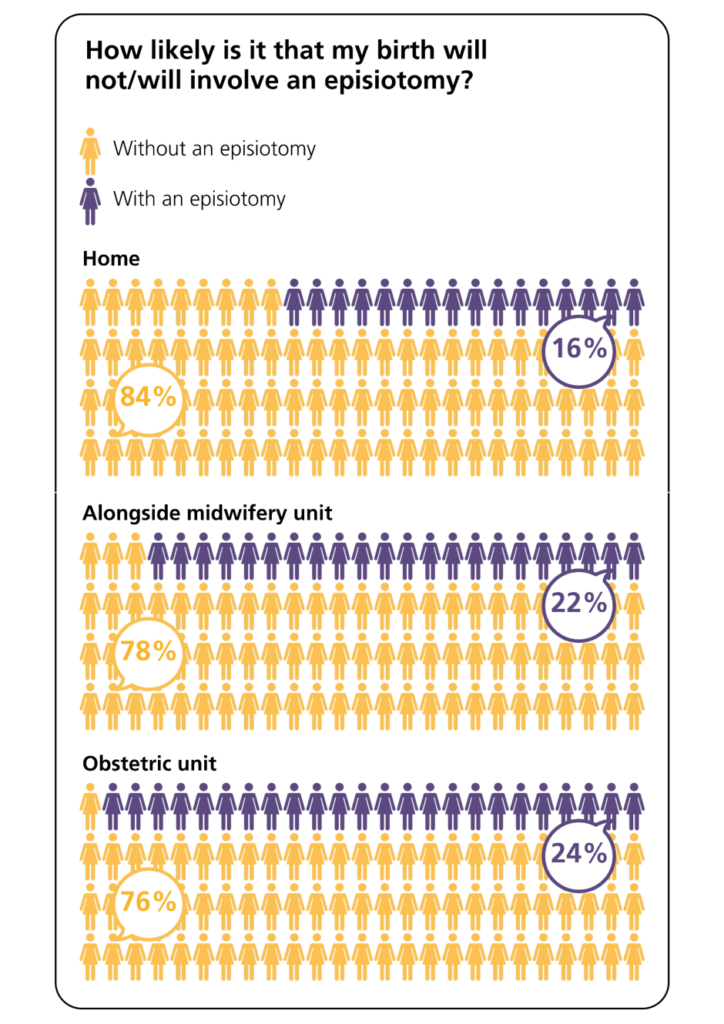
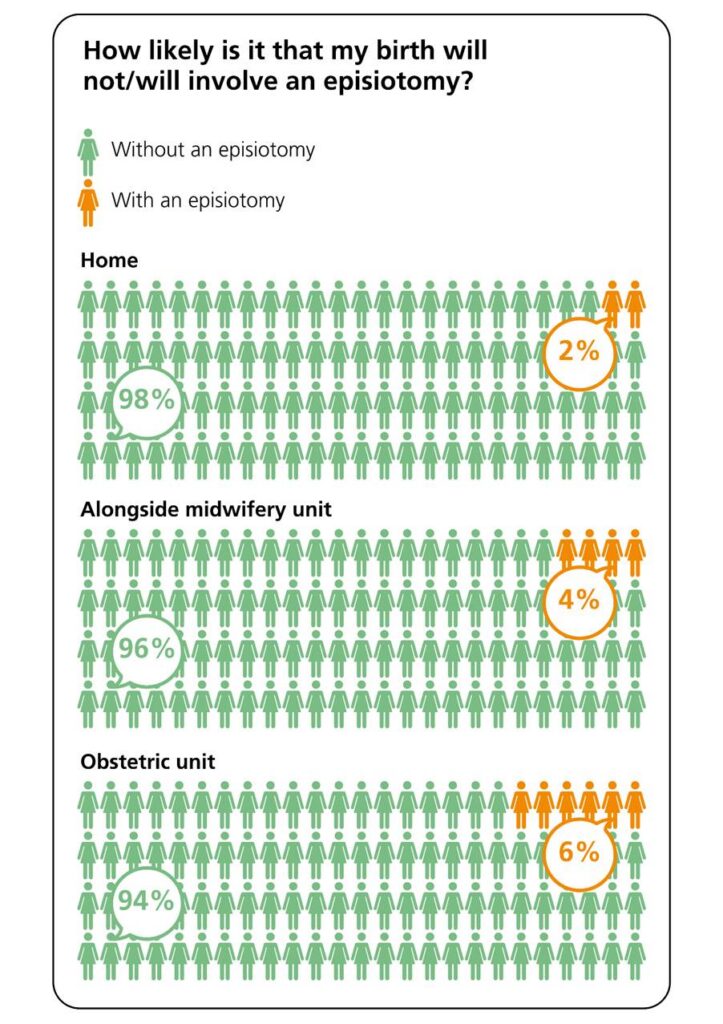
| Episiotomy | 16.5%* | 21.6% | 24.2%* |
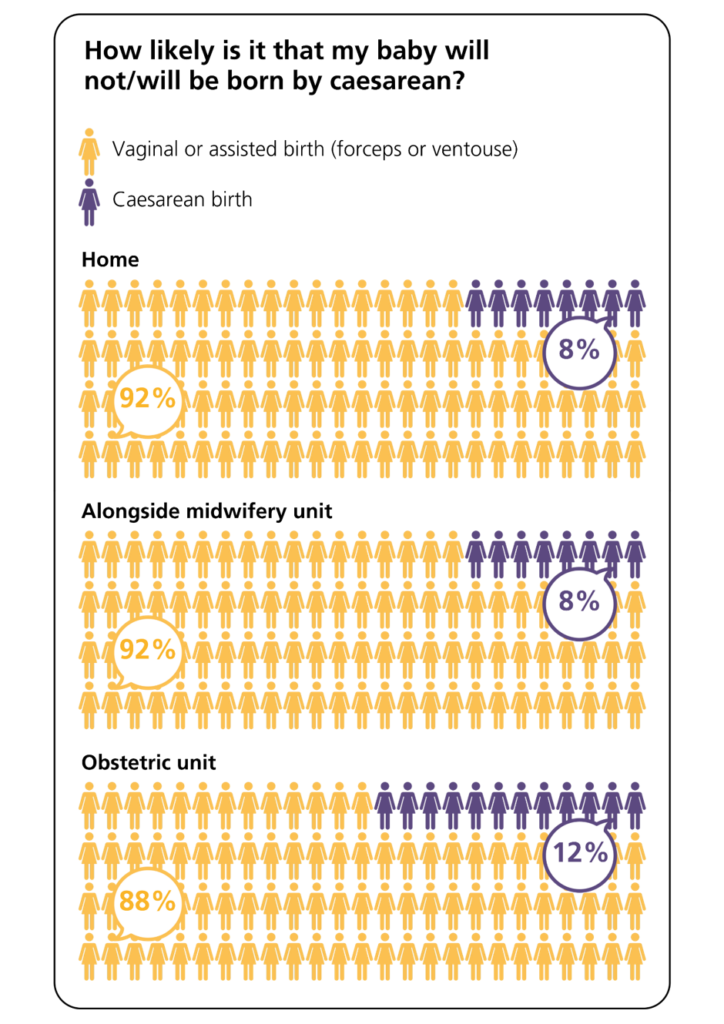
| Caesarean birth | 8.0%* | 7.6% | 12%* |
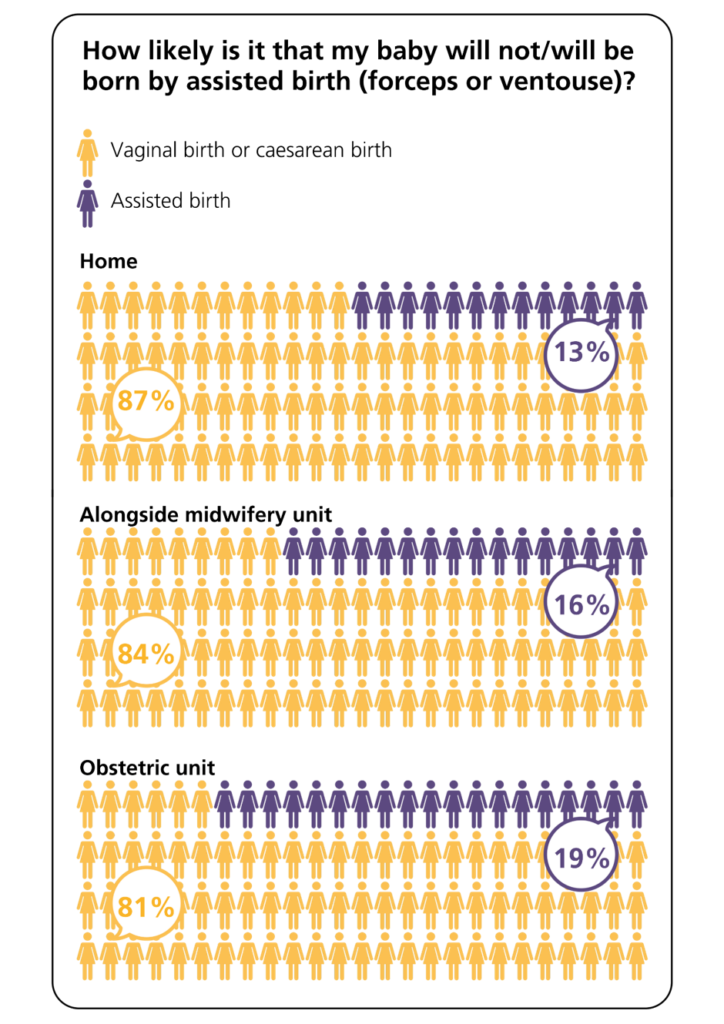
| Instrumental birth (forceps or ventouse) | 12.6%* | 15.9% | 19.1%* |
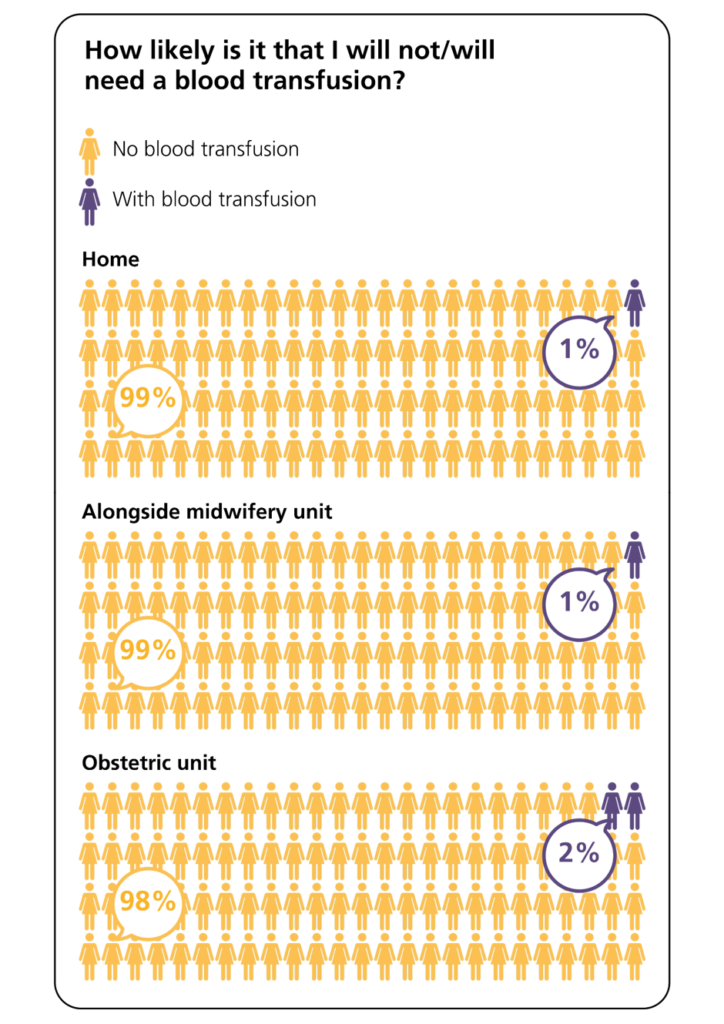
| Blood transfusion | 1.2% | 1.1% | 1.6% |
| * Figures from Birthplace 2011 and Blix et al. 2012 (all other figures from Birthplace 2011). ** Estimated transfer rate from an obstetric unit to a different obstetric unit owing to lack of capacity or expertise. *** Blix reported epidural analgesia and Birthplace reported spinal or epidural analgesia. | |||
This is the same information presented in a different way:
Women who have had a baby before
The chances vary depending on your individual circumstances, but the best available research evidence is shown in the table below.
The evidence in the tables below.
- Is about women who have had a baby before who were considered to be at low risk of complications prior to the start of labour. It relates to where women planned to have their baby, even if the birth eventually happened somewhere else. For example, if a woman planned to give birth out of hospital but transferred to hospital during labour and her baby was born by caesarean section, then that caesarean birth was recorded as being from wherever she had planned to give birth.
- The way women give birth in England has changed since this research was carried out, with caesarean birth rates increasing nationally. The national research and infographics in this booklet are still helpful for comparing different places of birth. To give you the most up to date information, we have also included data from UHSussex maternity services for 2025, showing the different types of births that took place locally. We hope this helps you compare the national evidence with what is happening in your local maternity service today.
Local births at UHSussex:
| UHSussex births in 2025 (not including planned caesarean births or inductions) | |
| Spontaneous vaginal birth | 89.3% |
| Instrumental birth (forceps or ventouse) | 5.2% |
| Emergency caesarean birth | 5.4% |
This table shows the different ways women who have had a baby before gave birth when labour started on its own. Women who had an induction of labour or a planned caesarean birth are not included. The data includes all births across UHSussex and is not broken down by planned place of birth (for example, home birth, birth centre or labour ward).
| Rates of spontaneous vaginal birth, transfer to an obstetric unit and obstetric interventions for each planned place of birth | Proportion of incidences with women who have had a baby before | ||
| Home | Alongside midwifery unit | Obstetric unit | |
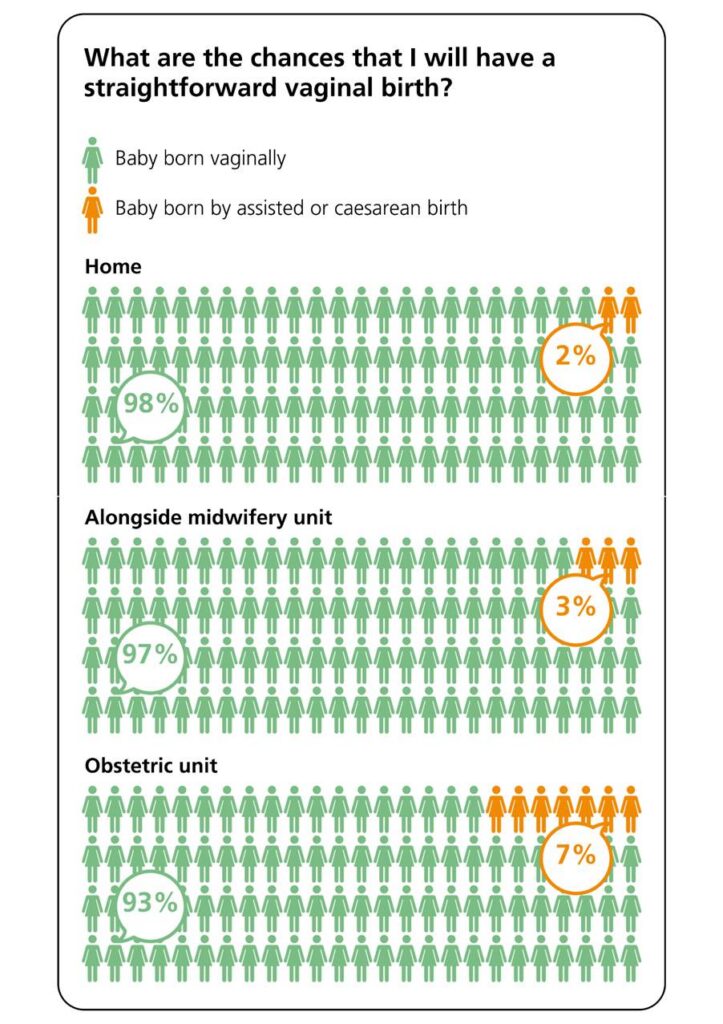
| Spontaneous vaginal birth | 98.4%* | 96.7% | 92.7%* |
| Transfer to an obstetric unit | 11.5%* | 12.5% | 1.0%** |
| Regional analgesia (epidural and/or spinal) *** | 2.8%* | 6.0% | 12.1%* |
| Episiotomy | 1.5%* | 3.5% | 5.6%* |
| Caesarean birth | 0.7%* | 1.0% | 3.5%* |
| Instrumental birth (forceps or ventouse) | 0.9%* | 2.3% | 3.8%* |
| Blood transfusion | 0.4% | 0.5% | 0.8% |
| * Figures from Birthplace 2011 and Blix et al. 2012 (all other figures from Birthplace 2011). ** Estimated transfer rate from an obstetric unit to a different obstetric unit owing to lack of capacity or expertise. *** Blix reported epidural analgesia and Birthplace reported spinal or epidural analgesia. | |||
This is the same information presented in a different way:
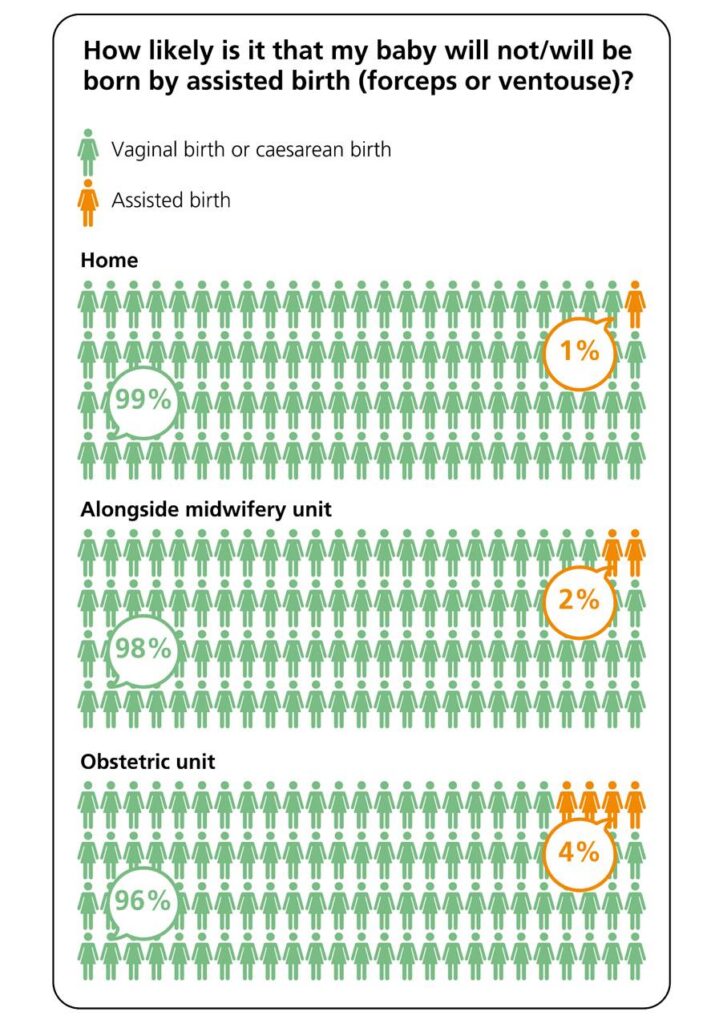
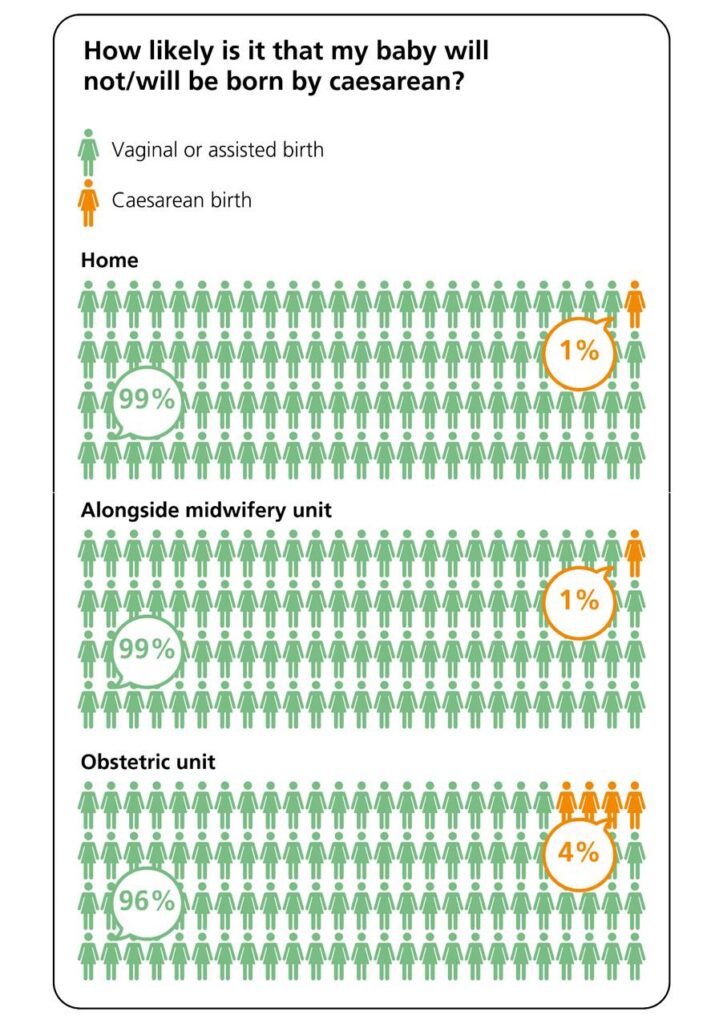
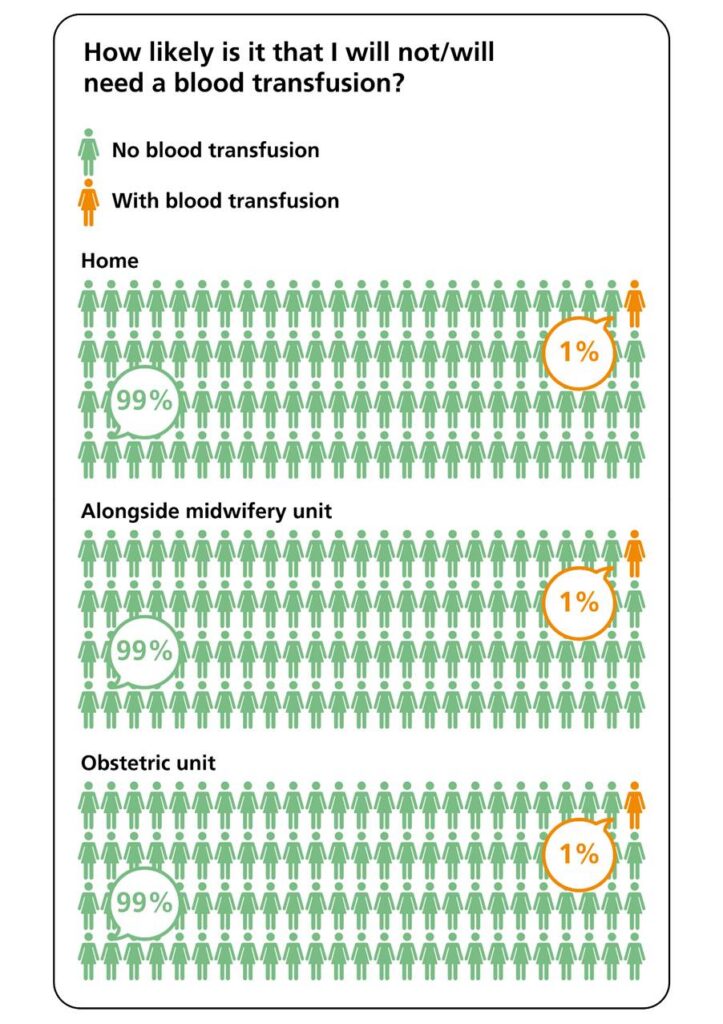
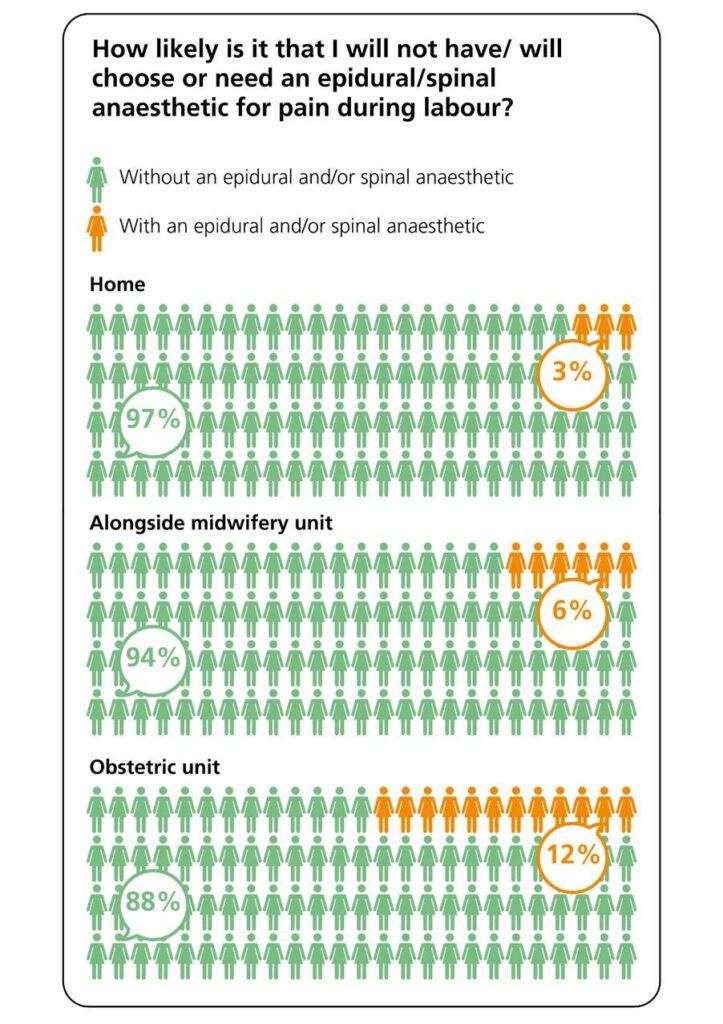
What are the chances my baby will be well or have serious medical problems, including stillbirth, during or after birth?
Women having their first baby
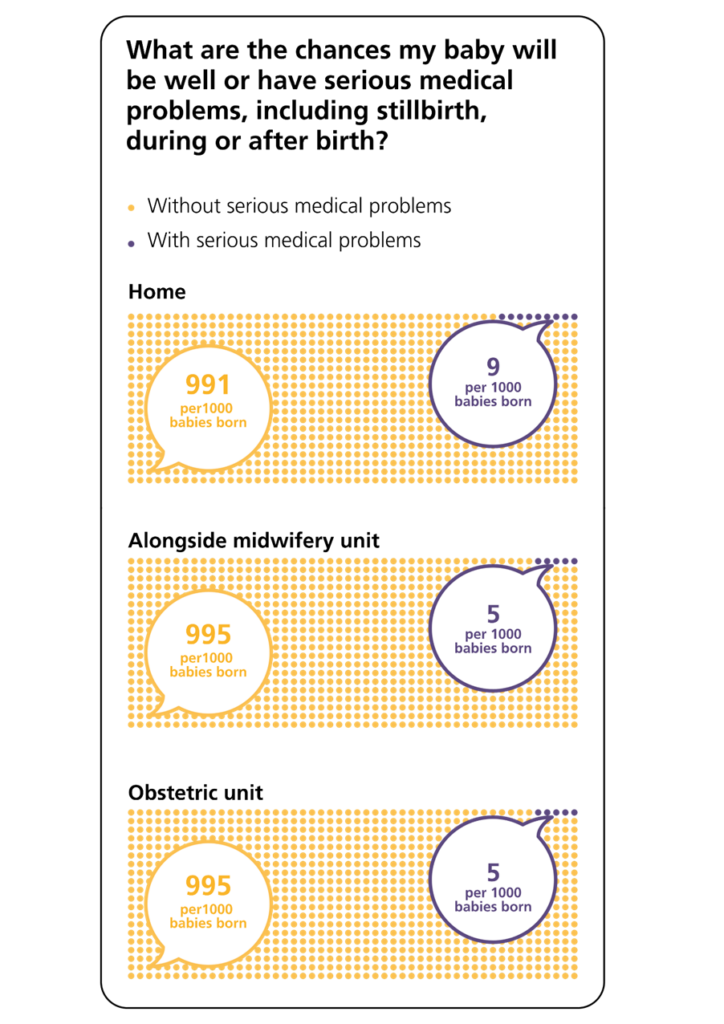
Wherever you choose to have your baby, a small number of babies will have unexpected medical problems during or after birth. Some problems are less serious and are not permanent, and some are more serious and long term, but still rare. The chances of a problem vary depending on your individual circumstances, but the best available evidence for healthy women who are having their first baby, and are at low risk of complications, is shown in the table below.
NB these are the numbers out of 1000.
| Outcomes for the baby for each planned place of birth | Number of babies per 1000 births | ||
| Home | Alongside midwifery unit | Obstetric unit | |
| Babies without serious medical problems | 991 | 995 | 995 |
| Babies with serious medical problems* | 9 | 5 | 5 |
| *Serious medical problems were combined in the study: neonatal encephalopathy and meconium aspiration syndrome were the most common adverse events, together accounting for 75% of the total. Stillbirths after the start of care in labour and death of the baby in the first week of life accounted for 13% of the events. Fractured humerus (fractured upper arm bone) and fractured clavicle (fractured collar bone) – less than 4% of adverse events. | |||
The information in this table comes from national guidance from NICE and is based on research published in 2011. More recent research (from 2019) found there was no difference in the chances of a baby having serious medical problems for women planning to birth at home compared to those intending to have a hospital birth.
Women who have had a baby before
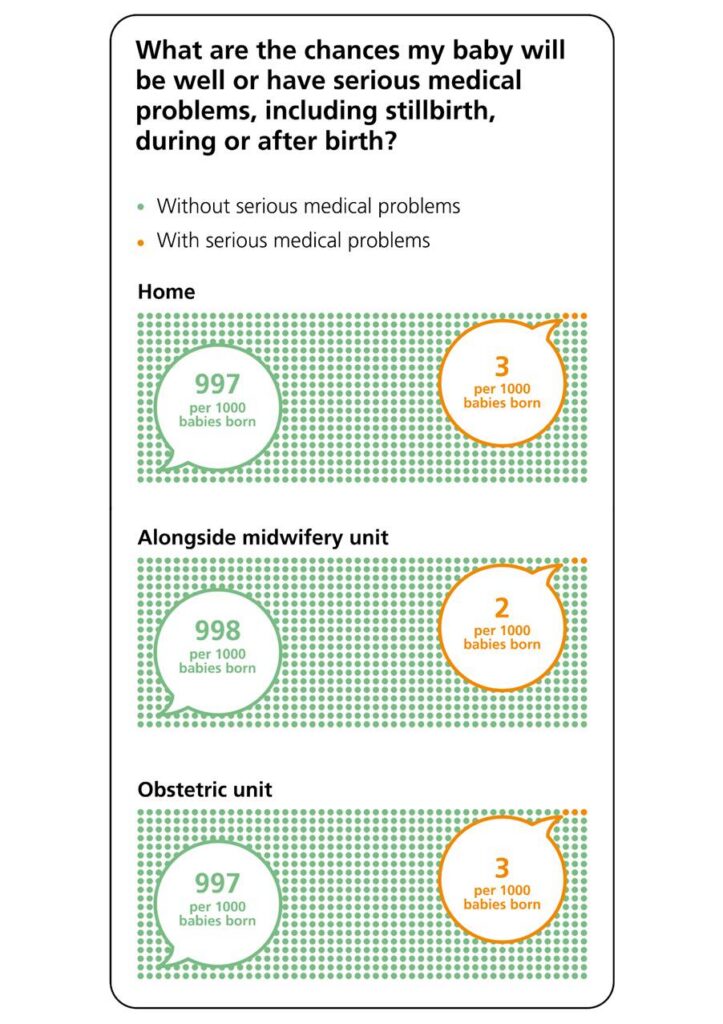
Wherever you choose to have your baby, a small number of babies will have unexpected medical problems during or after birth. Some problems are less serious and are not permanent, and some are more serious and long term, but still rare. The chances of a problem vary depending on your individual circumstances, but the best available evidence for healthy women who have had a baby before, and are at low risk of complications, is shown in the table below.
NB these are the numbers out of 1000.
| Outcomes for the baby for each planned place of birth | Number of babies per 1000 births | ||
| Home | Alongside midwifery unit | Obstetric unit | |
| Babies without serious medical problems | 997 | 997 | 998 |
| Babies with serious medical problems* | 3 | 3 | 2 |
| *Serious medical problems were combined in the study: neonatal encephalopathy and meconium aspiration syndrome were the most common adverse events, together accounting for 75% of the total. Stillbirths after the start of care in labour and death of the baby in the first week of life accounted for 13% of the events. Fractured humerus (fractured upper arm bone) and fractured clavicle (fractured collar bone) – less than 4% of adverse events. | |||
Serious medical problems
The large UK study that is the source for most of this information (Birthplace 2011) used a definition of serious medical problems or ‘adverse outcome’ that includes the outcomes listed below. These were chosen because they are all serious at birth.
Some babies get better and recover fully. Some things lead to long- term problems for the baby. Differences in how often these events occurred might reflect differences in the quality of care received during the birth.
Neonatal encephalopathy and meconium aspiration syndrome were the most common adverse events, together accounting for three- quarters of the total.
Stillbirths after the start of care in labour and death of the baby in the first week of life together accounted for 13% (or 1 in 7) of the events.
Fractured humerus (fractured upper arm bone) and fractured clavicle (fractured collar bone) were uncommon outcomes, accounting for fewer than 4% of adverse events. For the combined frequency of these events, see the following tables.
| Outcome | Actual number of babies affected out of [63,955 to 64,535]* (number per 1000) | Percentage of all the adverse outcomes measured |
| Stillbirth after start of care in labour | 14 out of 64,535 (0.22 per 1000) | 5% |
| Death of the baby in the first week after birth | 18 out of 64,292 (0.28 per 1000) | 7% |
| Neonatal encephalopathy (disordered brain function caused by lack of oxygen before or during birth that may get better but can lead to permanent brain damage or death) | 102 out of 63,955 (1.6 per 1000) | 40% |
| Meconium aspiration syndrome (the baby breathes meconium into the lungs) | 86 out of 63,955 (1.3 per 1000) | 34% |
| Brachial plexus injury (a nerve injury leading to arm weakness in the baby) | 24 out of 63,955 (0.38 per 1000) | 9% |
| Bone fractures caused by delivering the baby quickly in an emergency | 11 out of 63,955 (0.17 per 1000) | 4% |
| TOTAL (of all outcomes included in the ‘adverse outcome’ measure) | 55 out of 63,955 to 64,535 (approx. 4 per 1000) | 99%** |
| This data is the same for both women who have had a baby before and those who are having their first baby. Note: Each of the categories are mutually exclusive, and outcomes listed higher in the table take precedence over outcomes listed lower down. For example, if a baby with neonatal encephalopathy died within 7 days, the outcome is classified as an early neonatal death. * Denominator varies because of missing values. **Does not equal 100% because of rounding. | ||
The large UK study that is the source for most of this information (Birthplace 2011) used a definition of serious medical problems or ‘adverse outcome’ that includes the outcomes listed below. These were chosen because they are all serious at birth.
Some babies get better and recover fully. Some things lead to long- term problems for the baby. Differences in how often these events occurred might reflect differences in the quality of care received during the birth.
Neonatal encephalopathy and meconium aspiration syndrome were the most common adverse events, together accounting for three- quarters of the total.
Stillbirths after the start of care in labour and death of the baby in the first week of life together accounted for 13% (or 1 in 7) of the events.
Fractured humerus (fractured upper arm bone) and fractured clavicle (fractured collar bone) were uncommon outcomes, accounting for fewer than 4% of adverse events. For the combined frequency of these events, see the following tables.
| Outcome | Actual number of babies affected out of [63,955 to 64,535]* (number per 1000) | Percentage of all the adverse outcomes measured |
| Stillbirth after start of care in labour | 14 out of 64,535 (0.22 per 1000) | 5% |
| Death of the baby in the first week after birth | 18 out of 64,292 (0.28 per 1000) | 7% |
| Neonatal encephalopathy (disordered brain function caused by lack of oxygen before or during birth that may get better but can lead to permanent brain damage or death) | 102 out of 63,955 (1.6 per 1000) | 40% |
| Meconium aspiration syndrome (the baby breathes meconium into the lungs) | 86 out of 63,955 (1.3 per 1000) | 34% |
| Brachial plexus injury (a nerve injury leading to arm weakness in the baby) | 24 out of 63,955 (0.38 per 1000) | 9% |
| Bone fractures caused by delivering the baby quickly in an emergency | 11 out of 63,955 (0.17 per 1000) | 4% |
| TOTAL (of all outcomes included in the ‘adverse outcome’ measure) | 55 out of 63,955 to 64,535 (approx. 4 per 1000) | 99%** |
| This data is the same for both women who have had a baby before and those who are having their first baby. Note: Each of the categories are mutually exclusive, and outcomes listed higher in the table take precedence over outcomes listed lower down. For example, if a baby with neonatal encephalopathy died within 7 days, the outcome is classified as an early neonatal death. * Denominator varies because of missing values. **Does not equal 100% because of rounding. | ||
Transfers to the obstetric unit
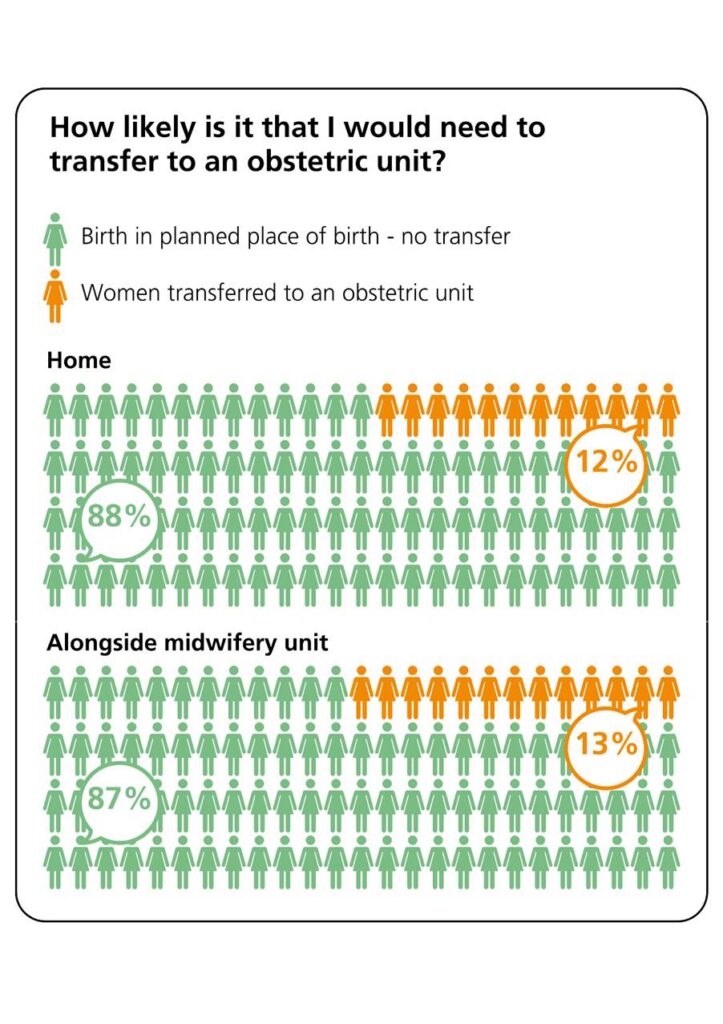
How likely is it that I would need to transfer to an obstetric unit?
Women having their first baby
If you are giving birth at home and you or your baby need to see a doctor, your midwife will call an ambulance and take you to an obstetric unit. If you are in an alongside midwifery unit you will be taken to an obstetric unit on the same site.
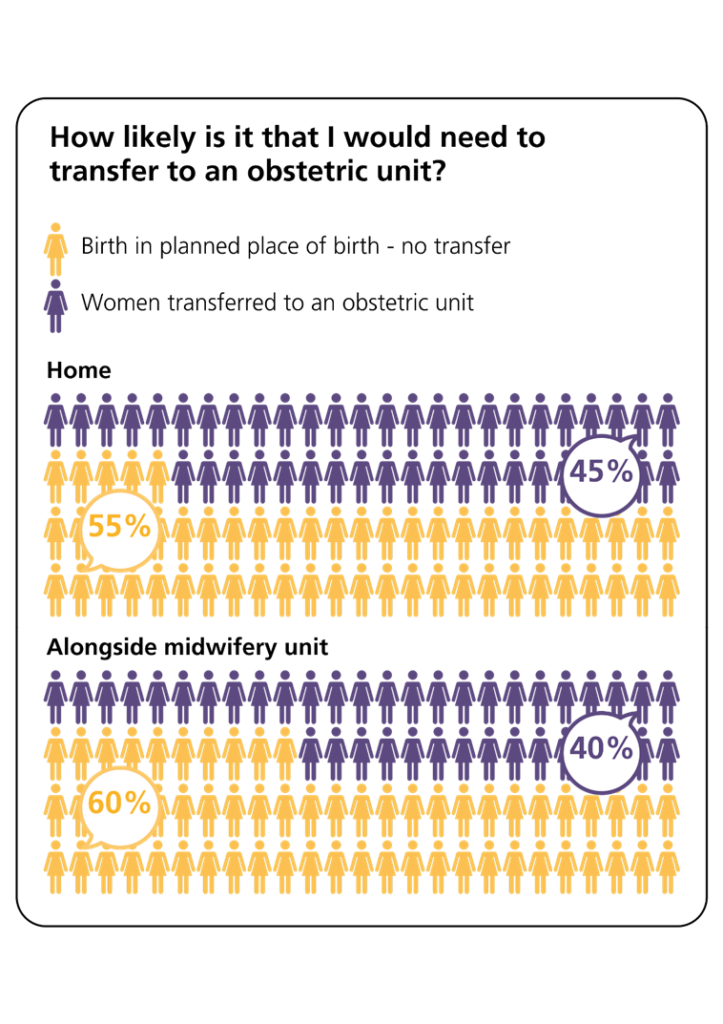
The table below shows rates and timing, of transfer to an obstetric unit during labour or immediately after birth among healthy women without complications in their pregnancy, having their first baby, recorded by their planned place of birth at the start of care in labour:
| Rates of transfer for each planned place of birth | From home | From an alongside midwifery unit |
| Transferred during labour | 35.1% | 33.8% |
| Transferred after the birth | 8.9% | 5.1% |
| Timing of transfer not known | 1.0% | 1.3% |
| All transferred | 45% | 40.2% |
| A small proportion of births planned in an obstetric unit also involved a transfer to another obstetric unit (0.7%). | ||
Women who have had a baby before
If you are giving birth at home and you or your baby need to see a doctor, your midwife will call an ambulance and take you to an obstetric unit. If you are in an alongside midwifery unit you will be taken to an obstetric unit on the same site.
The table below shows rates and timing, of transfer to an obstetric unit during labour or immediately after birth among healthy women without complications in their pregnancy, [MT1] who have had a baby before, recorded by their planned place of birth at the start of care in labour:
| Rates of transfer for each planned place of birth | From home | From an alongside midwifery unit |
| Transferred during labour | 6.4% | 8.5% |
| Transferred after the birth | 5.2% | 3.5% |
| Timing of transfer not known | 0.4% | 0.5% |
| All transferred | 12.0% | 12.5% |
| A small proportion of births planned in an obstetric unit also involved a transfer to another obstetric unit (0.7%). | ||
This is the same information presented in a different way (rounded to the nearest percentage point).
What are the most common reasons for transfer to an obstetric unit during labour or birth?
Sometimes women are transferred to an obstetric unit from home or a midwifery unit. The most common reasons for and likelihood of these transfers are shown in the table below:
| Main reason for transfer from planned place of birth to an obstetric unit | From home | From an alongside midwifery unit |
| Delay in labour (any stage) | 32.4% | 35.2% |
| Concerns about fetal heart rate | 7.0% | 10.8% |
| Request for epidural | 5.1% | 13.3% |
| Meconium | 12.2% | 12.2% |
| Retained placenta | 7.0% | 4.6% |
| For stitches | 10.9% | 8.4% |
| Neonatal concerns (after birth) | 5.2% | (less than 0.1%) |
| Other | 20.1% | 16.3% |
| This table includes figures for all healthy women (those having their first baby and those who have had a baby before) and is taken from the Birthplace Study. | ||
What are the ambulance response times if I need to be transferred to an obstetric unit during labour?
A “response time” is the time taken for the ambulance service to get to you after you call 999.
Here are the national target response times:
| Category of call | National Target Response Time | Example situation |
| Category 1 incidents (immediately life-threatening emergency) | In 9 out of 10 times, we aim to arrive by 15 minutes | A baby is not breathing |
| Category 2 incidents (other life-threatening emergencies) | In 9 out of 10 times, we aim to arrive by 40 minutes | You would like more pain relief |
Response times cannot be predicted in advance. The targets above cannot always be met.
Response times vary based on:
- How busy the NHS is at the time of your call
- Incidents taking place at the time
- Your location
- An ambulance clinician may arrive in a car first to assist you before more help arrives.
To find out more, visit: