
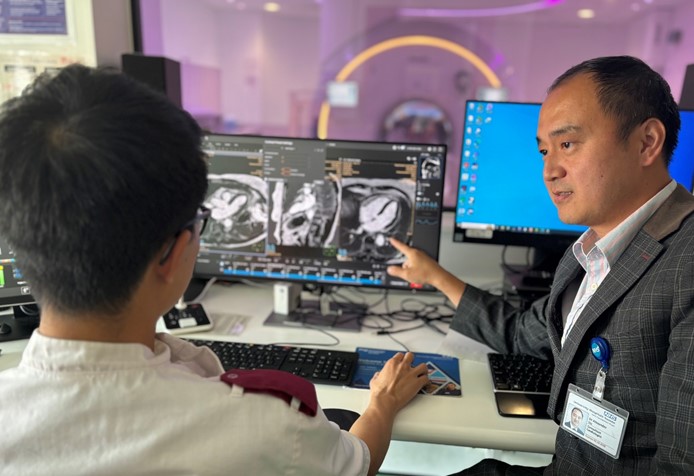
A pioneering study from the Sussex Cardiac Centre in Brighton has shed new light on the long-term effects of sepsis on heart health.
Despite medical advances, sepsis remains one of the world’s leading causes of death, claiming over 11 million lives each year.
For those who survive, the journey doesn’t always end with recovery. Many face ongoing health challenges including a higher risk of developing heart conditions like heart failure and heart attacks. This link that has puzzled clinicians for years.
Now, a team of researchers led by Consultant Cardiologist Dr Alexander Liu is using advanced imaging techniques to explore why this happens.
It was once believed that any heart damage caused during sepsis would heal over time. But new evidence suggests that for many survivors, heart function remains impaired, potentially leading to long-term cardiac problems.
In their latest study, the team used cardiovascular magnetic resonance (CMR) imaging – a powerful tool that uses magnets to create detailed pictures of the heart – to look for scarring in the heart muscle of sepsis survivors. This allowed them to measure how much of the heart had been damaged.
The research, led by Clinical Fellow Dr Shayan Datta, was the first to show a clear trend: the more scarring found in the heart, the weaker its ability to pump blood. This discovery could change how doctors monitor and treat patients after sepsis.
“This is a really interesting study on a condition that is not well understood,” said Dr Datta. “As junior doctors, we often care for patients with sepsis but rarely get the chance to contribute to research in this area. This project has been an incredible learning experience.”
For many survivors, the research resonates deeply.
“I thought once I got over the infection, I’d be fine,” said Angela, 70, who was treated for sepsis a year ago. “Then I became short of breath. Dr Liu and his team did scans to look at my heart and I felt better on the medications. Knowing there’s research into this condition makes me feel seen.”
“I’m glad that Dr Liu and his team are looking into what happens after sepsis,” added Ian, 79, who developed heart failure after pneumonia. “They found from the scan that my heart was not pumping well and started me on medications in clinic. I feel better for it and know that I’m not alone.”
While the study was relatively small and conducted at a single centre, it lays important groundwork for future research aimed at improving care for sepsis survivors.
“The findings aren’t ready to change clinical practice just yet,” Dr Datta added, “but they could be a vital step toward better understanding and eventually improving care for these patients.”
Building on a strong foundation
This study builds on earlier work by Dr Liu’s team, who were the first to use cardiovascular magnetic resonance (CMR) to show that sepsis survivors can experience lasting heart dysfunction. The group has also explored how CT scans can assess blood flow to the heart and investigated the effects of heart failure treatments in this patient group.
“Sepsis affects so many patients and their families,” said Dr Liu. “Our responsibility goes beyond treating the acute illness — we must also understand what happens after recovery. This research programme is focused on the cardiac journey that continues long after patients leave the hospital.”
The project brought together experts from Royal Sussex County Hospital (RSCH), part of University Hospitals Sussex NHS Foundation Trust, and Brighton and Sussex Medical School, with collaboration across cardiology, radiology, and intensive care medicine.
“This research is a testament to interdisciplinary collaboration,” Dr Liu said. “It wouldn’t have been possible without the combined expertise of colleagues across departments and institutions.”
The study was conducted in the cardiac imaging department at RSCH and approved by the Trust’s Research and Innovation department.
“It’s always a proud moment to see impactful research emerging from our imaging department,” said Dr Victoria Parish, cardiac imaging lead at RSCH. “This is clearly an under-recognised issue, and we hope these findings will one day lead to real benefits for our patients.”