
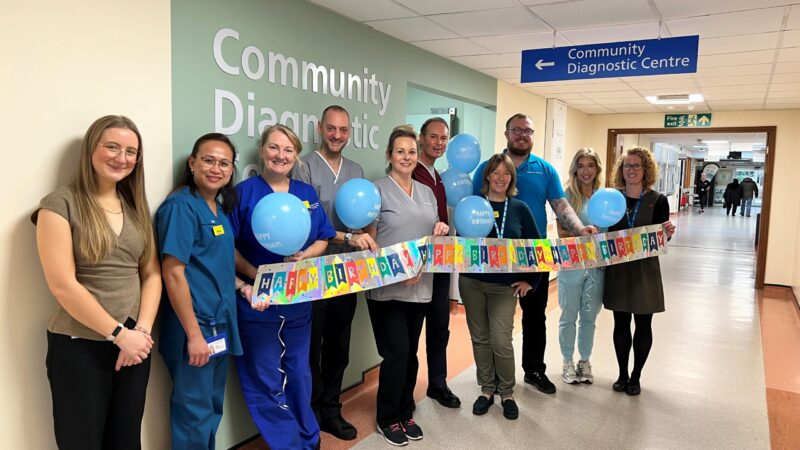
The Community Diagnostic Centre (CDC) at Southlands Hospital is celebrating its first full year of operation, having delivered more than 140,000 vital diagnostic tests and scans to people across Sussex.
This milestone represents a significant step forward in improving access to care and speeding up diagnoses.
The state-of-the-art centre is equipped with world-class CT and MRI scanners, cutting-edge X-ray rooms and a range of diagnostic services, including echocardiography, dermatology, pathology, ultrasound, gynaecology, and respiratory procedures, creating a game-changing facility for the region.
Jemma Deane, Head of Transformation for Radiology, said: “This milestone is a true testament to the dedication and teamwork of our fantastic staff, whose commitment to high-quality care continues to inspire me every day. Together with our partners, we have built something truly special.
“We see the difference our centre makes every day, providing patients with quicker access to tests and scans and helping them get the care they need sooner. As we move into our second year, we remain focused on expanding our capacity, enhancing patient experience, and supporting the wider transformation of healthcare delivery.”
Since its introduction, cardiac services have seen significantly reduced waiting times — with heart ultrasound appointments decreasing from eight weeks to just three, and access to heart rate and rhythm monitoring improving from 10–12 weeks to only four.
One of the key successes of the CDC has been the reintroduction of lung function testing, an essential service many GP practices were forced to stop performing during the pandemic.
This service has dramatically reduced waiting times from several months to just a few weeks, enabling earlier diagnosis and better management of respiratory conditions within primary care without the need for an initial referral to hospital.
Francisco Piai, Lead Respiratory & Sleep Physiologist said: “We’re incredibly proud of how far our Community Diagnostic Centre has come. Reintroducing lung function testing has transformed access to essential respiratory diagnostics—bringing care closer to home, reducing waiting times, and supporting both patients and clinicians across our community. Seeing the difference this service makes every day inspires us to keep growing and improving for the people we serve.”
Building on this success, the team is now developing dedicated pathways for specific respiratory conditions and introducing a paediatric lung function service which will include asthma checks.
The CDC’s integrated approach is making a difference to thousands of patients, including those on urgent pathways. Within gynaecology, more than 1,200 patients have been seen at the CDC over the past year, including supporting over 700 patients on a cancer pathway, ensuring faster access to care.
Operating seven days a week from 8am to 8pm, the centre offers patients greater flexibility to attend appointments around work, school, and personal commitments. Patients access the CDC through referral by their GP or other hospital services.
The CDC has become a cornerstone of community-based healthcare, delivering around 12,000 diagnostic tests monthly. Embodying a true ‘one-stop’ model of care, the centre streamlines patient pathways, enhancing efficiency and dramatically improving the overall patient experience for people in Sussex.
One patient shared: “I knew I had received the best care possible, with clear instructions for after care and what to look out for and expect. The staff here are wonderful and extremely skilled at not only performing the procedures they do, but also at keeping patients well informed, comfortable and as pain free as possible. I felt very safe and in the best possible hands.”
CDCs are part of a national NHS England programme, designed to make diagnostic services more accessible by providing care closer to home, in dedicated community hubs separate from busy hospital environments.
This means shorter waiting times for patients and reducing the risk of cancellations which can happen when more urgent cases take priority in acute hospitals.
The CDC is committed to improving patient experience by introducing less invasive and more patient-friendly diagnostic procedures.
Recent innovations include a digital telescope device that captures high-quality images and videos of the bowel, providing a faster and less invasive alternative to a traditional colonoscopy (a test to check inside the bowels), which eliminates going under sedation and helps reduce waiting lists.
The team are also an early adopter of a new colon capsule endoscopy procedure, where the patient swallows a ‘pill cam’ containing a small disposable camera which takes pictures as it travels through the gut. The camera sends the pictures wirelessly to a data recorder that the patient wears on their waist. This less invasive procedure offers a more comfortable alternative and is set to go-live by the end of this year.
The CDC’s innovative approach and commitment to helping people to access healthcare closer to home aligns with our dedication to delivering excellent care for our communities. It supports our new five-year Trust strategy, which commits to helping people to live well and thrive by improving services, pathways and patient experience.