
2725 – My feeding journal – 2026 (3MB pdf)
When your baby is born, you will be given this leaflet to help you on your breastfeeding journey. It includes helpful information and guidance to get you started. If you need extra help or have any questions, please speak to your midwife or the Infant Feeding Team
Congratulations on the birth of your baby
My baby’s name is:
My name is:
My baby was born on:
Time of birth:
Welcome to your feeding journal, a space created to support
you through your baby’s feeding journey.
Inside, you’ll find practical guidance and tips, evidence-based
resources, and prompts to help you learn and recognise when
extra support may be helpful. Whether feeding feels smooth or
challenging, this journal is here to empower you with knowledge,
build confidence, and remind you that you’re never alone
in asking for help.
We encourage you to use this journal alongside the Flying Start
guide. If you didn’t receive a copy in your pregnancy, you can
find it on Badger Notes under ‘leaflets’.
How to know breastfeeding is going well
This page is to prompt you to think about how feeding is going.
If you have any concerns, always speak with a midwife or your
Infant Feeding Team.

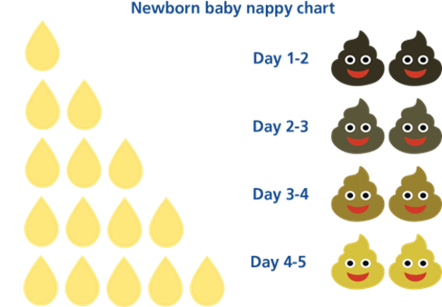
Your baby’s wet nappies should get heavier, and the poo should change from sticky meconium, to green and then more watery and yellow.
Not pooing is usually a sign your baby is not getting enough milk.
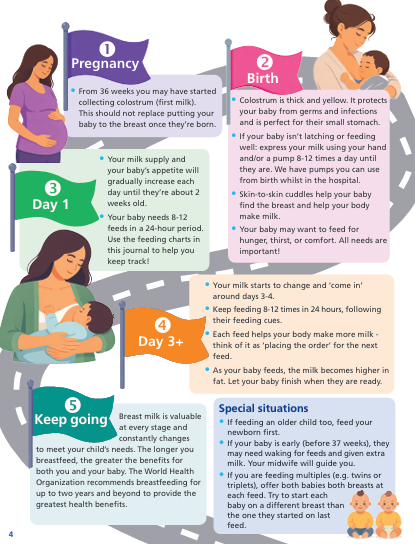
Your roadmap to breastfeeding
Feeding cues
Try to learn your baby’s signs that they’re hungry (feeding cues) and feed them whenever they and you want, you cannot overfeed a breastfed baby.
Early feeding cues may include looking for the breast, sucking on their fingers or fist, stirring, or looking around. Crying is a late cue.
Try to avoid dummies or long periods of swaddling, as these can make it harder to notice if your baby is hungry.

Milk-boosting tips
Being relaxed helps your milk flow. You could try:
- Listening to music
- Having lots of skin-to-skin cuddles with your baby.
- Milk-making hormones are highest at night, so night feeds are really important.
Milk supply can be low or delayed for many reasons, such as heavy blood loss, smoking, PCOS, thyroid issues, retained placenta, a caesarean birth, long gaps between feeds/expressing, or a poor latch (such as
tongue-tie). With a good plan, most of these issues will be temporary.

During your stay
Buzz for help at every feed. Breastfeeding is a new skill that can take weeks to master.
Did you know we have a Feeding Room? You are welcome to use it to feed in or to wash any feeding equipment.
If you are thinking your baby may need extra milk, please speak with your midwife first so that they can help you make an informed decision.

Tips for days 0-2
0-72 hours old
- Until your milk comes in, hand express and offer your baby colostrum ‘puddings’ after each feed. This will ensure they are getting enough milk and will support your milk supply.
- When positioning your baby to breastfeed, keep your baby close, with their body touching yours from their chin down. This makes them feel secure, and able to reach the breast with ease.
- Look at pages 12-14 of the Flying Start guide for suggestions on different positions you can try.
How to attach your baby to your breast:
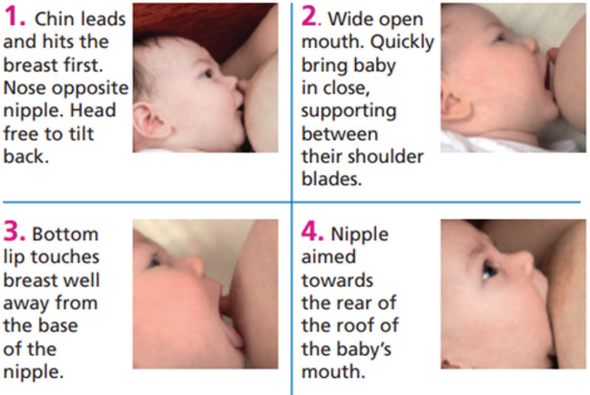
If you’re experiencing pain throughout a feed, this is probably due to a shallow latch – we can help with this.
How are you feeling about feeding?

Draw an arrow to show where you are on the scale.
Day 0
0-24 hours old
What to expect:

Your baby should feed in the first 1-2 hours after birth whilst skin-to-skin.
A well baby born after 37 weeks of pregnancy needs at least 4 good feeds in the first 24 hours.
Please print off the PDF version to fill in the form.
Tips for days 3-4
72-120 hours old
- Your baby should now be swallowing regularly with every 1–2 sucks and you should be able to hear it.
- Unsure if your baby is swallowing?
- Check out this video: How to recognise when a baby is drinking well

- Your baby’s poo should now be changing! They should no longer be sticky, and should be green in colour or turning yellow. If they’re not, contact your midwife or Infant Feeding Team for help.
- If your breasts feel full, you might need to hand express a little before feeding to help your baby latch comfortably.
- Engorged, lumpy, or sore breasts usually means your baby isn’t getting all the milk. If this happens, don’t worry, ask a midwife or a member of our community Infant Feeding Team to watch a feed and help you. Getting support early can make feeding much more comfortable for both you and your baby.
How are you feeling about feeding?
Draw an arrow to show where you are on the scale.

Day 3
72-96 hours old
Please print off the PDF version to fill in the form.
Day 4
96-120 hours old
Please print off the PDF version to fill in the form.
Tips for days 5+
- It is normal for babies to lose a little weight after they are born. By day 5, many babies have lost up to 8% of their birth weight. If your baby has lost more weight than this, we will help you make a plan to make sure your baby is feeding well and starting to gain weight.
- Your body makes milk based on your baby’s needs, the more milk your baby drinks (or you express), the more your breasts will make. Every feed helps your supply grow.
- By day 7 your body is usually making around 500–700 ml of breastmilk each day, how amazing.
- Night-time feeding is normal and necessary, it helps your milk supply grow.
- Your baby may sometimes want to feed more often and have lots of feeds close together. This is called cluster feeding, and it often happens in the evening. It is normal and often means your baby is going through a growth spurt and growing quickly.
Our Flying Start padlet has videos, websites, leaflets and more to support you on your feeding journey.

How are you feeling about feeding?

Draw an arrow to show where you are on the scale.
Day 5
Please print off the PDF version to fill in the form.
Resources
Videos
Unicef UK: Hand expression


Best Beginnings: Breastfeeding positions and holds


Dr Amy Brown. Why you might want to put the baby books down


Carla Mastroianni (RM, IBCLC): The exaggerated latch technique


UHSussex leaflets

QR code to: Helping your baby get all the breastmilk they need

QR code to How to know breastfeeding is going well.

QR code to The possible effects of giving a breastmilk substitute to a breastfed baby.
Website
Flying Start: feeding and nurturing your baby (padlet)
More resources can be found here!

Before you go home
It is important to us that you have all the information and support you need to get off to the best start. Before leaving the hospital, please make sure a midwife speaks with you about the following:
Please print off the PDF version to fill in the form.
Our Flying Start padlet has videos, websites, leaflets and more to support you on your feeding journey.

This information is intended for patients receiving care at Brighton & Hove, Worthing, Haywards Heath and Chichester St.Richard’s Hospital.
The information in this leaflet is for guidance purposes only and is in no way intended to replace professional clinical advice by a qualified practitioner.
Today’s research is tomorrow’s treatments. That’s why UHSx is proud to be a research-active Trust. Find out how you can get involved.
Visit our website www.uhsussex.nhs.uk/research-and-innovation/information-for-patients-and-public or scan the QR code: 