
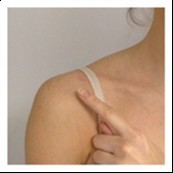
What is this information about?
This information is about a shoulder dislocation.
It tells you:
- How to look after yourself when you go home from hospital following a shoulder dislocation
- What exercises you can do to help heal and strengthen your arm
- What follow-up treatment you might have
- Who to contact if you need further help and support.
What is a primary shoulder dislocation injury?
Your shoulder is a ball and socket joint. The joint is made up of the ball of your upper arm bone (humerus), and a socket which is part of your shoulder blade (scapula).
A dislocation happens when the ball pops out of the socket. When the dislocation happens the ball of the upper arm bone is no longer in the joint, but after relocation it goes back into joint.
After a dislocation there is increased risk of dislocating the shoulder again. This depends on your age and other factors. Following the advice in this care plan will help to minimise this risk.
How long is it likely to take for my injury to heal?
It takes approximately 6 weeks for your shoulder dislocation injury to heal. Use the sling for the first week and follow this care plan to allow the soft tissues to settle.
Will smoking or vaping slow down my healing?
Yes. Smoking slows healing so if you smoke or vape try to stop or cut down. This is most important in the first 2 weeks after your injury. If you would like help to stop smoking talk to your GP or visit Quit smoking for further information.
What should I do if I am in pain after my shoulder dislocation injury?
There may be some swelling over your shoulder, and you will have some pain.
If you are in pain, take your usual pain killers or pain killers given to you in the emergency department. Follow the dose instructions on the packet. If you are struggling with pain do speak to your GP or pharmacist.
Put ice or a cold pack over the painful area for short term pain relief.
Be aware
Ice must never be in direct contact with the skin.
When should I be wearing my arm sling?
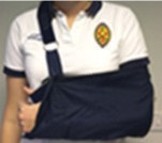
Use your sling for the first week to support your shoulder and allow the structures around your shoulder to heal. You can take it off to wash, dress and do the initial exercises listed below. You must wear your sling at night for the first week. You may find it more comfortable to sleep propped up on pillows. Contact the Virtual Fracture Clinic if you have any issues with your sling.
What should I do if I have numbness/tingling in my arm or hand?
You may have a small patch of numbness on the outside of the shoulder. This will improve with time. Please contact the Virtual Fracture Clinic if you:
- Have pins and needles or numbness in the arm or hand
- Are struggling to move the arm or hand at all
- Have pain or symptoms other than in your shoulder
When should I start exercising?
It is important to start gentle exercises straight away to prevent stiffness. You will find some exercises to start on the next page.
Be aware
You should not do any overhead movement for 3 weeks or any heavy lifting for 6 weeks after your injury.
Will I have a further (follow up) appointment?
Yes. We will refer you to physiotherapy for help with your rehabilitation.
We will also arrange a follow-up appointment at the Fracture Clinic in 3 weeks’ time. The specialist will examine your shoulder and decide if you need any further treatment. You will be sent an appointment in due course.
What should I do from week 1 to week 3 after my injury?
- Rest your arm for the first 24 to 72 hours (1 to 3 days). However, it is important to keep moving around.
- Use your sling for the first week, as explained earlier in this care plan.
- Apply cold packs (ice pack or frozen peas wrapped in a damp towel) to the sore area for up to 15 minutes, every few hours. Cold pack applications can provide short-term pain relief. However, the ice must never be in direct contact with the skin.
- Aim to practice the below exercises 5 times a day. These exercises should not cause too much pain. Do less if they are making your pain worse.
Hand, wrist and elbow exercises
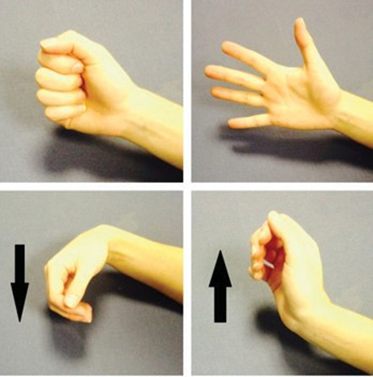
Finger and wrist bending and straightening
Open and close your hand as shown 10 times. Then move your wrist up and down 10 times.
After a few days, progress to holding a soft ball or ball of socks. Squeeze the ball as hard as possible without pain. Hold for 5 seconds and repeat 10 times.
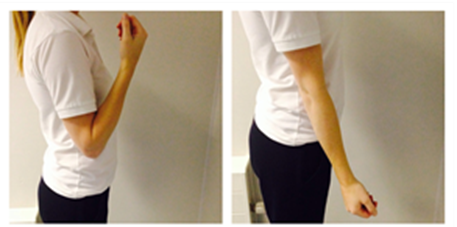
Elbow bend to straighten
Bend and straighten your elbow as far as you can without pain. You should not feel more than a mild to moderate stretch. You can use your other arm to help if you need to. Repeat 10 times if there is no increase in pain.
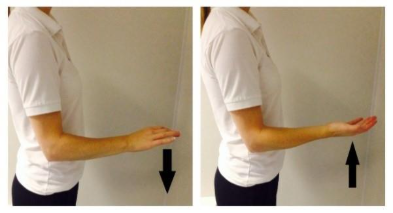
Forearm rotations
Keep your elbow at your side and bent to 90 degrees (a right angle). Slowly turn your palm up and down. You should not feel more than a mild to moderate stretch. You can use your other arm to help if you need to. Repeat 10 times if there is no increase in pain.
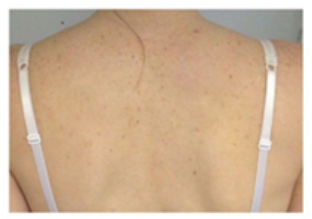
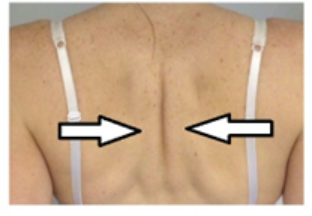
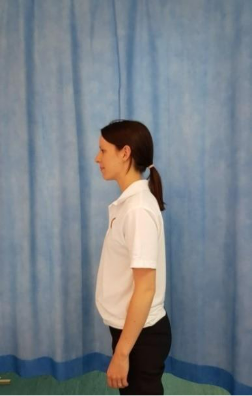
Posture exercise
Bring your shoulders back and gently squeeze your shoulder blades together. Hold for 30 seconds. Repeat 5 times.
Shoulder pendulum (swing) exercises
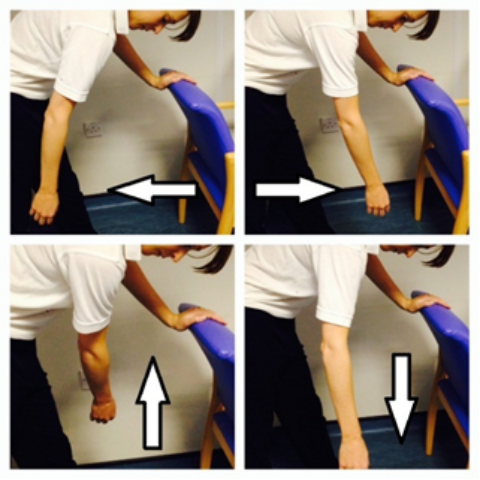
Stand next to a firm surface. Support yourself with your un-injured arm and lean forwards. Let your injured arm relax and hang down to the ground.
Gently swing your arm, making a small movement. Try to do this forward and backward, side to side and in small circles.
Aim to do this for 1 to 2 minutes in total.
Swing your arm gently so is does not cause you too much discomfort. Remember to keep your arm relaxed.
What should I do from week 3 to week 6 after my shoulder dislocation?
- You should have stopped using your sling by now.
- Start using your arm for light activities. Start with gentle movements and be guided by any pain or discomfort you experience.
- Start the exercises shown below 3 weeks after your injury. Aim to do them 5 times a day. Repeat each exercise 10 times. These exercises should not cause too much pain. Do fewer if they are making your pain worse.
- You should not do any heavy lifting for 6 weeks.
Exercises
Supported arm elevation:
Use your other hand to lift your injured arm up in front of you, as shown in these pictures.
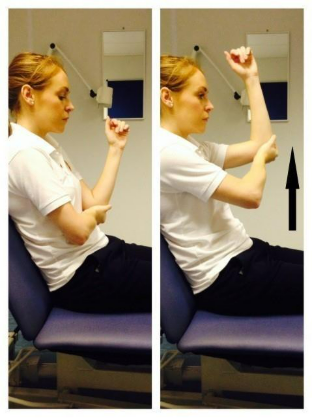
Supported arm rotation
With your elbow touching the side of your body, bend your injured arm as shown below.
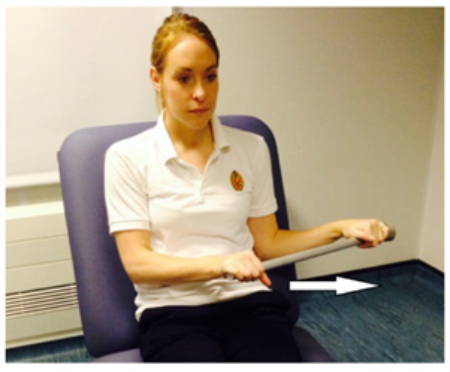
Hold onto a stick, umbrella, or something similar. Then use your good arm to gently move your forearm outwards away from your body. If you don’t have a stick, hold your injured arm at the wrist and guide it outwards with your other hand.
As you do this, keep your elbow bent and tucked into your side.
What should I do from week 6 after my injury?
- Your injury should be largely healed.
- Return to normal light activities. Do this gradually and be guided by any pain/discomfort.
- Some heavier tasks may still be uncomfortable. Movements above shoulder height are still likely to cause discomfort as well.
- When you have regained your full range of movement without the support of the other arm you can start to build up your regular activities.
- Start the below exercises. Try to do them 5 times day. Repeat each exercise 10 times.
Exercises
Arm elevation
Lift your arm forwards in front of you. Try to raise the arm as high as you can. This exercise can cause some discomfort. You do not need to raise your arm so high or for so long that it causes too much pain. If this is too difficult, try the same movement with a bent elbow.
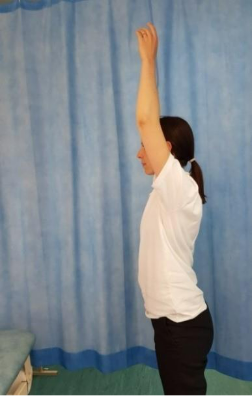
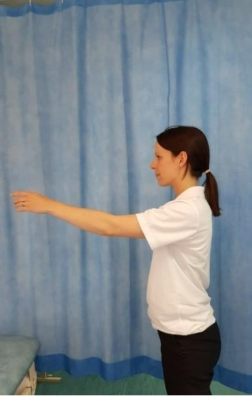
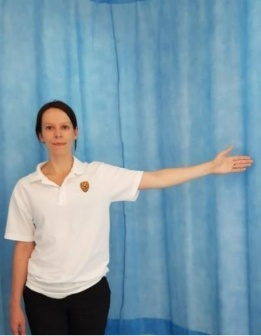
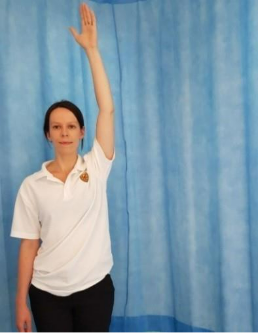
Raising your arm out to the side
With your palm facing forwards, move your arm out to the side in a big arc. Try to raise your arm as high as you can. If this is too difficult, try the same movement with a bent elbow. You do not need to raise your arm so high or for so long that it causes too much pain.
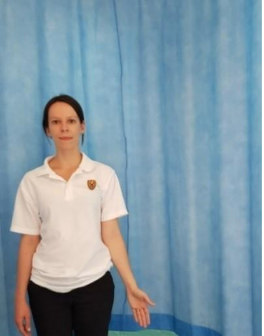
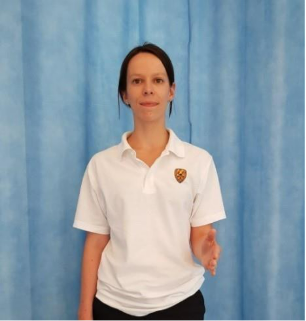
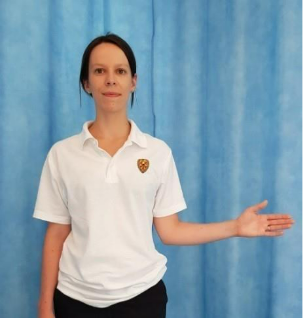
Arm rotation exercises
Start with your elbow bent by your side. Move your forearm out to the side, keeping your elbow bent and near your waist.
What should I do if I:
- am concerned about my symptoms
- am unable to follow this rehabilitation plan or notice pain other than at my shoulder
- am struggling to return to exercise or my usual activities
- would like further information or support after I have read this information?
Please contact the Virtual Fracture Clinic, or your specialist’s secretary if you have been seen in clinic.
When can I start driving?
You can return to driving when you:
- are no longer using your arm sling
- can turn the steering wheel as much as you need to without it hurting
- can safely deal with all emergency situations without being in pain or hesitating. For example, you must be able to stop the car quickly and in full control and safely avoid obstacles
- are covered by your insurance company.
Be aware
Always try driving in a safe place first.
How can I get a fit note for work?
You can get a fit note from the Virtual Fracture Clinic, or the specialist when you are seen in clinic.
If I need further advice about my injury, who can I contact?
Please contact the Virtual Fracture Clinic on the below details:
 Royal Sussex County Hospital
01273 696955
Ext. 63428
Royal Sussex County Hospital
01273 696955
Ext. 63428

 Monday to Friday
8:00 am to 4:00 pm
Monday to Friday
8:00 am to 4:00 pm
If contacting by phone, please leave a message with your date of birth, name and clear contact details, along with a brief message about what problems you are having.
We will contact you back as soon as possible.
We aim to get back to you within 24 hours.
Contacting us by email would be preferable as the phone line can be very busy.
This leaflet is intended for patients receiving care in Brighton and Hove and Haywards Heath.
The information in this leaflet is for guidance purposes only and is in no way intended to replace professional clinical advice by a qualified practitioner.
Today’s research is tomorrow’s treatments. That’s why UHSx is proud to be a research-active Trust. Find out how you can get involved.
Visit our website www.uhsussex.nhs.uk/research-and-innovation/information-for-patients-and-public or scan the QR code: 