
Information for patients
What is this information about?
This information is to guide you on how to do exercises to help increase and maintain your movement and strength.
Why have I been given this information?
Your physiotherapist has provided you these exercises to help your symptoms and prevent deconditioning. If you have any questions, you can ask the physiotherapist on your ward for advice.
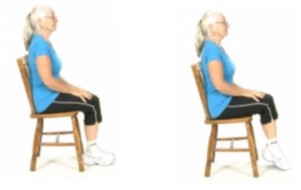
1. Heel Raises
- Sitting in a chair.
- Lift your heels as high as you can but keep your toes on the floor.
- Then lower your heels to the floor.
- Lift your toes upwards while keeping your heels on the floor.
- Keep repeating these 2 movements.
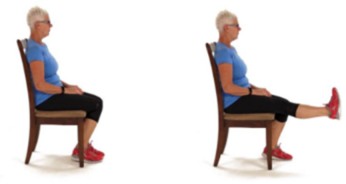
2. Bending and straightening your knee
- Sitting in a chair with both feet on the floor.
- Straighten one leg out in front of you.
- Hold it straight for 5 seconds, then slowly lower down to the floor.
- Then complete with your other leg.
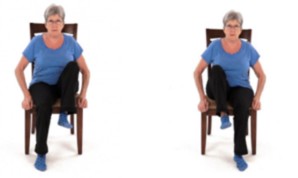
3. Marching on the spot
- Lift one foot off the floor and your knee up towards you.
- Then slowly lower this foot to the floor.
- Repeat this with your other leg like you are marching.
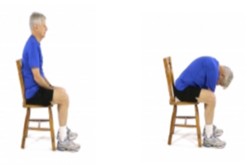
4. Reach towards the floor
- Sitting in a chair.
- Reach down your legs towards the floor as far as is comfortable. Do not strain yourself.
- Slowly sit back up to the starting position.
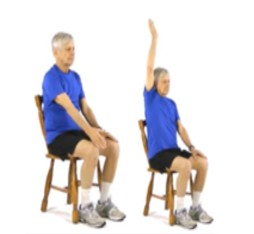
5. Lift your arms above your head
- Slowly lift one hand above your head as far as is comfortable.
- Slowly lower your hand back down. Repeat with your other arm.
6. Bending your arms
- Start with a straight arm, bend one elbow until your hand is in front of your shoulder.
- Then slowly lower your hand as you straighten your elbow.
- Repeat with your other arm.
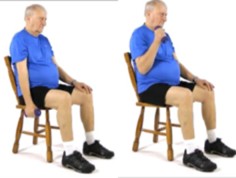
Bending your arm
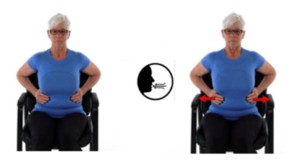
7. Deep Breathing
- Sitting up, place your hands on your lower ribcage.
- Take a big, deep, breath and hold it for 3 seconds.
- You should feel your rib cage expand while you are doing this.
- Breathe out slowly.
- Keep your shoulders relaxed throughout.
Who can I ask if I need any further information about doing these exercises?
Please ask a member of the ward therapy team.
This leaflet is intended for patients receiving care in Worthing.
The information in this leaflet is for guidance purposes only and is in no way intended to replace professional clinical advice by a qualified practitioner.
Today’s research is tomorrow’s treatments. That’s why UHSx is proud to be a research-active Trust. Find out how you can get involved.
Visit our website www.uhsussex.nhs.uk/research-and-innovation/information-for-patients-and-public or scan the QR code: 