
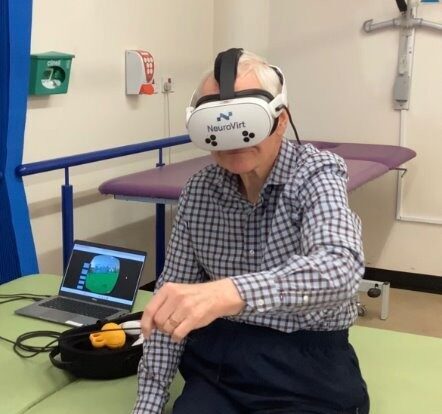
From catching virtual butterflies to building a virtual burger, 18 stroke survivors at University Hospitals Sussex NHS Foundation Trust (UHSussex) have helped researchers explore whether virtual reality games could give patients more opportunities to practise the arm and hand movements needed for everyday life.
The research was led by the University of East Anglia, sponsored by James Paget University Hospitals NHS Foundation Trust and funded through SBRI Healthcare, an NHS England initiative supporting innovative healthcare technologies. By taking part, patients at UHSussex have helped build evidence that could shape future stroke rehabilitation in Sussex and beyond.
The study was held across several sites in the UK. At UHSussex, it took place at the Sussex Rehabilitation Centre at Princess Royal Hospital in Haywards Heath. Recruitment at UHSussex has now finished, with 18 patients taking part against an original recruitment target of four.
Patients used NeuroVirt, a virtual reality system with interactive games developed with stroke survivors, alongside their usual rehabilitation. Researchers explored whether the technology could make repeated exercises more engaging and encourage patients to practise more frequently as they worked towards regaining movement and independence.
Making rehabilitation more engaging
After a stroke, weakness or reduced movement in the arms and hands can make eating, dressing and washing difficult. Rehabilitation involves practising movements repeatedly to help rebuild these skills, but providing enough opportunities for practice can be challenging.
Using a headset, patients entered a three-dimensional virtual environment where therapeutic exercises became games. Catching butterflies, boxing moving objects and building a virtual burger encouraged movements ranging from larger shoulder movements to the precise hand movements needed for everyday tasks.
The system tracked how many movements patients completed, their range of movement and how long they spent practising. Patients could also see their progress, potentially offering encouragement during recovery.
Exploring new ways to support recovery
The neurorehabilitation team at Princess Royal Hospital provides specialist inpatient rehabilitation for people recovering from stroke and other neurological injuries. Anne Eisenthal, Physiotherapy Team Lead, led the research at UHSussex as Principal Investigator, supported by Pete Ashdown, senior physiotherapist and Co-Principal Investigator. Tina Jaques, physiotherapy technical instructor, and Matt Mills, senior physiotherapist, were Clinical Champions.
Speaking about the trial investigating the real-world implementation in the NHS of an Immersive Virtual Reality System (NeuroVirt) for Optimising Arm Function After Stroke, Anne said: “Rehabilitation in brain injury is all about practice and repetition. We know how important it is for patients to have opportunities to practise movements and tasks as they work towards regaining their independence.
She added: “Virtual reality offers an opportunity to make repetitive practice more engaging and potentially increase the amount patients could do alongside their usual therapy. Patients really enjoyed being able to see their progress through the games. Seeing improvements is really encouraging and motivating during what is often a difficult recovery journey.”
The games supplemented conventional physiotherapy and occupational therapy; they did not replace existing treatment. Rehabilitation staff supported patients to use the equipment, including during supervised practice sessions.
A patient’s perspective
Jon, a patient who took part in the research following a stroke, said: “My left arm weakness affects me a lot. It makes everything hard like eating food, pouring a drink and holding things. I was really interested in trying the VR and had a great time using it. I really wanted to improve how much I can use my arm, and it has been getting better with my therapy and using the VR. Taking part in research was also interesting to me because it helps other people too.”
Patients helping shape future care
The researchers are examining patients’ arm function, quality of life and experiences of using the technology. They also considering practical questions about ease of use, costs and how the system could fit into existing rehabilitation services which may influence published guidance as well of our understanding of the utility of strategies such as virtuality in supporting arm recovery after stroke.
Participants included stroke survivors of different ages, with the team finding that enthusiasm for the technology did not necessarily depend on age. Anne explained: “We had people of all different ages enjoying using the technology. What was important was whether patients felt the games were helping them and whether they could see a benefit from taking part.”
Research that could improve care
More evidence is needed to establish which patients might benefit from virtual reality rehabilitation, how best to introduce it and whether it offers good value for NHS services. This study explored how NeuroVirt could fit alongside existing care, including whether it could encourage more frequent practice.
Watch Anne talk about the research study at https://youtu.be/1GvDWKynNXw?si=3eO6ZZWKH598R8Ek
Get involved in research at UHSussex
Sign up to NIHR’s Be Part of Research to find out about UK health and care research that’s relevant to you, and to get invitations to take part in approved health and care studies at local hospitals, GP practices, care settings or at home.
Find out more about research at UHSussex by visiting Research and innovation – University Hospitals Sussex NHS Foundation Trust.