
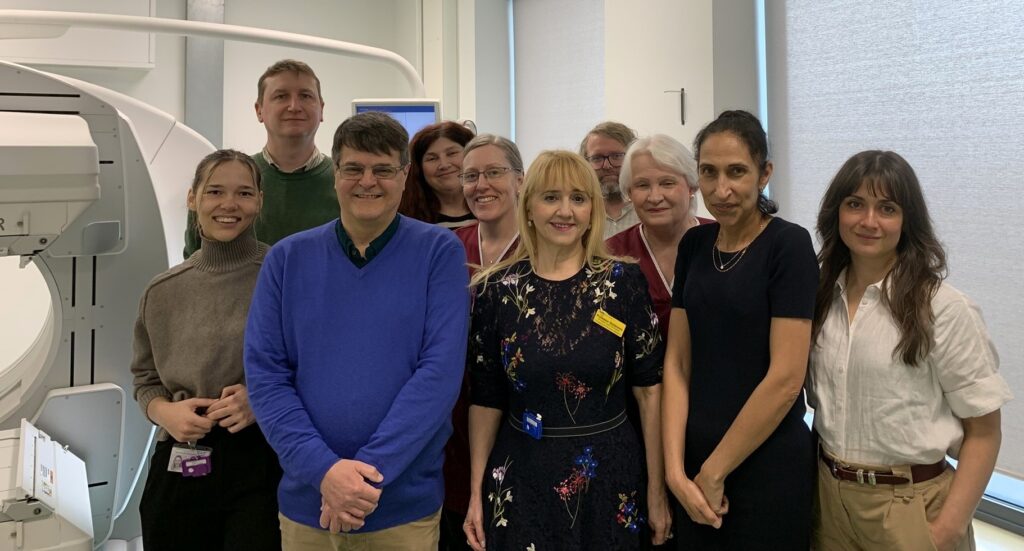
Sussex patients with advanced prostate cancer are now receiving highly personalised and innovative new treatments at Royal Sussex County Hospital in Brighton as part of a major trial.
The Phase 3 national trial, STAMPEDE2, is being run locally by a multidisciplinary team of clinicians at University Hospitals Sussex NHS Foundation Trust (UHSussex) as part of the Trust’s commitment to make more clinical research trials available to local people.
The trial aims to discover whether combining standard hormone therapy with innovative targeted treatments can improve survival and disease control for people with advanced prostate cancer. It introduces two new treatment approaches to Sussex patients: a radiopharmaceutical drug that actively seeks out cancer cells, and a high‑precision form of radiotherapy, both delivered alongside hormone therapy.
While prostate cancer can often be successfully treated with therapies such as hormone therapy, radiotherapy or chemotherapy, these approaches alone are not always suitable or effective for all patients. This is particularly the case as the disease becomes more advanced or spreads to other parts of the body, highlighting the need for new treatment options.
Prostate cancer, which often presents with no or few symptoms in its early stages, is now the most commonly diagnosed cancer in the UK, with around one in eight people at risk of prostate cancer expected to develop it in their lifetime.
First Sussex patient receives innovative drug therapy
Darius Aibara, 61, a retired civil engineer now living in Worthing, is the first patient in Sussex to receive the targeted radiopharmaceutical drug, Lutetium PSMA, at the Royal Sussex County Hospital as part of the STAMPEDE2 trial.
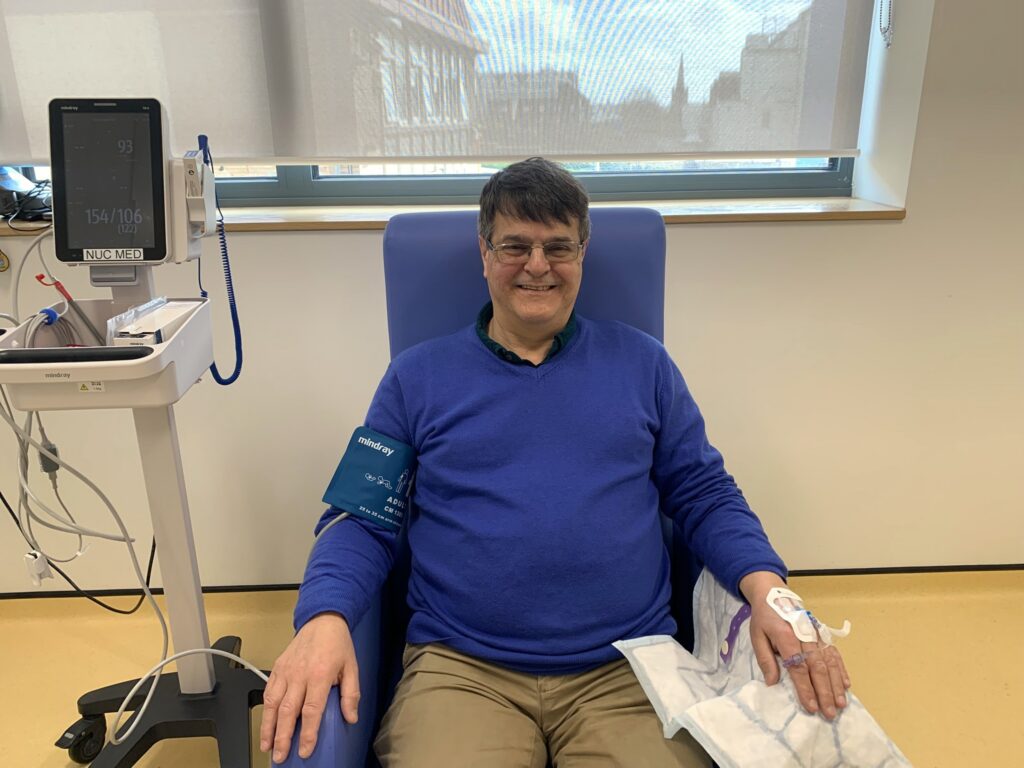
Darius was diagnosed with prostate cancer in October last year and after tests showed his cancer was more advanced, his oncologist told him about the opportunity to take part in the trial. Darius is receiving the targeted radiopharmaceutical drug therapy, alongside chemotherapy and hormone therapy. So far, he has completed four treatment sessions, with a couple more still to come.
Despite some natural worries about joining a clinical trial at first, Darius says the experience has been positive and straightforward, with no side effects so far.
“The treatment itself has been painless, and everything has gone very smoothly,” he said.
“The team at the Royal Sussex County Hospital have been fantastic and the care I’ve received has been excellent. It’s also a nice setting for treatment. I’ve had no problems at all.
“I feel optimistic about how things are going and I’m hopeful the treatment will continue to work.”
How the trial works
Patients taking part in the trial receive one of two advanced therapies: a radiopharmaceutical drug or a highly targeted form of radiotherapy. Both are delivered alongside standard hormone therapy. This approach reflects a growing frontier in cancer medicine, where radiopharmaceuticals and highly precise radiotherapy are being used to target tumours more accurately.
The drug, called Lutetium PSMA, is given via a drip and works by travelling through the bloodstream to seek out prostate cancer cells and deliver targeted internal radiation wherever they are in the body. Before receiving this treatment, patients have a specialist scan (known as a PSMA PET-CT scan) which uses a small amount of radioactive material, injected into the bloodstream, to help clinicians see exactly where the cancerous cells are located.
Other eligible patients are receiving a radiotherapy technique called Stereotactic Ablative Body Radiotherapy (SABR). While this approach is already used in certain NHS settings, this trial is investigating its use for disease that has spread beyond the prostate. SABR delivers highly focused, high-dose radiation beams from outside the body directly to cancer cells, typically over a small number of sessions. Careful planning ensures the radiation is delivered with high precision, minimising impact on nearby healthy tissue.
Patients at the hospital are also benefiting from advanced imaging to diagnose and map prostate cancer more precisely. Specialised PET-CT scans can detect small areas of cancer that may not appear on standard scans, helping doctors plan the most effective treatment.
Locally, treatments are being delivered by a multidisciplinary team of cancer, nuclear medicine, radiotherapy, medical physics and research specialists. The work is being spearheaded by Professor Sabina Dizdarevic, Divisional Research and Innovation Director (and President of the British Nuclear Medicine Society), alongside Ashok Nikapota, Consultant Oncologist and Principal Investigator, and Senior Radiographer Louisa Karacochi.
Professor Sabina Dizdarevic at UHSussex said: “We’re delighted to see the first Sussex patients now benefiting from innovative treatments and taking part in the STAMPEDE2 trial as part of our Trust’s commitment to give patients better access to research.
“It’s incredibly rewarding to see local patients, such as Darius, receiving therapies that are at the forefront of prostate cancer research. This trial is an important step in developing more effective treatments for advanced prostate cancer, and we are proud that the team at the Royal Sussex County Hospital in Brighton is playing a key role in this national research.”
Local support connecting patients with research sooner
The trial in Brighton has also received funding from the Sussex Cancer Fund, including support for a Research and Senior Therapeutic Radiographer role to help patients and the clinical team.
Steve Crocker, Trustee and Head of Research at the Sussex Cancer Fund, said:
“We’re proud to fund a wide range of bench-to-bedside research that helps deepen our understanding of cancer and ultimately improve outcomes for patients. Supporting projects like STAMPEDE2 at Royal Sussex County Hospital is incredibly important to us, as it not only strengthens clinical research in Sussex but also has the potential to deliver immediate benefits for people affected by cancer. Alongside funding vital research, we also support a number of patient services aimed at making the cancer journey more manageable and providing practical support to those who need it most.”