
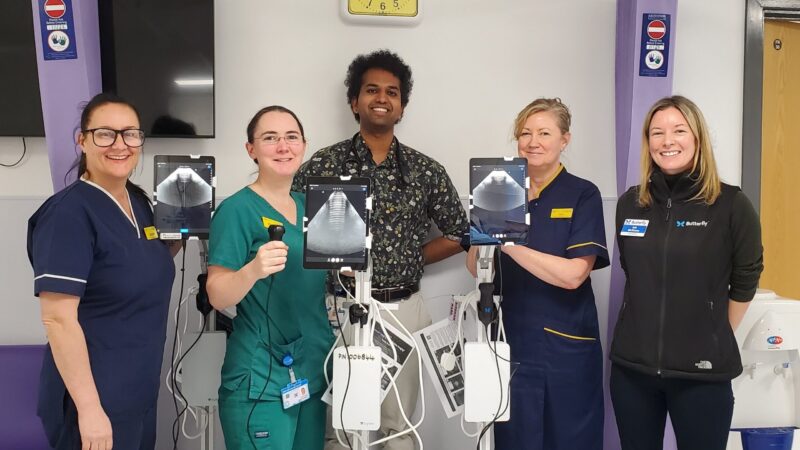
Access to rapid, high-quality ultrasound imaging at the patient’s bedside has been transformed at St Richard’s and Worthing hospitals, thanks to the dedication and initiative of a Foundation Year 1 doctor.
When a patient needs a timely scan to support diagnosis or guide an intervention, clinicians often turn to Point of Care Ultrasound (POCUS) — a portable device used wherever the patient is being treated, frequently right at the bedside. POCUS can guide injections, assist with cannulation and excess fluid build-up, assess traumatic injuries, and so much more, making it an invaluable tool to help aid fast, accurate clinical decision making.
While working as a newly qualified doctor in gastroenterology at St Richard’s Hospital, Dr Nisal Karunaratne spotted several challenges with POCUS access. Only a small number of cart-based machines were being shared across wards, leading to delays and making procedures and investigations more difficult to perform without ultrasound guidance.
To address this, Nisal led a quality improvement project to expand and streamline access to POCUS equipment across the hospital.
Nisal, who is nearing the end of his second year of foundation training, explained: “I wanted to showcase leadership and take responsibility for finding a solution to a common problem affecting almost every ward. It was clear we needed to make ultrasound machines more accessible for departments, wards and other hospitals, who needed it the most.”
His research showed the highest demand for ultrasound-guided procedures came from wards caring for elderly, bariatric and haemodynamically (inadequate blood circulation) compromised patients.
In response, Nisal initiated a trial of newly released, more cost-effective handheld ultrasound devices. These portable devices function both as automated bladder scanners and as full POCUS tools, enabling procedures to be performed more efficiently at the bedside and reducing risk of complications from medical interventions.
The trial received excellent feedback from clinical teams, who praised their speed, accuracy and positive impact on patient care.
Following the successful trial and governance approval, funding was reallocated to purchase a number of multifunctional ultrasound devices. These are now available across designated medical wards at St Richard’s and Worthing, significantly improving access and consistency across both sites.
Dr Natalie McGahan, Acute Medical Consultant, supported Nisal with this project. She said: “Having these easy-to-use, accessible, and versatile ultrasound probes is transforming clinical practice. We can now obtain answers immediately at the patient’s bedside, enabling faster diagnosis and more timely treatment.
“As a Foundation Year 1 doctor, it can be challenging to navigate through unfamiliar systems and terrain and initiate processes required to bring about meaningful change. However, Nisal demonstrated exceptional enthusiasm, determination, and professionalism in ensuring this project became a reality. He consistently drove the project forward on all fronts, supporting both managers and clinicians throughout the process.”
Plans are now underway to expand training so even more professionals can benefit from this technology.
Nisal said: “Navigating through a project of this magnitude and complexity was a big step-up from the level of a foundation training doctor. However, after listening to my colleagues, registrars, consultants and senior nurses, I felt a strong sense of responsibility, and it was very clear that we really needed POCUS to help optimise patient care and to be made more accessible. I had to steer in through un-charted waters, and this was a whole new experience for me.
“Luckily, I was fortunate to have worked with a very dedicated team, who listened and followed my plans and guidance, performed their role perfectly, worked together and persevered despite the numerous challenges that we faced along the way.
“Embarking on this project has been one my best achievements in my medical career so far and has enabled me to develop new transferable skills, which I will take forward when I begin speciality training.”
This work reflects the ambitions of our new five year Trust strategy. We want all our patients to have the best possible outcomes and experiences. That means giving them fast and fair access to high-quality care. This project demonstrates what is possible when colleagues feel inspired, supported and equipped with the tools they need to drive improvement in patient care.