
A pioneering programme at University Hospitals Sussex is quietly transforming the way patients experience urgent and emergency care by starting with a fundamental question: what actually happens during a patient’s journey, and how can we remove the barriers that get in the way of good care?
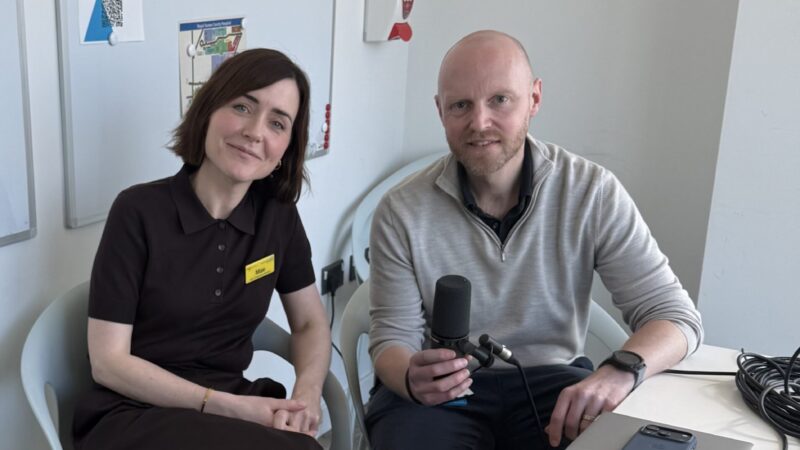
The HALO programme, Hospital Alternative Oversight, is led by Mae Sullivan, Head of Urgent and Emergency Care, and Mark Edwards, Chief of Service for the Division of Medicine and Consultant Vascular and Major Trauma Surgeon. Together, they have taken a deliberately holistic view of care, looking beyond hospital walls to understand how patients move between ambulance services, community care, care homes and acute hospitals.
Rather than accepting organisational boundaries as fixed, the programme set out to make sure that patients experience the NHS as one system – receiving the right care, in the right place, at the right time.
This approach has led to new ways of working with partners across Sussex, including the ambulance service, general practice and care homes. One of HALO’s most successful initiatives has seen hospital clinicians working directly alongside advanced paramedic practitioners, providing real-time specialist advice and virtual assessments for patients in the community.
During an initial five‑month pilot, clinicians supported more than 1,200 patient cases, with 77% of those patients avoiding an emergency department attendance altogether. Instead, patients were safely redirected to same-day emergency care, planned hospital assessment, or community-based support, often with greater reassurance and far less disruption.
“Patients shouldn’t be subject to arbitrary organisational boundaries. They should experience the NHS as one system and get the right care first time.”
Mae Sullivan, Head of Urgent and Emergency Care
The programme has also focused on improving care for some of the Trust’s most vulnerable patients by working closely with care homes. Weekly multidisciplinary meetings bring together clinicians, care home staff and community partners to support residents, reduce unnecessary hospital admissions and improve communication.
The impact has been significant, with over 2,000 bed days saved, a 30% reduction in overnight length of stay for this group of patients, and improved flow through emergency departments. The introduction of the Red Bag Scheme has further supported frail and elderly patients, helping staff quickly identify their needs and reducing time spent in ED by around a quarter.
Beyond the numbers, HALO is about reconnecting people – staff and patients alike – with purpose. For Mark Edwards, the programme represents a different style of leadership, one that empowers clinicians and trusts those closest to patients to shape solutions.
“We set clear goals, but we don’t micromanage how to get there,” he explains. “When people are given permission to innovate, build relationships and act, that’s when meaningful change happens.”
That culture has led to extraordinary engagement, with clinicians across disciplines contributing ideas, energy and, in some cases, their own time to develop new ways of delivering care closer to home.
HALO is now evolving from a pilot programme into a scalable model that aligns closely with the NHS 10‑Year Plan and the ambitions set out in the UHSussex Trust Strategy, particularly around partnership working, prevention, reducing inequalities and delivering more person‑centred care.
As the programme grows across Sussex, its focus remains firmly rooted in the lived experience of patients, making sure that care feels joined-up, compassionate and designed around real lives, not organisational lines, as part of the Trust strategy to help local people live well and thrive.
To find out more about the HALO programme and the impact it is having across Sussex, listen to the latest episode of the UHSussex Podcast on Spotify, Apple or YouTube. Mae Sullivan and Mark Edwards discuss the thinking behind the programme, the partnerships that have made it successful, and how a focus on patient journeys is helping deliver more joined-up, person-centred care for local communities.