
For many people, finishing treatment for breast cancer is not the end of their healthcare journey.
Treatments such as chemotherapy, ovarian suppression and endocrine therapies can trigger an early complex menopause or cause menopause-like symptoms, including hot flushes, sleep problems, joint pain, fatigue, low mood and changes to sexual health.
Complex (often treatment-induced) menopause happens abruptly due to medical interventions like cancer treatments, making symptoms much more severe and harder to treat, whereas natural menopause is a gradual, natural biological transition where hormone levels slowly decline over several years.
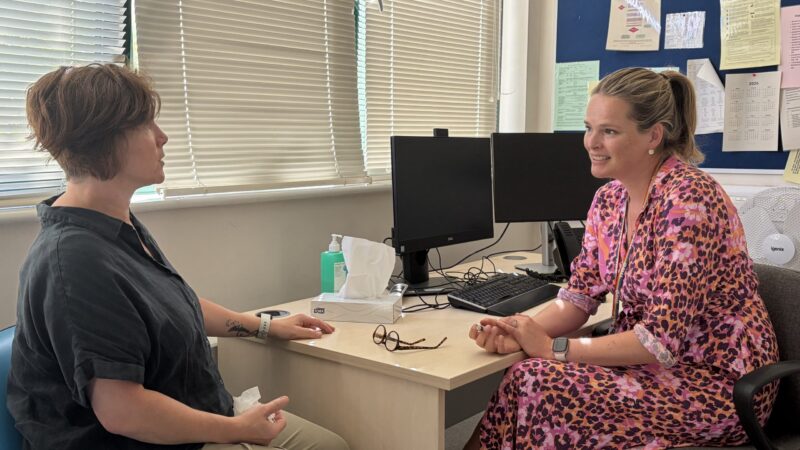
To better support patients, University Hospitals Sussex (UHSussex) has launched an Integrative Menopause Support Clinic within its breast service. Led by Dr Renske McFarlane, Specialty Doctor in Breast Surgery, the clinic is working to improve support for patients experiencing symptoms of complex menopause.
The clinic forms part of Renske’s research supported by a My Charity Fellowship and is helping to develop and evaluate a more holistic approach to menopause care for people affected by breast cancer.
Speaking about why she felt the research was needed, Renske said: “Nationally, we’re very good at screening, diagnosing cancers, operating and providing initial treatment. But for many women, living with the effects of treatment can continue for years. I was having more and more conversations with patients about how they were feeling, the impact on their confidence at work, their relationships and family life. It’s not just hot flushes. It can be joint pain, poor sleep, mood changes, brain fog, fatigue and sexual health issues. I felt we needed to do more to support women with that aftercare.”
Renske’s own experience of early menopause helped spark her interest in improving care. After joining the breast service, she completed additional training with the British Menopause Society and a Master’s degree in integrative medicine.
Looking at the whole person
Patients can be referred by their surgeon, breast care nurse, oncology team or GP and receive an extended appointment focused on their individual symptoms and circumstances. Rather than concentrating on a single issue, the clinic looks at the wider picture, including sleep, mood, fatigue, sexual health, exercise and lifestyle. Patients can discuss evidence-based options ranging from lifestyle changes and exercise to cognitive behavioural therapy (CBT), acupuncture and appropriate non-hormonal medications.
Because the clinic sits within the breast service, Renske can work closely with oncologists, pharmacists and the wider breast team to ensure the clinic’s recommendations are safe and appropriate for each patient. It also means patients know that the person they are speaking to understands both their breast cancer and their menopause.
Creating a safe space for difficult conversations
Feedback shows how valuable it can be simply to have the time and space to discuss symptoms holistically and openly. A patient, aged 57, described how the support helped her continue treatment. She said: “This is a very useful clinic, and it has helped me stay on tamoxifen in the early days.”
The clinic has also created opportunities for patients to openly discuss the impact of complex menopause on their sexual health, an area that many patients find difficult to raise. One patient, aged 65, said: “I have recommended other patients to you. You were the first and only person who spoke to me about my sex life. Others have only skirted around the subject; I found this a real positive of this clinic.”
For Renske, these clinic conversations are an essential part of treating the whole person rather than focusing solely on cancer.
Improving care through research
As well as supporting patients, the clinic is helping UHSussex understand how complex menopause care after breast cancer could be improved.
Through her research Renske has been evaluating the service through a registered audit alongside wider work examining menopause support for breast cancer patients.
This includes reviewing evidence, developing patient information, educating breast care teams and carrying out a Freedom of Information study looking at menopause provision across the UK. Early findings suggest access to specialist support remains variable. The National Institute for Health and Care Excellence recommends that people with a personal history of breast cancer and menopause-associated symptoms are offered information on management options and referral to a healthcare professional with menopause expertise. Yet there is a persistent gap between guidance and practice and access remains inconsistent. Data shows that nationally only 21.3% of UK women recalled receiving menopause information during treatment and only 17% reported specialist referral. A 2026 systematic review of menopause care in all cancer cohorts showed that 26-80% of patients’ menopause symptoms are untreated or self-managed and that 26-68% of patients desire further support, mainly with vasomotor symptoms (such as hot flashes) and genitourinary (vaginal dryness, painful intercourse) symptoms. With specialist menopause support, 83% of patients report improvement in symptoms.
Shaping services for our diverse communities
An important next step in Renske’s research, is ensuring the service meets the needs of the diverse communities affected by breast cancer. Renske’s work is exploring inequalities in both breast cancer outcomes and experiences of menopause care, including those of people from ethnic minority and LGBTQIA+ communities, in line with our Trust’s strategic commitment to providing excellent care for our patients.
The pilot clinic, launched in 2025 has already supported around 100 patients, and the work is receiving recognition. In October 2026, Renske was awarded a grant from the Sussex Cancer Fund to further develop the complex menopause service across Sussex for patients with breast and gynaecological cancers. This was preceded by her winning the Gold Award for her oral presentation on menopause at the Sussex Clinical Academic Conference on 1 July 2026.
She wants patients to play a central role in shaping future support, helping the team understand what information people need, when it should be provided and what an accessible, inclusive service should look like.
She said: “Breast cancer is a whole journey. People can have treatment for a year and then must live with the aftermath. We need to think about what happens afterwards and how we help people live well. “For me, this is about putting all our patient communities who live with breast cancer and menopause in the driving seat looking at the needs of the individuals holistically, and not just at the disease.”
Find out more about research
To find out more about clinical research taking place at the Trust visit Research and innovation – University Hospitals Sussex NHS Foundation Trust.
Sign up to NIHR’s Be Part of Research to be contacted about clinical research studies that you might be able to eligible to participate in.
Find out more about the work of our Research Champions and how you can get involved at Research champions – University Hospitals Sussex NHS Foundation Trust.