
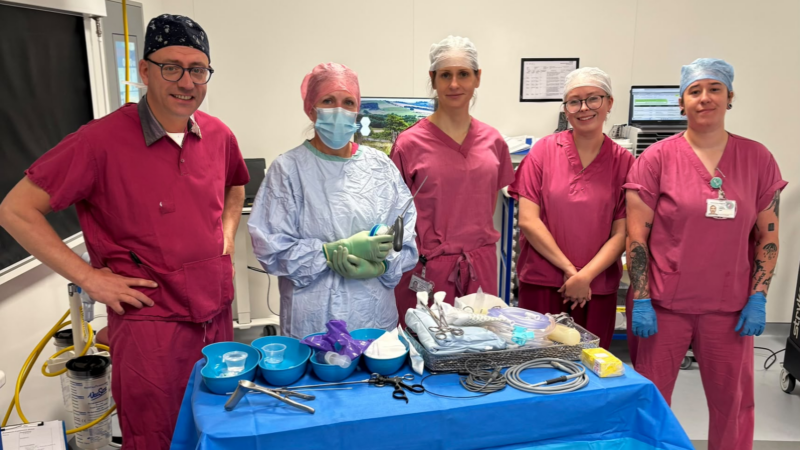
Patients with Crohn’s disease are now benefitting from a cutting-edge surgical procedure that is improving both their experience and outcomes, available in the NHS for the first time in the South East.
Crohn’s disease is a long-term condition where part of the gut becomes inflamed, and symptoms can vary from mild or severe, causing flare-ups and remissions. For many patients living with Crohn’s disease, complex anal fistulas can be one of the most distressing and exhausting parts of their condition. These can severely impact a patient’s everyday life, confidence, relationships.
An anal fistula is a small tunnel that develops between the end of the bowel and the skin near the opening of the bottom (anus). It’s usually caused by an infection near the anus, which results in a collection of pus (abscess) in the nearby tissue. When the pus drains away, it can leave a small channel behind which can cause unpleasant symptoms, such as pain and skin irritation, and will not usually heal on its own, so surgery is recommended in most cases.
University Hospitals Sussex is now offering Video Assisted Anal Fistula Treatment (VAAFT), a minimally invasive technique that allows surgeons to directly visualise and treat the fistula tract using a small camera. Avoiding the need for more invasive traditional surgery, VAAFT helps preserve the sphincter (muscle that contracts and relaxes to open or close body passage function) and allows for a faster recovery, reduced pain, and improved quality of life for patients.
The first VAAFT procedure was carried out on a paediatric patient at the Royal Alexandra Children’s Hospital, followed by the first adult patient at Princess Royal Hospital, both by Mr Alfredo Tonsi and his clinical team.
Mr Alfredo Tonsi, Consultant Colorectal Surgeon and Surgical Inflammatory Bowel Disease (IBD) Lead, said: “I feel incredibly proud of what we have achieved by introducing VAAFT within our Trust. For patients living with complex anal fistulas—particularly those with Crohn’s disease—this can be a long and very difficult journey, often marked by pain, repeated procedures, and uncertainty.
“The introduction of VAAFT marks an exciting step forward for our colorectal service and for patients across our local community. This is more than introducing a new technique; it is about restoring hope and improving quality of life for patients who have often struggled for a long time. We have enhanced our pathways to ensure that patients with complex fistula disease are identified earlier and can be offered this innovative, minimally invasive treatment as part of a specialist-led service.”
Until now, patients were referred to specialist centres in London for this procedure, so its introduction at University Hospitals Sussex means that patients can access treatment much closer to home.
As a day case procedure, VAAFT allows patients to return home the same day, reducing disruption to their lives while delivering more precise and effective treatment.
The advanced equipment used to deliver this service was jointly funded through a generous donation from a patient’s family, matched by our dedicated charity, My University Hospitals Sussex.
Polly Smith, from Burgess Hill, saw first-hand the impact complex fistulas can have after her son developed the condition as a result of Crohn’s disease.
She said: “These are so tough to manage on a day-to-day basis and to have the normal life that you want when you’re young and in Brighton!”
Polly explains that her experience with her son’s clinical team inspired her to explore ways to help the future of this care.
She said: “The care and explanations that Mr Tonsi gave made my son feel really included in the planning of his care. I was the person who asked if there was any equipment that would help in this procedure, there was but it wasn’t available at the Trust. I thought it would be prohibitively expensive, but it wasn’t. Essentially making this donation plus the charitable fund money meant that patients at UHSussex can all benefit from this for the same price as one procedure if I had paid for that privately.
“It’s not a glamorous procedure but so vital for normal life. I felt that the equipment would mean a much smaller procedure for people and give the surgeons more scope to treat more complex cases locally.”
Plans to expand theatre capacity at Princess Royal Hospital will enable the team to undertake more complex fistula procedures, allowing more patients to benefit from this innovative technique.
Polly said: “It feels quite amazing and the first patient the equipment was used on was a child and honestly knowing how tough it was for an adult to manage this condition, I’ve no idea how that child and their parents managed. So having it used on them for the first time, getting them back to a normal childhood faster, made it super special.”
Plans to roll out VAAFT across the Trust are also underway, so all eligible patients can access this treatment as part of a responsive clinical pathway.
This expansion of specialist, day-case surgery further establishes us as a centre of excellence in complex medicine focusing on diagnosing and treating disorders of the anus, rectum, and lower digestive tract, that is improving access and providing high-quality care.