
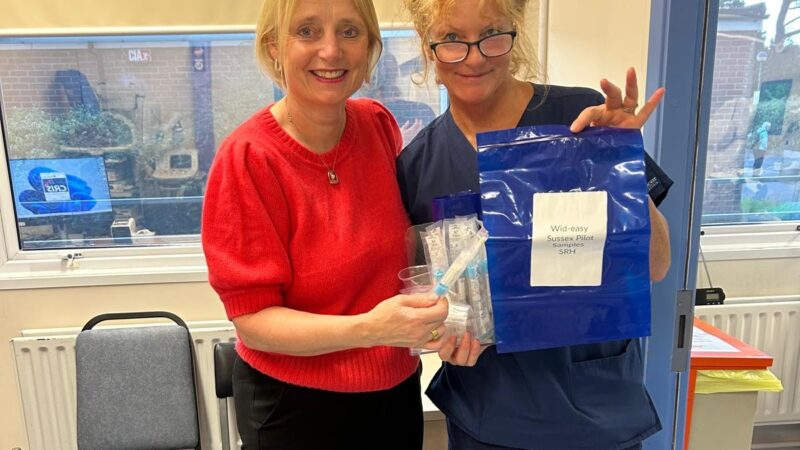
A pioneering test for endometrial (womb) cancer is being piloted for the first time in Sussex which could prevent women experiencing unnecessary invasive procedures in the future and lead to faster diagnosis.
Eligible patients undergoing investigations for post-menopausal bleeding at St Richard’s, Worthing and Southlands hospitals will also be offered a WID-easy test.
This new diagnostic test is a simple, non-invasive vaginal swab that detects specific DNA markers to help diagnose or rule out womb cancer earlier, particularly in women who are peri (leading up to) or post-menopausal.
Womb cancer is the fourth most common cancer in women in the UK and around 9,800 women are diagnosed with womb cancer in the UK each year (Cancer Research UK). The number of womb cancer cases continues to rise, driven largely by increasing rates of obesity and longer life expectancy.
The most common symptom of womb cancer is abnormal uterine bleeding (AUB) affecting more than 300,000 women each year, yet only 3% are diagnosed with womb cancer.
Most diagnostic pathways start with a transvaginal ultrasound to check for signs of cancer. However, this method has low specificity, meaning many women undergo further unnecessary and sometimes invasive investigations, such as a hysteroscopy (a test to look inside a woman’s womb using a thin tube with a small camera inside it).
Ms Bronwyn Middleton, Clinical Director for Gynaecology and Consultant Obstetrician and Gynaecologist, is leading on this pilot project for UHSussex. She said: “We are proud to be participating in this project. This test will help significantly reduce the need for painful and invasive procedures like hysteroscopies and biopsies, by accurately identifying those who do not have cancer. That means faster diagnosis for those who do, and fewer unnecessary interventions for those who don’t.
“This will help doctors to prioritise women with the highest risk of cancer. The test performs reliably across different ethnic groups. This is a key advantage over ultrasound which is known to be less reliable at ruling out womb cancer in Black women.”
Despite national targets set by NHS England, fewer than 75% of women receive a gynaecological cancer diagnosis within 28 days, so integrating this swab test into the diagnostic pathway could help accelerate diagnosis for more women.
The pilot will run alongside existing diagnostics to evaluate its effectiveness and potential for wider implementation into the diagnostic pathway.
Mr Peter Larson-Disney, Gynaecology Oncology Lead and Consultant Obstetrician and Gynaecologist, said: “WID-easy is a game changer for the investigation of women with peri/post-menopausal bleeding. Suspected endometrial cancer represents about 80% of referrals into Urgent Suspicion of Cancer clinics and, if this pilot is validated as we expect, the investigation of these women will be much simpler, and our patients will avoid many painful procedures to get a diagnosis. I cannot see how this technique, when validated, will not improve the experience of our patients and shorten their pathway to diagnosis and treatment.”
Since its launch in mid-September, 45 patients have been recruited, with a target of 600 by the project’s end in December 2025.
This regional project is a collaboration between University Hospitals Sussex NHS Foundation Trust, Surrey and Sussex Cancer Alliance, Health Innovation Kent Surrey Sussex, and Advanced Global Health Ltd. Independent evaluation will be carried out by Unity Insights.
The WID-easy test was developed by researchers at University College London in partnership with the UK’s largest gynaecology cancer charity, The Eve Appeal.
This pilot project reflects our commitment to delivering excellent care. It aligns with our new five-year Trust strategy, which commits to every patient receiving the best possible outcomes and experiences, whenever they need us. That means giving them fast and fair access to high-quality treatment. As part of this vision, we are focusing on faster access to care by reducing waiting times for planned procedures and cancer treatment.