
After receiving emergency care at Royal Sussex County Hospital during a heart attack, Carolyn Thompson became the first patient at University Hospitals Sussex NHS Foundation Trust (UHSussex) to take part in a world-first research trial aiming to improve long-term treatment and transform future cardiac care for patients.
Carolyn, 71, from Shoreham-by-Sea, was admitted to Royal Sussex County Hospital in October 2025 after experiencing severe and persistent pain in her upper back. What she initially thought was a pulled muscle was quickly diagnosed by doctors as a ST‑elevation myocardial infarction (STEMI), the most dangerous type of heart attack, caused by a complete blockage of a coronary artery, stopping blood flow to the heart muscle. It is identified by a characteristic pattern on an electrocardiogram (ECG) and requires immediate treatment.
Carolyn was taken straight to the cardiac catheter laboratory, where she received urgent, life-saving treatment from the cardiology team. This involved a primary angioplasty; a procedure to reopen the blocked artery and restore blood flow. UHSussex cardiology teams carry out around 400 primary angioplasty procedures each year.
Carolyn described her care as calm and reassuring, with clinical and support staff clearly focused on her safety. She said: “I never panicked. I felt calm and knew help was on the way. Everything moved seamlessly, from the A&E staff who were waiting for me when I arrived by ambulance, to the doctors and nurses during the procedure, and later, on the Cardiac Care Unit.”
Once her condition was stable, Carolyn was invited by the research team to consent formally to the STEMI DCB trial. She was the first patient in the UK to be successfully randomised into the study, which is recruiting 700 patients across 15 hospital sites in England, Wales and Scotland.
The STEMI DCB trial is exploring the most effective way to treat coronary artery blockages, in patients experiencing a STEMI heart attack. It compares two approved and routinely used treatments deployed during a primary angioplasty: Drug Eluting Stents and Drug Coated Balloons. Drug Coated Balloons may offer potential long-term benefits as they do not leave a permanent implant behind. Patients taking part in the trial are randomly assigned to receive one of the two treatments during their primary angioplasty. Participants are followed up for up to eight years to monitor their heart health and help determine which treatment provides the best long-term outcomes. The study is led at UHSussex by Consultant Cardiologists – Professor David Hildick-Smith and Dr Chris Broyd.
Professor Hildick-Smith said: “We are delighted that Carolyn was successfully treated as the first randomised participant in the trial and that she is doing well. Stent treatment has an excellent track record, and this trial will help us understand whether Drug Coated Balloons may offer additional long-term benefits for patients.”
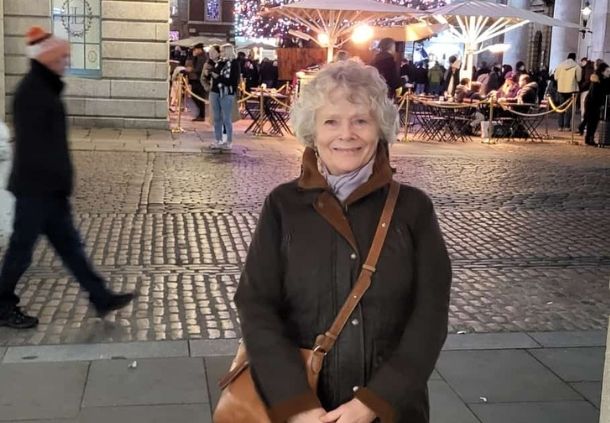
Since her heart attack, Carolyn has completed cardiac rehabilitation and has returned to many of her usual activities, including daily walks, a weekly dance class and spending time with family and friends. She says the experience has encouraged her to prioritise her health and feels positive about her recovery.
Reflecting on her involvement in research, Carolyn said: “If research can help doctors understand which treatments work best and improve care for future patients, then it’s important to be involved. For me, it was straightforward and non-intrusive, and you could be helping the next patient.”
Find out more about our commitment to leading regional research and improving access to research for our patients as part of our new strategy Excellent care for the future – University Hospitals Sussex NHS Foundation Trust. You can also find out how we are how research is already improving patient care at UHSussex by visiting Research and innovation – University Hospitals Sussex NHS Foundation Trust