
Download and print as a PDF (638kB pdf)
What is this information about?
This information is about ankle avulsion fracture.
It tells you:
- How to look after yourself when you go home from hospital with an ankle avulsion fracture.
- What exercises you can do to help heal and strengthen your ankle.
- Who to contact if you need further help and support.
What is an ankle avulsion fracture?
An ankle avulsion is a minor fracture that occurs when a piece of bone breaks off from the ankle bone where it attaches to a ligament or tendon. This is treated as a soft tissue injury to the ankle.
If you have a fracture, it means you have a broken bone. ‘Fractured bone’ and ‘broken bone’ both mean the same.
How long is it likely to take for my injury to heal?
It usually takes around six weeks for an ankle avulsion fracture to heal.
Will smoking or vaping slow down my healing?
Yes. Smoking slows healing so if you smoke or vape try to stop or cur down. This is most important in the first two weeks after your injury. If you would like help to stop smoking talk to your GP or visit Quit smoking – NHS for further information.
What should I do if I am in pain after my ankle avulsion fracture?
You may have ankle pain after your injury. If you are in pain, take your usual pain killers or pain killers given to you in the emergency department. Follow the dose instructions on the packet. If you are struggling with pain do speak to your GP or pharmacist.
What should I do if I have swelling after my ankle avulsion fracture?
You may have ankle pain and swelling for three to six months after your injury. Swelling is often worse at the end of the day. To reduce swelling:
- Apply a cold pack to the injury site. You can use an ice pack or bag of frozen peas wrapped in a damp towel. Put this on your ankle for up to 15 minutes every few hours. Make sure the ice is not in direct contact with your skin.
- Try to rest your ankle, especially in the first 24-72 hours (one to three days). Raise your ankle on a stool or cushions so that it is above the level of your hip.
Can I walk after my ankle avulsion fracture?
Yes. You can walk on the foot as much as it is comfortable. You may find crutches useful to help take some of the load off in the early stages.
If you have been given a boot, this is for your comfort only. Take it off when you are not walking. You can start to use your normal shoes as soon as you feel comfortable. You should stop using the boot two weeks after your surgery.
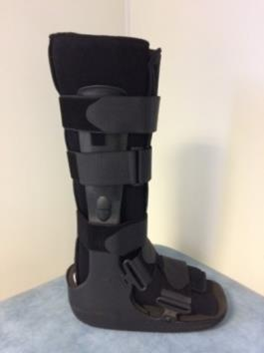
Will I have further (follow up) appointments?
No. We do not routinely follow up patients with this type of injury. If after six weeks you are :
- Still experiencing pain and swelling, or
- Struggling to wean out of (stop using) the boot
Please contact the Virtual Fracture Clinic for further advice.
What should I do in the first and second week after my injury?
- Rest your ankle elevated (raised) for the first 24 to 72 hours (one to three days). This will help reduce your swelling. You can use an ice pack or bag of frozen peas wrapped in a damp towel. Put this on your ankle for up to 15 minutes every few hours. Make sure the ice is not in direct contact with your skin.
- Keep moving around and walk on the foot as much as is comfortable. If supplied, wear the boot of rigid sole shoe for comfort when walking, but remove at night or when resting
- Wear a long sock in your boot. Try to stop using he boot as soon as you can. Start around your house first, then try outside.
- Start provided exercises as soon as possible. Early movement of the foot and ankle stimulates circulation and reduces the risk of developing a Deep Vein Thrombosis (blood clot).
- Do these exercises about five times a day. Start straight away, working within your pain levels.
Exercises:
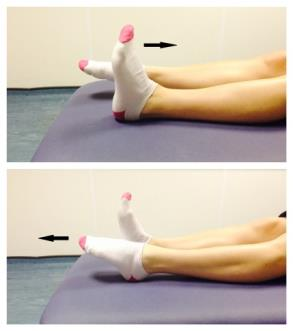
- Point your foot up and down. Repeat this 10 times.
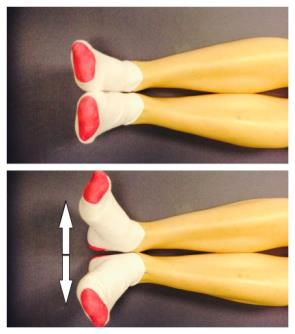
2. With your heels together, move your toes apart to turn the foot outwards. Repeat this 10 times. Do this movement gently within comfort.
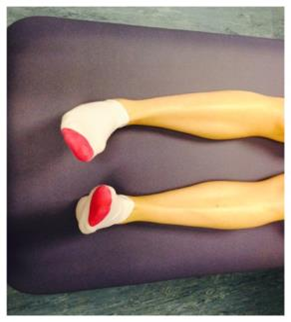
3. Make gentle circles with your foot in one direction and then the other direction. Repeat this 10 times.
What should I do from week two to week five after my injury?
- Try to wear your boot less each day until you no longer need to wear it at all after two weeks. It is usual to still have mild discomfort and swelling at this stage. This may continue for three to six months.
- Aim to move on to doing gentle stretching exercises as shown below.
- Slowly increase your day-to-day activity level.
Be aware
You should avoid impact activity for six weeks. This includes running, jumping and dancing.
Exercises:
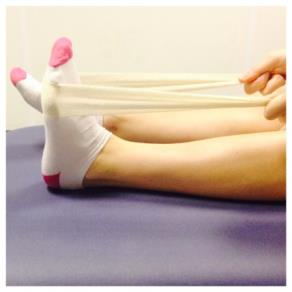
- Sit with your leg straight out in front of you. Put a towel or bandage around your foot and pull it towards you. Feel a stretch in the back of the calf. Hold for 30 seconds.
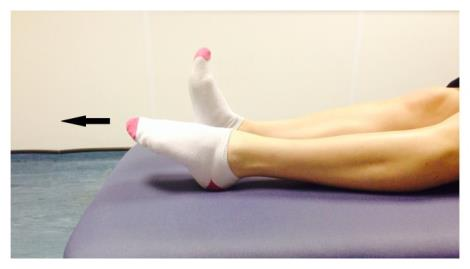
2. Point your toes down as far as they go, place your other foot on top and apply some pressure. This will stretch the top of your foot. Hold for 30 seconds.
What should I do from week six after my injury?
It is usual to still have mild discomfort and swelling. This may continue for three to six months. Your fracture should be healed by this times. Aim to practice balance exercises as shown below:
Level 1: These exercises are for people who could not stand on one leg before their injury
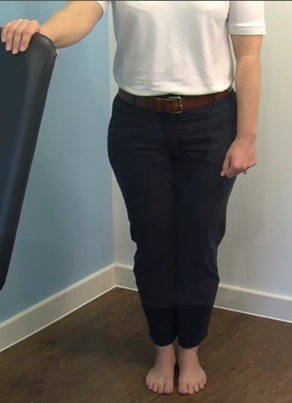
- Stand with your feet as close together as possible. Hold onto a firm support in a safe space. Hold your balance for 30 seconds
- Now try removing your hand. Try to keep your balance for 30 seconds
- Hold onto a firm support. Put one foot in front of the other, as close together as you can. Hold onto this for 30 seconds. If you can, try to let go of the support and keep your balance.
Level 2: These exercises are for people who could stand on one leg before their injury
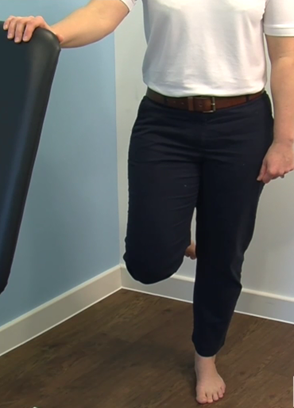
- Hold onto a firm surface in a safe space. Try to stand on one leg. Hold this for 30 seconds. Stop if you experience pain. When you can do this comfortably, try the next exercise.
- Try to stand on one leg without holding onto a support. Try to hold this for 30 seconds. When you can do this comfortably, try the next exercise.
- You can try these exercises with your eyes closed. Make sure you are always in a safe environment with a support to hold if needed.
What do I do if I am struggling with my boot?
Make sure you wear a supportive shoe or trainer on your uninjured foot due to the boot having a thicker sole which can make you feel uneven. This will help reduce stress on other joints.
If you need more advice contact the Virtual Fracture Clinic.
What should I do if I have diabetes?
If you have diabetes there is a greater chance that pressure on your skin over a long period could cause skin ulcers. Wearing a boot or rigid sole shoe could cause pressure on your skin.
Do
- Ask the Virtual Fracture Clinic for special boot care advice for people with diabetes if you have not had it already.
- Check the condition of your skin each day for any redness of your skin. If you have black or brown skin this may appear differently. It is even more important for you to check your skin if you have dry or itchy skin or other skin problems.
- Contact the Virtual Fracture Clinic if you notice any changes in your skin colour.
We can give you advice if arrange for your foot to be checked in the plaster room if you need that.
When should I contact Virtual Fracture Clinic?
Please contact the Virtual Fracture Clinic if you:
- Are concerned about your symptoms, especially 6 weeks after your injury.
- Are struggling to return to exercise or your usual activities 6 to 8 weeks after your injury.
- Would like further information or support after you have read this information.
When can I start driving?
You can return to driving when:
- You are no longer using your boot.
- You can walk comfortably.
- You can safely deal with all emergency situations without being in pain or hesitating. For example, you must be able to stop the car quickly and in full control and safely avoid obstacles.
- You are covered by your insurance company.
Be aware
Always try driving in a safe place first.
How can I get a note for work?
Please contact the Virtual Fracture Clinic.
What should I do if I am struggling to return to my sport?
Please contact us and we can discuss further or refer you on for outpatient physiotherapy.
What do I do with my boot and crutches when I no longer need them?
Do
- Return your crutches to the Virtual Fracture Clinic or A&E.
Do not
- Return boots or shoes to the hospital. We are unable to reuse them.
How do I contact the Virtual Fracture Clinic?
Working hours: Monday to Friday 8.30am to 4.30pm. We aim to respond to messages within 24 hours during these times. At times you may receive a call outside of these hours.
 Worthing Hospital
01903 205111
Ext. 86312
Worthing Hospital
01903 205111
Ext. 86312
St Richard’s Hospital
01243 788122
Ext. 35503

This leaflet is intended for patients receiving care in St Richard’s Hospital or Worthing Hospital.
The information in this leaflet is for guidance purposes only and is in no way intended to replace professional clinical advice by a qualified practitioner.
Today’s research is tomorrow’s treatments. That’s why UHSx is proud to be a research-active Trust. Find out how you can get involved.
Visit our website www.uhsussex.nhs.uk/research-and-innovation/information-for-patients-and-public or scan the QR code: 