
Download and print as a PDF (643kB pdf)
What is this information about?
This information is about phalanx fractures. A fracture means the same as a broken bone. A phalanx is a small bone in your finger.
It tells you:
- How to look after yourself when you go home from hospital with a phalanx fracture
- What exercises you can do to help heal and strengthen your hand
- What follow-up treatment you might have
- Who to contact if you need further help and support.
What is a phalanx fracture?
The fingers are made up of small bones and each of these is called a phalanx. A phalanx fracture is a break to one of the small bones in your finger.
How long is it likely to take for my injury to heal?
It usually takes around four to six weeks for a phalanx fracture to heal. Some people may need to continue with exercise for several months to get back to their usual activities.
Will smoking slow down the healing process?
Yes. Smoking will slow down your healing. We would advise that you stop smoking while your fracture heals. Talk to your GP or go to www.smokefree.nhs.uk for more information.
What should I do if I am in pain after my phalanx fracture?
If you are in pain, take your usual painkillers or painkillers given to you in the emergency department. Follow the dose instructions on the packet. If you are struggling with pain, speak to your GP or pharmacist.
Will I have a cast or splint after I have a phalanx fracture?
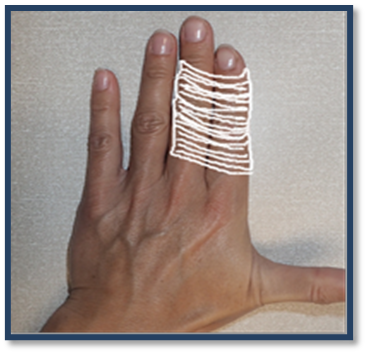
A phalanx fracture is treated with neighbour strapping.
What should I do to care for myself if I have neighbour strapping?
Do
- Wear it to support your finger and reduce pain.
- The exercises which are shown later in this information.
- Check your skin under the strapping to make sure it is not being damaged.
Do not
- Use anything to scratch yourself under the strapping.
What should I do if I am struggling with my strapping?
Contact the Virtual Fracture Clinic. We can give you advice or arrange for your strapping to be changed if you need that.
Will I have a (follow up) appointments?
You do not require follow up as this injury heals well.
What should I do in the first and second week after my injury?
- Try to rest your hand for the first 24 to 72 hours. However, it is important to maintain movement in your hand. Gently move your hand following the exercises shown. These should not cause too much pain. This will ensure your hand does not become stiff and it will help the healing process.
- You may use your hand for light tasks as comfort allows. Use the splint or strapping for comfort for the first two weeks.
- A cold pack (ice pack or frozen peas wrapped in a damp towel) can provide short term pain relief. Apply this to the sore area for up to 15 minutes, every few hours. The ice must never be in direct contact with the skin.
- Raise your hand above the level of your heart to reduce swelling. You can use pillows to support with this as needed.
- It is important to start gentle exercises straight away to prevent stiffness, get the muscles that support your hand working, and help the healing process. You will find pictures and instructions for your exercises over the page.
What exercises should I start with?
Hand Movement:
Move your hand and fingers every now and then throughout the day. Try and follow these images, but don’t worry if your hand is too stiff. Avoid exercises that make the pain much worse. These exercises will help with stiffness and healing.
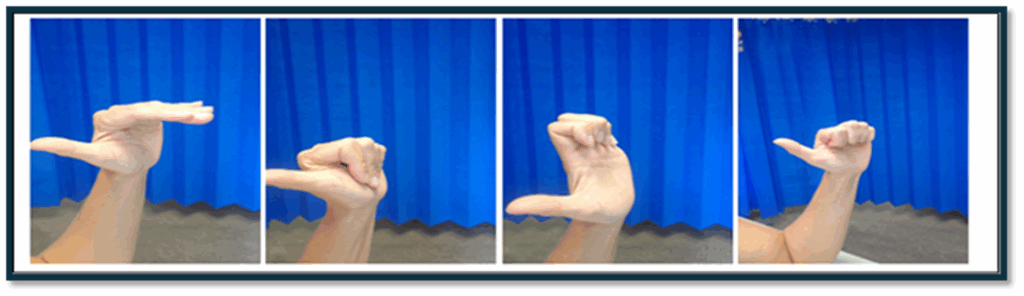
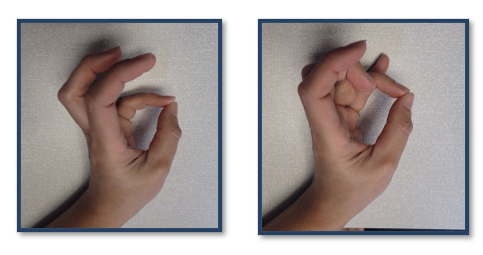
Touch each finger to thumb 5 times.
What should I be doing in the third, fourth, and fifth week after my injury?
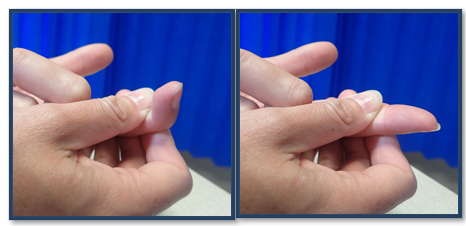
You can try to stop using the strapping. Begin using your hand for normal tasks, but be guided by your pain levels. Start the below exercises and continue with the earlier ones if your fingers remain stiff.
Use your other hand to keep your finger steady and bend and straighten the finger joint nearest your palm. Repeat 5 times.
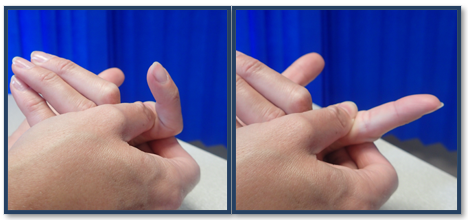
Use your other hand to keep your finger steady and bend and straighten the finger joint nearest the end of your finger. Repeat 5 times.
What should I be doing six weeks after my injury?
The injury has healed. You can return to normal activities guided by pain. Heavy tasks, lifting, and impact may still cause some discomfort and swelling. Return gradually to these types of activities.
When should I contact Virtual Fracture Clinic?
Please contact the Virtual Fracture Clinic if you:
- Are concerned about your symptoms, especially 6 weeks after your injury.
- Are struggling to return to exercise or your usual activities 6 to 8 weeks after your injury.
- Would like further information or support after you have read this information.
When can I start driving?
You can return to driving when:
- You can move comfortably and no longer require a splint.
- You can safely deal with all emergency situations without being in pain or hesitating. For example, you must be able to stop the car quickly and in full control and safely avoid obstacles.
- You are covered by your insurance company.
Be aware
Always try driving in a safe place first.
How can I get a certificate for work?
You can get a fitness for work statement from the Virtual Fracture Clinic.
How do I contact the Virtual Fracture Clinic?
Working hours: Monday to Friday 8.30am to 4.30pm. We aim to respond to messages within 24 hours during these times. At times you may receive a call outside of these hours.
 Worthing
01903 205111
Ext. 86312
Worthing
01903 205111
Ext. 86312
Chichester
01243 788122
Ext. 35503

This leaflet is intended for patients receiving care in Worthing and St Richard’s.
The information in this leaflet is for guidance purposes only and is in no way intended to replace professional clinical advice by a qualified practitioner.
Today’s research is tomorrow’s treatments. That’s why UHSx is proud to be a research-active Trust. Find out how you can get involved.
Visit our website www.uhsussex.nhs.uk/research-and-innovation/information-for-patients-and-public or scan the QR code: 