
Download and print as a PDF (767kB pdf)
Information for patients
Welcome to the cardiac rehabilitation programme.
What is this information about?
This information explains how you can exercise safely as part of your cardiac rehabilitation (cardiac rehab) programme.
It includes information about:
- what to expect in classes
- how to exercise at home
- what warning signs to look for
- who to contact for help and further advice and support.
Why have I been given this information?
Reading this information and following the advice in it can help you to:
- recover from your heart condition
- feel and be fitter and healthier
- return to doing the activities that you need to and that you enjoy
- avoid further heart problems
- improve your strength and confidence.
About cardiac rehab
What is cardiac rehab?
Cardiac rehab is a supervised programme that helps you get fitter and feel more confident after a heart problem or heart treatment.
We will talk with you about the type of programme that suits you best. You can also access information sessions on how to keep your heart healthy.
Where is the cardiac rehab team based and how do I contact you?
Cardiac rehab team
If no one is free, please leave a message. We will call you back.
 Southlands Hospital
01273 446019
Southlands Hospital
01273 446019
Where can I find more trusted information?
Speak with your doctor or a member of the cardiac rehab team. You can also find helpful resources from the British Heart Foundation (BHF) www.bhf.org.uk/informationsupport
How can regular exercise help me?
Regular activity can:
- improve heart fitness and stamina so daily tasks feel easier
- slow the build‑up of fatty deposits in arteries and lower the risk of more heart problems
- reduce angina episodes and shortness of breath (if you had these)
- lower blood pressure and improve cholesterol
- help prevent or slow type 2 diabetes
- support your immune system
- build muscle strength and reduce tiredness
- improve posture and flexibility
- slow bone thinning (osteoporosis) through weight‑bearing exercise
- boost blood flow, raise the rate at which you burn calories and help reduce body fat
- Improve sleep and help you deal with stress
- lift your mood and support confidence and self-esteem (exercise releases “feel‑good” chemicals).
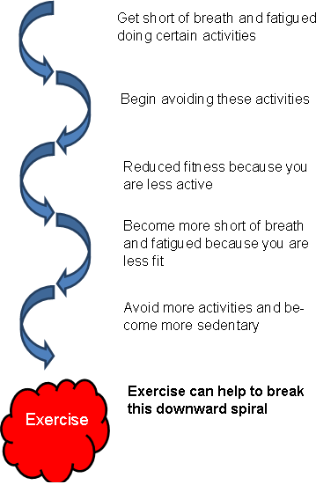
- help you to break out of ‘the spiral of deconditioning’
Getting started
How do I choose an activity?
Pick something you enjoy and can fit into daily life. Exercise does not have to mean joining a gym. A brisk walk or a short home routine can work well. Involve family or friends if you wish. Build up gradually.
What about weather and clothing?
- Check the weather before you walk outdoors. Very cold, windy, or hot days can make exercise harder so try to avoid these.
- In cold weather, a loose scarf over your nose and mouth can help warm the air you breathe
- Have an indoor option for bad weather
- Wear loose, comfy layers and supportive shoes
- Keep the room well-ventilated if you exercise indoors.
What tips can help me get started with exercising and being more active?
Most people who have not been active for a long time are unsure of how to get started. These tips can help:
- Do what’s right for you. Choose a way of being active that you enjoy and that fits into your daily routine.
- If going to a gym or exercise class is not right for you, try something else. This could be going for a walk or doing a short exercise routine at home. What matters most is that it works for you.
- Choose a type of exercise that matches your age and fitness level. This will help you to stay safe and enjoy the activities you choose.
- Choose activities that you enjoy and are fun for you to do.
- Walking is good exercise. Aim to walk briskly for 20 to 30 minutes each day. This will soon build up your stamina. Be aware, if the weather is very cold, windy, or hot it can be harder to exercise safely:
- Check the weather before you go out
- Avoid early-morning or evening chill and mid-day heat if you can
- If you go out in cold weather, wrap a scarf loosely around your nose and mouth. This warms the air that you breathe in
- Have a back-up exercise option that you can do all year round for when the weather is not suitable for outside activity. This should be something that you enjoy and can stick with.
- Try exercising with your family or friends. They may be looking for a way to get active too.
- Make exercise a part of your weekly routine. Try to find more energetic ways of doing everyday things. For example, use the stairs and not the lift or walk instead of using the car or the bus for short journeys.
- Wear loose comfortable clothes and good supportive shoes to exercise.
- Build your activity and exercise up slowly. It takes time to get fit.
Starting the cardiac rehab programme supervised classes
What can I expect from the classes?
- Up to 15 people may exercise with you
- At least two staff lead the class (numbers depend on attendance)
- Staff wear red polo shirts and name badges
- You may wear a heart rate monitor and a name badge during class
- Classes include a warm‑up to start with, a circuit (the main workout), and a cool‑down with stretches
- Each exercise has levels. You start at a lower level and build up safely.
- Cardiac Rehab Buddies (in blue polo shirts) may be there to support you.
What should I tell staff before the class starts?
Please tell us if, since the last session, you have had:
- chest pain, chest tightness or felt unwell
- any medication changes including starting antibiotics to treat an infection
- new or worse joint or muscle pains
- any new tests, results, or appointments (for example, blood pressure, angiogram, echo, MRI).
What should I tell staff during the class?
Be aware,
please tell us straight away if you:
-get chest pain, chest tightness or need your GTN
-feel unwell, sick, or dizzy
-notice new joint or muscle pain
Exercising safely and effectively
How often should I exercise?
Aim to build up to at least 150 minutes of moderate activity each week (for example, 5 sessions of 30 minutes). You can split this into 10‑minute blocks if this suits you better.
What is the F.I.T.T. plan?
We recommend that you follow the FITT plan to help you to get the exercise that you need:
- F – Frequency: at least 5 days a week
- I – Intensity: moderate effort (see Borg effort scale below)
- T – Time: 150 minutes (2 ½ hours) a week, 10 minutes or more each session
- T – Type: mainly aerobic (steady, rhythmic moves using large muscles) such as walking, cycling, swimming, an exercise session or dancing.
Be aware,
if you have had heart surgery, your breastbone (sternum) is still healing for the first 12 weeks afterwards. During this time do:
– stick to the exercises and advice given to you by your rehab team
– have brisk walking as your main exercise activity.
Once your sternum has fully healed, you can slowly begin more dynamic types of exercise. Do check with your rehab team before starting any new activity to make sure it’s safe and right for you. You may be able to do exercise such as:
- swimming
- cycling
- jogging
- golf
- bowls
- badminton
- tennis
- aerobics classes
- dance
- yoga
What should I do before I start an exercise session?
- Wear loose layers and flat supportive shoes.
- Keep the room at a comfortable temperature. Open a window or remove some layers of clothing if you are too hot.
- Have water with you to drink
- Do not exercise for 1 to 2 hours after a heavy meal or alcohol
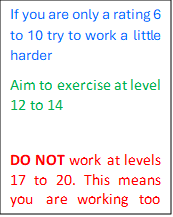
- Be aware of the effort (Borg) scale and try to work at the 12 to 14 level of the scale. Keep it near you so that you can check your effort level. See further information on the Borg scale further on in this information.
How do I structure each exercise session?
Be aware,
all three parts (warm-up, main workout, cool-down) of your exercise session are equally important. Even if you are short of time do not skip any part.
1. Warm‑up (about 10 to 15 minutes). Prepares your heart and body for exercise. Gets blood flowing to your heart and muscles.
- Build up slowly so your heart rate rises gradually and
- Aim to feel an effort level of 10 to 11 by the end
- Keep your feet moving until you start the cool‑down (this helps you to avoid feeling dizzy).
2. Main workout (about 20 to 30 minutes). Strengthens and conditions your heart, arms and legs.
- Choose aerobic exercise that you enjoy. For example, walking, cycling, swimming, doing a set of exercises or dancing.
- Aim for continuous activity if you can.
- Work at 12 to 14 on the Borg effort scale (see below)
- Keep your legs moving even during short pauses or arm work
- Drink water during your session and after you finish.
3. Cool‑down and stretching (about 10 minutes). Lets your heart rate and blood pressure come back down slowly
- Stretch to help prevent stiffness
- Do not skip the cool‑down, even if you are in a hurry.
How hard should I push myself? (the Borg effort scale)
What is the Borg effort (exertion) scale?
We use the Borg scale (6 to 20) to help you judge how hard you are working (how much effort you are expending) when you are in an exercise class, exercising at home or doing any physical activity.
The Borg scale is a standard way to measure exercise intensity and set exercise levels in rehab. It is useful when you do not need to monitor your heart-rate.
Using this scale helps you to exercise at the right level for your heart and fitness goals.
Choose the number on the scale that best matches how hard an activity feels. Consider how your whole body feels, including your breathing, overall effort and how tired you feel. There is no right or wrong answer.
The Borg effort scale
- 6: No effort (exertion) at all.
- 7:
- 8: Extremely light
- 9: Very light
- 10:
- 11: Light
- 12:
- 13: Quite hard
- 14:
- 15: Hard (heavy)
- 16:
- 17: Very hard.
- 18:
- 19: Extremely hard.
- 20: Highest level of exertion
How should I feel when I‘m exercising?
What feelings are usual during exercise?
It is usual to feel:
- a bit sweaty and warm
- that you are breathing faster, but still able to talk comfortably
- your heart beating faster.
What feelings are not usual?
Do stop exercising at once and tell the team (or your GP if you’re at home) if you:
- have chest pain, tightness, or heaviness (more than wound discomfort)
- are feeling dizzy, faint, or sick
- have a very fast heartbeat or your heartbeat is not regular
- are very out of breath (so that you are unable to talk comfortably) or sweating
- feel extreme tiredness
These symptoms may just be because you have been exercising too hard.
When should I not start exercise?
Do not start if you feel unwell (for example, cold or flu, or sickness). If you take a break for any reason, restart slowly and build up again.
What if I get chest pain (angina)?
If you get pain, tightness, or heaviness in your chest, arms, or upper back:
If pain is unbearable, dial 999 for an ambulance straight away
- Otherwise, sit down and stay calm.
- Take your GTN (if prescribed)
- Wait 5 minutes
- Still in pain?
- Repeat your GTN
- Wait another 5 minutes
- Still in pain after this?
- Dial 999 for an ambulance. Do not wait any longer. Stay calm.
Strength (resistance) training
Should I do strength (resistance) exercise as well as aerobic exercise?
Yes. As well as doing aerobic (cardiovascular) exercises try to do exercises that will build up your strength twice a week. Leave at least one rest day in between your resistance exercise days. For example, do them on Monday and Thursday.
Strength training exercises help to:
- reduce the workload on your heart
- build your muscles up and keep them strong
- make daily tasks (like climbing stairs or shopping) easier
- support healthy weight
- manage type 2 diabetes and high cholesterol
How should I do strength exercises so they work well and are safe?
- If you are only doing strength exercises during your exercise session, warm up first (10 repeats of each move without weight), and stretch after
- If you are doing strength exercises after an aerobic session, cool down from that first for 5 to 10 minutes
- Do not hold your breath or grip weights too tight
- Keep your core tight and your posture good
- Aim for 2 sets of 10 to 15 repeats. Rest for 30 seconds between sets
- The last 2 repeats should feel hard. If not, increase weight next time or add another set.
Do I need to wear a heart monitor to count my pulse while I am exercising?
We may ask you to wear a heart rate monitor whilst exercising. This lets us check that you are:
- working at the right pace for you
- using the Borg effort scale properly.
You do not need to wear a heart rate monitor or count your pulse every time you are exercising. Once you have learnt how to use the Borg effort scale do use this every time you exercise to check the intensity of your exercise.
If you have a break from exercise for any reason, start again at a slower pace and build up gradually.
What exercises could I do in class or at home?
Try the exercises below.
Be aware,
if you have had heart surgery, your breastbone (sternum) is still healing for the first 12 weeks afterwards. During this time do:
-stick to the exercises and advice given to you by your rehab team
-have brisk walking as your main exercise activity.
Bicep Curl
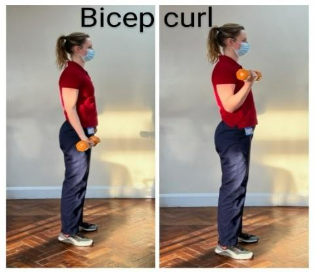
- Stand holding the dumbbells by your sides with a light grip and your core (tummy) muscles clenched (engaged)
- Bend your elbows to bring the dumbbells up to your shoulders, keeping your elbows close to your sides
- Slowly return to the starting position.
Single arm row
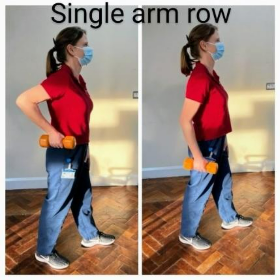
- Start with a weight in one hand and step forward with the opposite leg
- Keep your arm close to your side and bend your arm as shown in the picture
- Return to the starting position.
Heel raises

- Start with feet slightly apart. You can hold on to a chair for support and hold weights to progress.
- Raise your heels and go up on to your toes
- Return to the starting position
Upright row
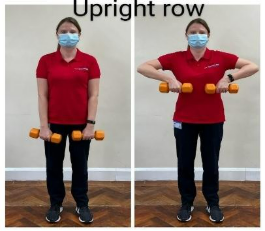
- Stand with your feet shoulder width apart. Engage your core muscles and hold the weights in front of you
- Keep the weights close to your body and lift them straight up (towards your chin) to chest height
- Return to the starting position.
Squat
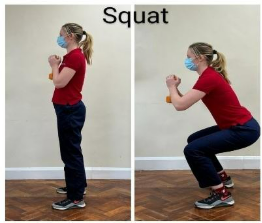
- Start with feet hip width apart with your core muscles engaged. If using a weight hold it with both hands under your collar bone
- Bend your knees and lower your body down as if to sit in a chair. Only go as far as you can comfortably.
Chest press
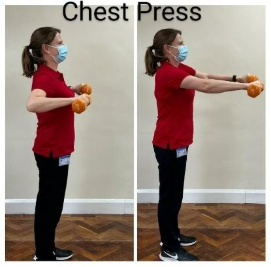
- Shoulder width apart and your core muscles engaged
- Raise your elbows so they are out to the sides just below shoulder height, straighten your arms forward
- Bend your arms and return to the starting position.
Side lunge
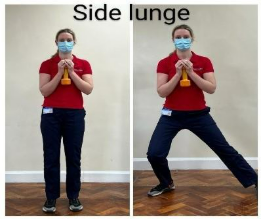
- Stand with your feet hip distance apart with your core muscles engaged. If using a weight, hold it with both hands under your collar bone
- Step your right foot about 2 feet (just over half a metre) to the right. Bend your right knee and lower your hips in a squat position. Keep your left leg straight.
- Press through your right foot and return to the starting position
- Repeat on the other side.
What 10 rules can I follow that will help me to make my exercise programme a success?
- Choose activities that are right for you and that you enjoy and stick with them
- Build up the amount of time and effort you put into exercising slowly
- Restart exercising slowly after any break (because of illness or holidays for example and build up
- Always warm up and cool down
- Do not exercise if you feel unwell
- Stop at once if you feel unwell during exercise or have chest pain or discomfort, dizziness, breathlessness that prevents you from speaking comfortably, or a pounding or irregular heartbeat
- You should be able to talk while exercising. This shows that you’re working at a safe level.
- Wear comfortable clothing and supportive shoes
- Avoid exercise soon after food, alcohol, or smoking. Wait at least 1 hour after a light meal or 2 hours after a heavy meal.
- Ask for advice from your rehab team or a healthcare professional if you are unsure about your exercise plan or how you feel during activity.
Exercise record
Please go to the top of this leaflet to print out the PDF for exercise records.
Exercise diary
Do make a habit of exercising at least 5 times per week.
Use a diary to help you build a habit.
Record what exercise you are doing on this diary chart if it helps you to keep track.
You should record:
- Date
- Type of exercise (walking, cycle, circuit)
- Duration (minutes)
- How hard it felt (Borg 6 to 20)
- Steps (if you track them)
- Symptoms or comments (for example, “felt fine”)
Here is an example showing how to fill in a line in your exercise diary:

Your exercise diary
Please go to the top of this leaflet to print out the PDF for exercise diary.
You can use the section (please go to the top of this leaflet to print out the PDF) to write notes about things such as questions you have, follow up appointments or things you want to tell your Dr. or rehab team.
Your risk factor record – Please go to the top of this leaflet to print out the PDF for your risk factor record.
Keeping active after the course
Why is it important for me to keep exercising after I have finished my exercise programme with the rehab team?
You cannot ‘store’ fitness. If you stop, you lose the gains you made. Do make regular exercise part of your life. Start your own routine that is right for you and that you will enjoy and stick with as soon as the programme ends so you do not lose momentum.
Be aware,
with any new activities, build up slowly based on how you feel. Do warm up before and cool down after your session.
If you’re unsure whether an activity is right for you, please ask your rehab team for advice.
What should I do before I start any new exercise classes?
Do
- Talk with the instructor. They may not have had someone with a heart condition in their class before.
- Let them know what exercise you have done so far.
- Ask to watch a class so that you can see what it involves and decide if it is right for you.
- Choose exercises that you know will push you the right amount. Base this on what you have done and learned on your rehab course with us.
What options can help me stay active?
Cardiac Rehab Support West Sussex (CRSWS) run social events and help to fund special low-rates for exercise classes. CRSWS (Charity No.1154903)

- Local exercise classes:
- are run in the community by cardiac trained instructors
- are offered at a special low-cost.
- are like the sessions you did on your rehab programme. This can make them feel safe and familiar for you.
- allow you to exercise in a class rather than alone. Many people enjoy the social aspect of exercising with other people who have similar goals.
- Gyms or leisure centres:
- may be easier for you to get to
- allow you to exercise at times that suit you.
- offer a range of sports and activities and equipment for you to use
- have fitness instructors to help you get started
- may not run many special cardiac sessions
- can be expensive but we may be able to refer you for a discounted 12 week. Please ask your rehab team for details.
Joining a local class or gym can be a great way to stay motivated, stay active, and stay connected. The cardiac rehab team can support you with this and refer you.
- Dancing: A fun way to be active, socialize, and meet people.
- Swimming or water exercise: For confident swimmers, swimming is great exercise. Others find water-based exercise such as aqua aerobics is right for them. This is easier on your joints but still great exercise.
- Walking:
- Try to build walking into your daily life. For example, walk rather than using the car when you can for all or part of your journey.
- Aim for a brisk pace
- Join a local walking group if you would like to walk with others
- Use an app or step counter to help you keep track of your activity if you find them useful.
- Cycling: A great way to exercise for almost everyone. Cycling lets you travel, get out and about in the countryside, spend active time with family or friends and keep fit.
- BHF home exercise: We can give you a DVD or online BHF links if you need them. Talk with the team.
Who should I contact if I have any questions or concerns, would like further information, or need to change or cancel an appointment?
Contact the cardiac rehab team. Though we may see you at other places, you can only contact us directly through our main base at Southlands Hospital:
Phone: 01273 446019
If no one can take your call, please leave a message and we will respond as soon as possible.
A final reminder:
- Build up slowly
- Listen to your body
- Stop if something feels wrong
- Ask for help when you need it .You are not alone. We are here to support you.
Use the space below to write notes. For example, you may want to write down questions that you have for the rehab team or your doctor or details of your follow-up appointments:
This leaflet is intended for patients receiving care in Worthing and Southlands Hospital.
The information in this leaflet is for guidance purposes only and is in no way intended to replace professional clinical advice by a qualified practitioner.
Today’s research is tomorrow’s treatments. That’s why UHSx is proud to be a research-active Trust. Find out how you can get involved.
Visit our website www.uhsussex.nhs.uk/research-and-innovation/information-for-patients-and-public or scan the QR code: 