
Download and print as a PDF (541kB pdf)
Information for patients
What is this information about?
This information is about an operation (surgery) used to repair (reattach) your ‘distal bicep tendon’.
It explains:
- what the distal biceps tendon is and how it can get damaged and detached from your forearm bone
- how we do the operation to repair your tendon
- what may happen if you do not have the operation
- the things that you should do soon after your operation that will help:
- your operation wound to heal well
- you to return to doing the things you did before your injury as far as possible.
- what exercises you can do to help heal and strengthen your arm
- what you need to know about returning to activities such as work, sports, and driving.
Why have I been given this information?
You have been given this information because you (or a relative or someone that you are a carer for) are due to have an operation to repair your distal biceps tendon.
Reading this information will help you to know what to expect from your operation and while you are recovering. Following the advice in this information can help to make sure that you recover as quickly and as well as possible.
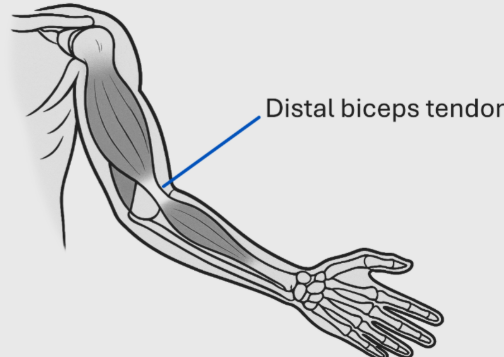
What is the distal biceps tendon?
Your biceps muscle is the large muscle in the front of your upper arm. You use it to bend your elbow and to twist your forearm so that the palm of your hand faces upwards.
Tendons are tough, flexible, bands of fibrous body tissue (like a rope) that connect muscles to bones.
The distal biceps tendon connects your biceps to your radius bone, which is in your forearm.
Why might I have got a distal tendon injury (rupture)?
A tendon rupture is a severe tear of the tendon. Sometimes this is a complete tear, so your tendon no longer connects your muscle to your bone at all. Tendon ruptures can happen without any warning.
They can happen because of age-related changes that weaken the tendon over time.
Distal biceps tendon ruptures most often happen when you are lifting something heavy.
Why do I need an operation to repair my tendon?
- Your tendon will not reattach to the bone without an operation.
- Having the operation should help to reduce feelings of pain and cramping in your bicep muscle. These may not go entirely.
- After your operation you should get back up to 90% of your original strength. This depends on your age, how badly your tendon was damaged, and how soon after your injury you have your operation.
Be aware,
after your injury you will lose muscle bulk and strength on your injured side at first. This happens whether you have an operation to repair it or not.
You will recover your muscle strength and bulk if you follow a rehab (rehabilitation) programme that is right for your injury, such as the exercises shown further on in this information.
What happens during the operation?
The surgeon will reattach your distal biceps tendon to your forearm bone. They will make a small cut (incision) in your forearm over the place where your biceps should attach to the bone.
If the tendon has ‘shrunk away’(retracted) from its usual position the surgeon may need to make another cut higher up your arm so that they can find it.
Rehab exercise after your operation
What should I do to start my rehab on the first day after my operation?
After your operation you should do exercises to stop your elbow from getting stiff.
Do
- start gentle exercises to move your elbow on the first day after your operation if you have been told to by your physiotherapist.
Sometimes the elbow needs to be in a cast after surgery. It’s important to move the other parts of the arm that are not in the cast.
If a physiotherapist has not given you exercise advice on the day of your operation they will phone you the next working day to advise you.
What rehab appointments will I have and what other exercise should I do?
We will arrange physio (physiotherapy) outpatient appointments for you to:
- check how your recovery is going
- give you exercises that will help you to regain strength in your arm and prevent stiffness. These will change as you progress and are designed to be right for you and your lifestyle.
Be aware,
you will need to do regular exercise sessions at home for several months. This is so that you get as much benefit from your operation as you can.
Advice for straight after your operation and the next 2 weeks
What can I do to relieve any pain or discomfort caused by my operation?
It is usual:
- to feel some discomfort after your operation. This can be worse when you are exercising and after you exercise
- for your elbow to feel sore for many weeks. This can last longer if your condition was ‘chronic)’ (you had your injury for a long time before you had your operation).
If you have mild to moderate pain, try:
- Pain relief medicines. If you are in mild or moderate pain, take your usual pain killers or pain killers given to you by the hospital. Follow the dose instructions on the packet.
- Applying cold packs (if you are not wearing a cast). Apply a cold pack such as an ice pack or frozen peas wrapped in a damp towel to the sore area for around 15 to 20 minutes every few hours. This can provide short-term pain relief and reduce swelling.
Be aware,
to avoid getting an ‘ice burn’ the ice must never be in direct contact with your skin. Check your skin often. It is usual for it to go pink or red. If it goes purple, white, yellowy-grey or blisters remove the pack straight away. Skin colour changes to the affected area might be difficult to see and look different on brown and black skin.
If you are struggling with pain or have bleeding do speak to your GP practice or pharmacist.
When should my wound dressings be removed?
Do
- remove the outer ‘pressure dressing’ as advised in your discharge letter and as discussed with the nurse on the ward before you left hospital.
Do not
- remove or adjust the deeper dressings. The surgeon or GP practice nurse will remove these at the appointment that you will have with them. This will be around 10 to 14 days after your operation.
What should I do if I am worried about my wound?
Be aware,
if you are worried about your wound because:
– you have pain that is getting worse around your wound
– your wound is becoming redder (on white skin) or purple, violet, dark brown or grey (on black or brown skin)
– your wound feels hotter
– fluid is draining from your wound
or for any other reason that makes you think you may have a wound infection do seek urgent advice from your GP surgery.
If you are worried outside of staffed hours, please use the online NHS 111 service.
How should I wash?
Your physiotherapist or nurse may advise you of how to wash so that you avoid discomfort and protect your arm while it is healing. Your deeper dressings are splashproof but do keep your wound dry.
How soon after my operation can I drive, use machinery, and sign legal documents?
You should not use machinery or sign legal documents for 48 hours (2 days) after you have had an anaesthetic.
- Before you return to driving you must make sure that you:
- can use your vehicle controls safely
- are always in complete control of your car. This includes being able to do an emergency stop pain free. This may take 6 to 12 weeks.
- We advise that you do not drive for the first 6 weeks after your operation
- Your physiotherapists may give you more specific advice on when you can return to driving
- Always test your ability to drive in a safe place first
- Tell your insurance company about your operation.
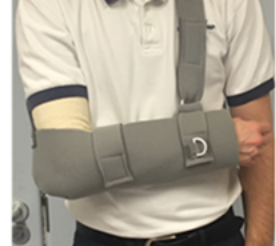
Will I need to wear an arm sling after my operation?
Yes. Your physiotherapist will advise you on how and when you should wear your sling. How long you should wear your sling for is different for different people.
For the first 2 weeks after your operation do wear your sling:
- at night (including when you are sleeping)
- during the day. You can remove it carefully to allow you to dress or wash or when you are sitting in a chair. Put it on again as soon as you have finished doing these things.
Do
- support your injured arm to begin with during the times when you have removed your sling. For example, use your other arm or a pillow.
During the weeks when you are wearing your sling:
Avoid:
- hard or forceful pushing, pulling, lifting or twisting elbow movements. Avoid these for at least 6 to 12 weeks as advised by your Physiotherapist.
Do not
- try to fully straighten your operated arm if you are not wearing your sling, or
- reach your arm behind you and away from your body for at least 2 weeks or until advised by your Physiotherapist.
When can I start to have periods of time during the day when I’m not wearing my sling (when can I wean from my sling)?
You can usually begin to stop wearing your sling during the day after around 2 weeks. This will depend on the operation that you had and how your arm is recovering.
Your surgeon may advise you to wear an elbow brace after they have checked how you are at your first follow up (clinic review) appointment. You will have this appointment around 2 to 6 weeks after your operation.
How long have I been advised by my physiotherapy or surgeon to wear my sling for?
Use the space below to write down how long you have been advised to wear your sling for:
Please print the PDF for this
Is there a video that can explain more about my sling?
Yes. Scan the QR code below or click here visit to watch a video on You Tube.

Physiotherapy exercises
What exercises should I do to help me to prevent stiffness and regain movement in my arm?
Start doing up to 10 repeats of each of the exercises shown below as soon as possible. Do this 3 to 4 times every day. Make sure that you follow the instructions.
Your physiotherapist will ask you to do more of these, or different exercises, when you are ready to move on to them.
You may have some discomfort when you are doing the exercises and afterwards. This should get less after 1 to 2 hours.
Move your fingers and wrist often.
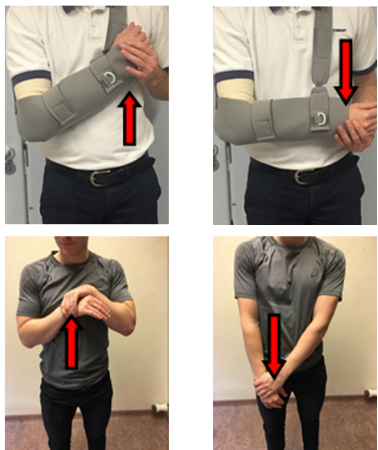
- Exercise 1
Wearing your sling at first, use your uninjured arm to gently help your operated arm to bend its elbow up towards your neck. Bend it up as far as comfort allows.
Move on to doing this exercise without wearing your sling. Gently try to get your elbow to straighten as fully as any pain you are feeling allows. Do not force this movement in the first 2 weeks.
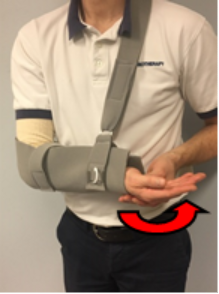
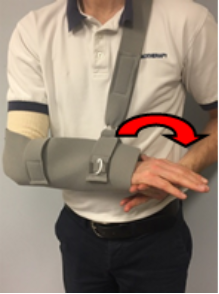
Exercise 2
Wearing your sling, gently (as pain allows) use your uninjured arm to help your operated arm to turn your forearm so that your palm is facing up. Hold it like this for 2 to 3 seconds then move your forearm so that your palm is facing down. Do not force your arm into these positions.
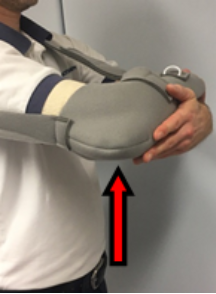
Exercise 3
Wearing your sling, use your uninured arm to help lift your operated arm gently in the air and move it forwards and upwards. Only do this so far as comfort allows.
Recovery and returning to activities
How soon may I be able to return to work and activities such as sports?
For a few months after your operation:
- your arm is likely to ache after you have used it
- your operation cuts are likely to feel tender.
With support most people can return to their usual everyday activities (such as washing, dressing and eating) soon after their operation. These may be limited by having to wear a sling.
- Work. After around 4 to 6 weeks most people can do gentle activities. This includes returning to work that does not involve too much physical activity such as office work (sedentary work).
It is likely that you will need at least 3 months off work to recover if your job is more physical and involves:
- movements that you repeat a lot
- carrying heavy things.
Before you leave hospital, we will give you an ‘off work’ certificate to cover at least 6 weeks.
Be aware,
we cannot issue ‘off-work’ certificates to people who are self-employed. If you need a certificate for longer, please contact your GP.
- Sport and activities that take more physical effort. You can start these once:
- your elbow is feeling strong and no longer painful
- your muscles have recovered some strength.
This may take 12 weeks (3 months) or longer.
Do
- increase your level of activity slowly to see how your elbow copes.
It may take up to 6 months or more before it is safe and comfortable for you to return to activities such as:
- racquet sports. For example, tennis, squash or padel.
- contact sports. For example, rugby, martial arts, football or hockey.
We will give you further guidance about returning to activities. This may be from:
- your physiotherapist at around 2 to 3 weeks after your operation
- your surgeon at your outpatient clinic.
How soon after my operation might I be fully recovered?
It may take up to 18 months (a year and a half) for you to recover fully. For some people it will be sooner than this.
Where can I get further information or support if I need it after I have read this information?
Please phone the hospital switchboard and ask for the Orthopaedic Consultants’ secretary. Leave a message on their answer phone and they will contact you.
You will get further information from the physiotherapist that you see at home after you have left hospital.
This leaflet is intended for patients receiving care in Southlands, St Richard’s and Worthing.
The information in this leaflet is for guidance purposes only and is in no way intended to replace professional clinical advice by a qualified practitioner.
Today’s research is tomorrow’s treatments. That’s why UHSx is proud to be a research-active Trust. Find out how you can get involved.
Visit our website www.uhsussex.nhs.uk/research-and-innovation/information-for-patients-and-public or scan the QR code: 