
Download and print as a PDF (395kB pdf)
What is this information about?
This information is about looking after your distal radius fracture. This is a break to the wrist bone on the thumb side of the wrist. A fracture means the same as a broken bone.
It tells you:
- What exercises you can do to help your bone heal
- What signs to look for that may mean you need further help
- Who to contact if you need further help or support.
How long will my distal radius fracture take to heal?
This normally takes about 6 weeks to heal.
Will smoking slow down the healing process?
Yes. Smoking will slow down your healing. We would advise that you stop smoking while your fracture heals. Talk to your GP or go to www.smokefree.nhs.uk for more information.
Will I have any pain and swelling?
You may have wrist and hand pain and swelling for 3 to 6 months after your injury. Swelling is often worse at the end of the day.
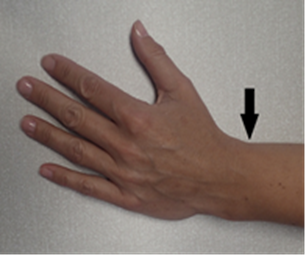
Taking pain medication and elevating (raising) your wrist will help. More information is on the next page.
Should I keep using my arm?
It is important to keep the fingers, thumb, elbow and shoulder moving to prevent stiffness (see below, Stage 1 exercises in the cast). It is important to start exercises as soon as possible. Instructions are further on in this information.
Will I have a follow up appointment?
The fracture in your wrist is stable and should heal well. You do not need a follow up. But if you are not feeling a little better in the next 2 weeks, please get in touch by email or phone.
Please also contact us if you develop significant ongoing pain over the back of your thumb at any point in the first 4 months after your injury.
If I am over 50, do I need a bone health check?
If your injury happened from a standing height or less (even if it was a hard fall) this may be a fragility fracture. This could be a sign of osteoporosis (weaker bones).
Please contact your GP for a discussion about having a bone health check or call us for more information. For more information go to www.theros.org.uk
When should I contact Virtual Fracture Clinic?
Please contact the Virtual Fracture Clinic if you:
- Are concerned about your symptoms
- Cannot follow this rehabilitation plan
How should I care for my injury? Week 0 to 2.
Managing your pain and swelling:
Elevate (raise) your wrist to reduce swelling for the first few days.
Keep your hand high above the level of the heart (see picture). If you go out, you may wish to continue to use the sling.
Exercises: stage 1
Do these exercises 3-4 times a day. Start straight away, working within your pain levels.
Finger exercises:
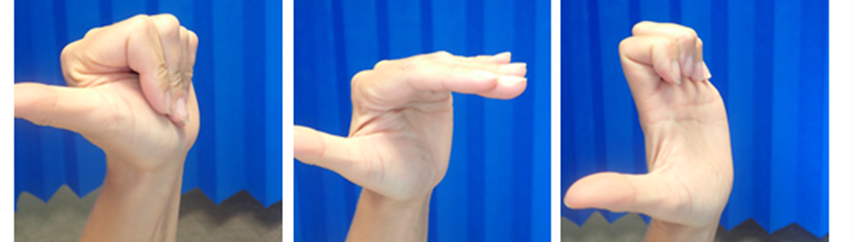
Keep your fingers moving whilst you are in the splint.
Elbow bend to straighten:
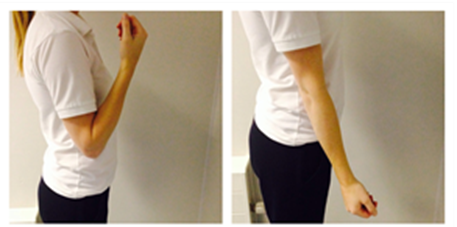
Bend and straighten your elbow as far as you can without pain.
Forearm twists:
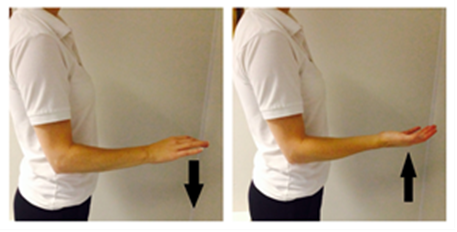
Begin this exercise with your elbow at your side and bent to 90 degrees.
Slowly turn your palm up to the ceiling and down to the floor as far as you can go without pain.
You should not feel more than a mild to moderate stretch.
You can use your other arm to assist if necessary.
Repeat 10 – 15 times if there is no increase in pain.
How should I care for my injury? After week 2.
You can start to wean out of the splint from 2 weeks after your injury unless advised differently on the phone. From 2 weeks you can start to use your arm for simple tasks, but you should avoid sport or anything heavy for a minimum of 6 weeks.
Only do these exercises and move your wrist as far as is comfortable.
Exercises: stage 2 (from 2 weeks)
Finger and wrist flexion and extension
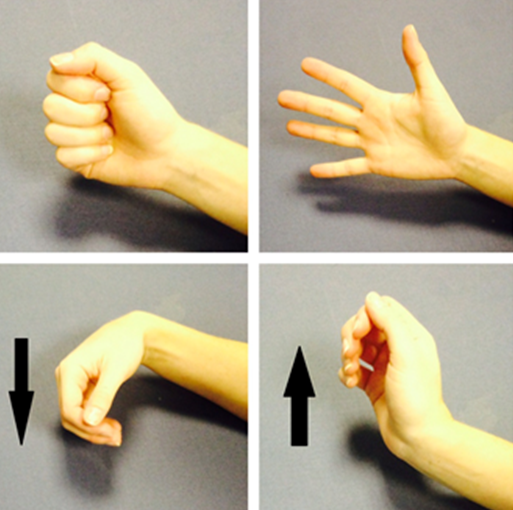
Open and close your hand as shown. Repeat10-15 times.
Then move your wrist up and down. Repeat 10-15 times.
After a few days, hold a soft ball / ball of socks.
Squeeze the ball as hard as possible without pain.
Hold for 5 seconds and repeat 10 times.
Be guided by your pain on how much you push your exercises.
What should I do if I am still having problems?
Contact the Virtual Fracture Clinic if you are struggling to get your movement back or return to activity.
My splint does not support my wrist enough. What do I do?
If you are still in a lot of pain when wearing the splint, we can bring you in for a cast which may make it more comfortable. You will need to contact the Virtual Fracture Clinic team to discuss this.
Can I remove my splint to wash?
Yes, it is safe to remove your splint to wash. As you have a stable fracture, the splint is more for comfort and does not affect the healing of the bone.
My symptoms have changed. What do I do?
If you have any of these symptoms, please get in touch:
- Increasing joint pain
- Increasing swelling with difficulty to bend the fingers/thumb
- Hypersensitivity to touching the skin
- Shiny/red skin
- Increased hair growth on skin
- A sensation of the hand not belonging to you.
When can I start driving?
You can return to driving when:
- You are no longer in a cast
- You can perform an emergency stop pain free.
Always test your ability to drive in a safe environment first.
How can I get a note for work?
Please contact the Virtual Fracture Clinic.
How do I contact the Virtual Fracture Clinic?


This leaflet is intended for patients receiving care in Worthing and St Richard’s.
The information in this leaflet is for guidance purposes only and is in no way intended to replace professional clinical advice by a qualified practitioner.
Today’s research is tomorrow’s treatments. That’s why UHSx is proud to be a research-active Trust. Find out how you can get involved.
Visit our website www.uhsussex.nhs.uk/research-and-innovation/information-for-patients-and-public or scan the QR code: 