
Download and print as a PDF (296kB pdf)
What is this information about?
This information is about making a decision about eating and drinking if you cannot swallow safely. It contains information on potential decisions and the process for people who have an unsafe swallow. It covers the following topics:
- Potential risks of eating and drinking with an unsafe swallow.
- How a Speech and Language Therapist can help you.
- Potential options and choices for someone with an unsafe swallow.
- What happens if you are not able to make this decision.
Why have I been given this information?
You have been given this information because you have dysphagia (swallowing difficulty) and may need to make decisions around your eating and drinking.
It is important that you understand what the risks are if you choose to keep eating and drinking despite having an unsafe swallow.
It is important to make sure that your decision is shared with people who may look after you (like GP, doctors, carers etc.).
What is dysphagia?
Dysphagia is the medical term for a swallowing difficulty.
It can be caused by a variety of conditions. These can include:
- Stroke
- Brain injury
- The normal aging process
- Respiratory conditions
- Neurological conditions
Dysphagia can increase the risk of food or fluid entering the lungs (aspiration). Aspiration can lead to the development of a chest infection (aspiration pneumonia).
Dysphagia also has other risks such as malnutrition, dehydration and impact on quality of life.
What else can increase the risks of developing an aspiration pneumonia?
- Poor oral hygiene.
- Needing other people to help you to eat and drink.
- Poor posture when eating and drinking.
What does a speech and language therapist do?
A speech and language therapist (SALT) has specialist skills to assess and manage dysphagia. They can suggest ways to help reduce the risks of aspiration pneumonia for people with dysphagia.
These can include:
- Changing the texture of your food or drink
- Strategies and techniques to help reduce risks and maximise comfort
- Advice about eating and drinking
- Help, support and training for people looking after individuals with dysphagia
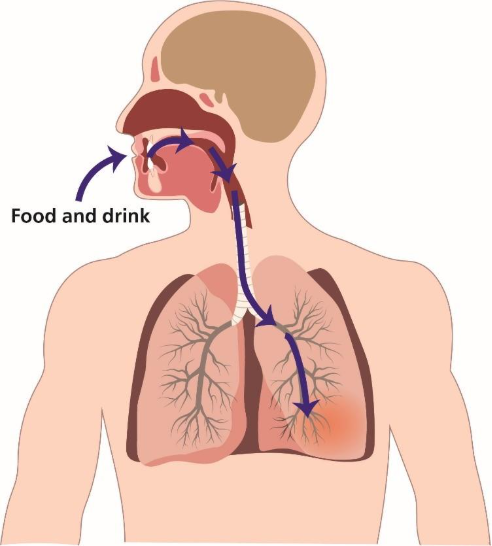
What is eating and drinking with acknowledged risks (EDAR)?
For some people, even if they get help from a Speech and Language Therapist, their swallow is still unsafe for any food or drink taken through the mouth (orally).
In this circumstance people may decide to continue eating and drinking orally and accept the potential risks. This is known as eating and drinking with acknowledged risks (EDAR).
The risks can include:
- Aspiration (when something you swallow enters your airway or lungs)
- Malnutrition (when you do not get enough nutrients in your diet)
- Dehydration (when you do not have enough fluid)
- Choking (obstruction of the airway)
- Death
The medical team will discuss this with you and plan for if or when these risks occur. These can involve decisions on the following:
- Future antibiotic use
- IV fluids
- Admissions to hospital or ICU (Intensive care unit)
- Consideration of end-of-life care
What happens if someone with dysphagia does not want to eat and drink with acknowledged risk?
If a person with dysphagia does not wish to eat and drink with acknowledged risks (EDAR) another option may be to have non-oral nutrition or hydration (food or drink).
This would involve a narrow plastic tube being inserted into their stomach. Food and fluid are the passed through the tube into the stomach. The most common tubes are:
- PEG (percutaneous endoscopic gastrostomy).
- RIG (radiologically inserted gastrostomy).
Important points
- The medical team decide if this would be appropriate for the individual.
- The tubes are inserted by the gastroenterology team. They will discuss which tube is most appropriate for the individual.
- Dietitians will support each person and their carers or family to use the tube.
What about eating and drinking for pleasure?
People with non-oral nutrition or hydration sometimes continue to have small amounts of food or drink for pleasure with a level of accepted risk.
What if someone cannot make their own decision?
Sometimes there are reasons to doubt someone’s mental capacity to make their own decisions. This can be for various reasons, such as:
- Communication difficulties
- Cognitive (thinking) difficulties
- Memory difficulties.
To have mental capacity an individual must be able to:
- Understand the information
- Retain the information
- Balance and weigh the information
- Communicate a decision.
What is a mental capacity assessment (MCA)?
This assessment is completed by professionals to look at a specific decision. For example, whether someone wants to eat and drink with acknowledged risks (EDAR) rather than having a feeding tube inserted.
During this assessment, information should be presented to maximise a person’s ability to engage in the assessment (this is a legal requirement as per The Mental Capacity Act 2015). This means that the information should be given to the person in a way that they can best understand.
What happens of someone does not have the capacity to make a decision?
If the person is deemed not to have capacity, then a best interest decision is made.
A best interest decision can involve the following people:
- The person with an unsafe swallow (if appropriate)
- Their family or next of kin (NOK) or carers.
- Independent mental capacity advocate (IMCA), if someone does not have family or a NOK.
- Medical team
- Healthcare Power of Attorney (if there is one)
- Speech and Language Therapist (SALT)
- Dietitian
- Social worker
Contact details
Speech and Language Therapy
 Royal Sussex County Hospital
01273 696955
Royal Sussex County Hospital
01273 696955
Acute inpatients
Ext. 64891
Neuro/Trauma
Ext. 64931
Stroke
Ext. 64590
Head and Neck
Ext. 67211
Voice/ENT
Ext. 64804
Princess Royal Hospital
01444 441881
Acute inpatients
Ext. 68057
Voice/ENT
Ext. 68057
Sussex Rehab Centre
Ext. 65770
Worthing Hospital
01903 205111
Acute inpatients/stroke
Ext. 85582
The information in this leaflet is for guidance purposes only and is in no way intended to replace professional clinical advice by a qualified practitioner.
Today’s research is tomorrow’s treatments. That’s why UHSx is proud to be a research-active Trust. Find out how you can get involved.
Visit our website www.uhsussex.nhs.uk/research-and-innovation/information-for-patients-and-public or scan the QR code: 