
Download and print as a PDF (311kB pdf)
Information for patients and carers
(IDDSI level 6)
What is this information about?
This information is about having a ‘soft and bite-sized diet’. It explains:
- what dysphagia is
- why you may need a soft and bite-sized diet if you have dysphagia
- what your soft and bite-sized diet food should be like.
It also gives you some ideas for soft and bite-sized diet foods that you can try for breakfast, your main meals, desserts and snacks.
Why have I been given this information?
You (or your relative or carer) have been given this information because your Speech and Language Therapist (SLT) has assessed how well you are able to swallow.
They have found that you have dysphagia (difficulty swallowing in the usual way) and recommend that you have a soft and bite-sized diet.
Following the advice in this information will help you to:
- understand what your diet involves
- help you to avoid health conditions (some of which can be serious) that dysphagia can cause.
What is dysphagia?
If you have dysphagia, it means that it is more difficult than usual for you to swallow.
People may get dysphagia because they have a medical condition or after they have had some types of operation which affect swallowing.
For example, they may have:
- a condition which affects their nervous system or brain (a neurological condition)
- a head or neck condition
- difficulty swallowing after an operation such as an operation on their neck, throat or mouth
- frailty because of old age or a medical condition
- breathing (respiratory) conditions.
Speech and Language Therapists (SLTs) check swallowing difficulties and advise people on the right thickness and ‘lumpiness’ (consistency) of food that they should have in their diet.
Why has my SLT advised me to have a soft and bite-sized diet?
Your SLT may recommend a soft and bite-sized diet for you if:
- it is difficult for you to chew larger pieces of food
- your mouth or throat muscles (or both) are weaker than usual and may not be working together as they should
- you get tired (fatigued) easily when eating
- food stays in your mouth or throat for longer than it should after you have finished eating. Doing things such as swallowing or coughing may not clear it.
- there is a chance that:
- you may choke on your food
- your food may go ‘down the wrong way’ (into your lungs). This is called aspiration.
What should my food be like if I am on a soft and bite-sized diet?
When you are on a soft and bite-sized diet your food should:
- be soft, tender, and moist all the way through
- have no separate thin liquid in it
- be in bite-sized pieces. These should be no bigger than 15mm (about the width of an adult thumbnail) across or high.
- need to be chewed before you can swallow it
- be soft enough that you can mash and break it down with a fork or spoon.
Is there an easy way to tell if the food in my soft and bite-sized diet meals is soft enough?
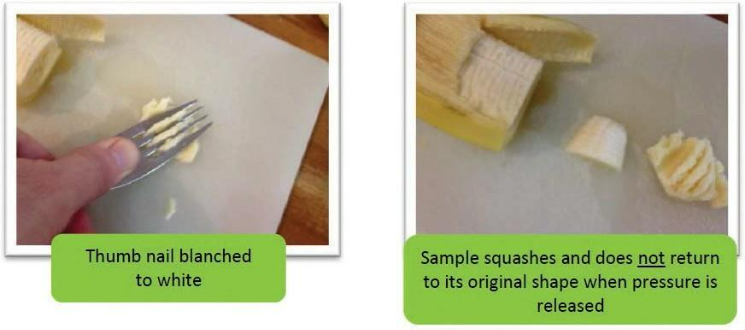
Yes. You can use the ‘fork test’.
Press down on your food with a fork, hard enough that your thumb-nail blanches to white. If the fork cuts your food easily, it is soft enough and safe for you to have.
What ideas for food can I try?
Be aware
all the foods below which say they should be diced must be cut into pieces no more than 15mm across and 15mm high. This is the ‘maximum particle size’.
For breakfast try:
- egg (scrambled, poached or boiled) diced to maximum particle size.
- soft fruits such as banana, ripe peaches, melon or nectarines diced to maximum particle size
- porridge, Ready Brek or instant oat cereal
- Weetabix (well soaked with no loose milk)
For your main meals try:
- well cooked soft pasta and thick sauce, diced to maximum particle size
- steamed, poached or baked fish in thick sauce, diced to maximum particle size
- plain, soft omelette or egg (see ‘Breakfast’), diced to maximum particle size
- minced or diced meat in thick sauce
- skinless sausages, diced to maximum particle size
- thick dahl
- potatoes and other vegetables:
- well boiled potatoes, diced to maximum particle size
- moist mashed potato or root vegetables
- inside of a jacket (baked) potato (skin removed) with a soft filling
- peeled, well-cooked vegetables diced to maximum particle size.
For desserts and snacks try:
- plain moist cake, diced to maximum particle size. You can add thick custard or cream
- steamed plain pudding, diced to maximum particle size. You can add custard or cream
- Soft tinned, fresh, or stewed fruit, diced to maximum particle size. You can add thick yoghurt, ice cream, cream or evaporated milk
- thick and creamy yoghurt or fromage frais
- Angel Delight
- mousse
- thick custard
- semolina, rice or other milk pudding
- smooth fruit fools
- thick smooth soup. You should only have soup of the ‘thickness’ that your SLT has advised is right for you. Please see the advice that they have given you.
- banana, diced to maximum particle size
- avocado, diced to maximum particle size
- smooth dips such as taramasalata or hummus.
Where can I find further information or support if I need it after I have read this information?
If you have any queries or would like further advice do contact the Speech and Language Therapy staff in the relevant department.
Royal Sussex County Hospital
 Royal Sussex County Hospital
01273 696955
Royal Sussex County Hospital
01273 696955
Acute Inpatients
Ext. 64891
Neurology and Trauma
Ext. 64931
Stroke
Ext. 64590
Head and Neck
Ext. 67211
Voice and ENT
Ext. 64804
Princess Royal Hospital
Princess Royal Hospital
01444 441881
Acute Inpatients
Ext. 68057
Sussex Rehabilitation Centre
Ext. 65770
St Richard’s Hospital, Chichester
St Richard’s Hospital
01243 831477
Acute Inpatients and Stroke
Ext. 35205
Donald Wilson NRC
Ext. 32205
The information in this leaflet is for guidance purposes only and is in no way intended to replace professional clinical advice by a qualified practitioner.
Today’s research is tomorrow’s treatments. That’s why UHSx is proud to be a research-active Trust. Find out how you can get involved.
Visit our website www.uhsussex.nhs.uk/research-and-innovation/information-for-patients-and-public or scan the QR code: 