
What is this information about?
This information is about common pain procedures that you may be offered to help you to manage your pain. They are given by injection. Which injection you are offered depends on the type of pain you have and where it is in your body.
They include:
- Facet joint medial branch nerve blocks.
- Sacroiliac joint injections/lateral branch nerve blocks.
- Epidural and nerve root blocks.
- Peripheral nerve blocks.
- Trigger point injections.
- Radiofrequency denervation treatment.
You will find information here about what to expect before, during and after a pain procedure, including possible side effects to be aware of.
Be aware
Some details here may be different to what actually happens. Your doctor will be able to explain fully what to expect.
Why have I been given this information?
You have been given this guide because it is important that you have all the information you need before you decide to have these injections.
If you do have these injections, reading this information will prepare you for the procedure and help you to recover safely at home.
Keep this information in a safe place, so that you can share it with anyone living with you or looking after you.
What do these injections do?
Injections are used to:
- Identify the source of the pain.
- Relieve (reduce) pain.
- Reduce inflammation.
- Support rehabilitation.
Different injections work in different ways:
- Steroid injections reduce inflammation and swelling.
- Nerve blocks interrupt pain signals from specific nerves.
- Trigger point injections help myofascial pain by relaxing tight muscle knots.
- Radiofrequency ablation is not an injection but applies heat to stop pain-carrying nerves from working.
By reducing pain temporarily, injections can:
- Improve mobility (moving around).
- Help you to take part in physiotherapy.
- Give you increased confidence in movement.
- Reduce reliance on oral medications, especially opioids.
Is this the right treatment for me?
The decision on whether to go ahead with the injection(s) is a shared decision between you and your doctor.
You can talk about your treatment options with your doctor. This will help you decide if you want to go ahead with the injections.
Your doctor will be able to give you up-to-date information about:
- How likely it is that this treatment will be successful.
- How this treatment fits into the other care that you are getting.
If you are still not sure whether to have the injections, you can ask for more information and advice. Please speak to your doctor.
Be aware
Any injection treatment should be combined with active treatments like physiotherapy, exercise, or CBT, not used on their own.
Injections are very unlikely to provide permanent solutions. As well as this, they work only for peripherally based pain and so do not work for all pain types.
This is especially true for neuroplastic pain, which often needs education and psychological therapies. Neuroplastic pain is common in chronic pain conditions.
Injection treatments are not always effective and may not help your pain. This is very common.
Should I let my doctor know if my health has changed?
Yes. It is important to let your doctor know:
- If you have an infection in your body or on the skin where the injection is to take place. If you do, your doctor will postpone (delay) the treatment until the infection is cleared.
- If you have been started on anticoagulant or antiplatelet medicines (sometimes called blood thinners) such as warfarin, heparin or clopidogrel. This may mean that you need to prepare for your injections in a different way. For some injections, this medicine will need to be stopped. You will be given help with this from your doctor and at your pre-assessment visit.
- If you have diabetes. Steroids are sometimes used during injections. This may cause your blood sugar to change. This means that your diabetic medication may need monitoring or changing.
- If you have any allergies.
You must also tell the doctor if there is any chance that you could be pregnant.
If you are planning to travel abroad or fly within two weeks after the injections, please let your doctor know as it may be best to change the date of the injections.
Is there anything I need to consider before the procedure?
- Please bring your glasses if you need them for reading.
- Always bring a list of all current medication.
- Continue to take your medication as usual on the treatment day, expect for those medications you have been told to stop, such as blood thinners.
Can I drive home after I have these injections?
No. Make sure that you have made arrangements for someone to collect you. It is unsafe for you to drive home. If you do, your motor insurance will be invalid.
Be aware
If you do not have someone to drive you home, your injections could be cancelled.
I have heard that steroids are being used unlicensed or off-label. What does this mean?
Steroids (corticosteroids) are commonly used to manage chronic (ongoing) pain. They are licensed to be used only in a specific way, for example, orally (swallowed), and they may not be licensed for use in any other way.
If they are used another way (for example, injected), this is called off-label use.
Many medicines used in pain medicine are used off-label. Steroids have been injected in pain medicine for a long time and are safe if used according to expert recommendations. However, as with any treatment there are risks and your doctor will be able to discuss this with you further.
What will happen to me during the procedure?
Before the injection, your doctor will discuss the procedure with you.
It is important that the doctor knows that you understand what is going to happen and agree to it (give your consent). They will either ask for your consent now or confirm that you gave your consent before.
The treatment will take place in a special area and you will be looked after by trained staff. An X-ray or ultrasound machine will be used to make sure that the injection is as accurate as possible.
Not all doctors do these injections in exactly the same way, but the following usually happens:
You will be prepared for the procedure.
- You may have your blood pressure and pulse rate taken.
- You will be carefully positioned and the skin around the injection site(s) will be cleaned with an antiseptic solution or spray. This can feel very cold.
- The needle will be guided to the correct position with X-ray or ultrasound (this may not happen with trigger point injections).
- You will feel a stinging sensation as local anaesthetic is injected to numb the skin and surrounding tissues. Your doctor will warn you of this first.
- The doctor will direct the special needles to the painful area(s).
- For certain procedures the doctor may inject contrast (a solution that is visible under imaging such as X-Ray) to make sure that the needle is correctly positioned.
- You will have an injection of local anaesthetic. This could be with or without a steroid. You may feel pressure, tightness or a pushing sensation. If there is any severe discomfort, do let the doctor know. It is important to keep very still during this part of the treatment.
- If you are having radiofrequency treatment:
- The tip of the needle has electricity applied to it. This is to test if the needle is placed correctly next to the nerve that is going to be heated.
- You will be asked to say when you feel a tingling sensation. Some doctors use a different technique without this step.
- The doctor will then ask when you feel any muscle twitching, and if this is in your back, arm or leg. This is a test to make sure that the needle is not too close to important motor nerves. If it is, it will need to be repositioned.
- Once in the correct position, the needle tip will be heated to 80°C for 90 to 120 seconds.
Can I have a general anaesthetic (be put to sleep) or sedation when I have the procedure?
These injections do not need sedation or a general anaesthetic. It is normal to feel some mild discomfort, but a local anaesthetic is enough to make you feel comfortable and have the injection in the safest way.
If you feel you would not manage your procedure under a local anaesthetic, please discuss this with your doctor.
What will happen to me after the procedure?
You will be taken to a recovery or ward area where nursing staff will observe you. Sometimes you will be asked to lie flat for about 30 minutes or longer. You may be helped to sit up and your blood pressure and pulse may be checked.
You will be advised when to get dressed. You will be helped to stand up so that the nursing staff know that you can do so safely.
When will I be able to go home from hospital?
You will usually be able to return home within a few hours after the injection and in some cases much sooner. This depends on how many injections are needed and how long your doctor or nurse want you to stay for recovery.
What should I do after my procedure?
If you can, you should arrange for someone to stay with you for 24 hours. If this cannot happen, make sure that you can access a telephone.
You should not drive, operate machinery, sign legal documents, provide childcare unsupervised or drink alcohol until fit to do so. This will vary from person to person, depending on the type of injection you have had and your response to it.
If in doubt, please discuss these issues with your doctor for further advice.
When can I return to work after the procedure?
This varies from person to person and may depend on what your work is. Please talk about this with your doctor.
Will I experience any side-effects?
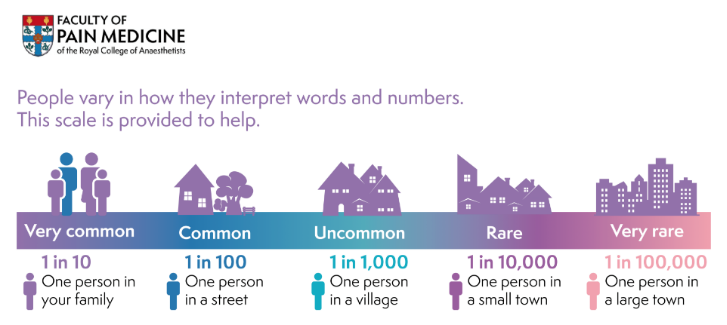
As with any procedure, side-effects may occur. However, these are usually minor and there is little risk of serious harm.
Side-effects may include:
- Mild local tenderness or bruising at the site of the injection. This usually settles over the first few days.
- Numbness or weakness in your arms or legs for neck or back injections. This is because of the local anaesthetic spreading, and it happens very rarely. The numbness or weakness is temporary, but can take some hours to go away.
What are the risks of these injections?
Risks may include:
- Worsening your pain. This can happen if pain is mainly neuroplastic. As well as this, procedures that damage or burn nerves, such are radiofrequency treatment, can cause deafferentation pain. This is a type of nerve-related pain that happens when the nerves that normally send signals to the brain are damaged or cut off, but the brain still tries to feel sensations from that area.
- Infection. This is rare. You should seek medical help if there is warmth or redness over the site of injection with tenderness or you feel hot and unwell. You may need antibiotics.
- There are important nerves in the spine, but serious nerve injury is very rare. It happens when there is serious bleeding or abscess near the spinal cord.
- Persistent (does not go away) weakness of the legs or incontinence (not being able to control when you pee or poo). You need to see a doctor straight away.
- Very rarely cervical injections have caused severe harm or even death. These complications are so rare it is difficult to say how often they happen with certainty. Your doctor will be able to give you more information about this before you have the procedure.
- Injury or collapse of the lung (pneumothorax) may happen after injections in the chest area only. This is very rare. If you get chest pain or breathlessness, you should seek immediate medical help.
- Intravascular injection. During the injection, you may experience signs of local anaesthetic toxicity if the injection is into a blood vessel. You should tell your doctor immediately if you develop tingling around your mouth or a metallic taste, ringing in your ears, feeling drunk, dizzy, blurred vision, muscle twitches or difficulty in breathing.
- With steroids:
- Fat necrosis of the skin (a potential risk of steroid injection close to the skin) may rarely result in skin dimpling.
- Skin discolouration (a potential risk of steroid injection close to the skin).
- In rare circumstances, steroid use can damage your eyesight. You should report any new problems with your eyesight (such as blurred or distorted vision) to your doctor.
- Steroids can increase your bloods sugars. This is especially important if you are diabetic. If you have poor diabetic control and your blood sugar is >12 on the day of the injection, it is likely the procedure will be postponed until you have had a diabetic review to control your blood sugars.
- Steroids can lower your immunity. This is important if you are already on immunosuppressives or on chemotherapy. You should also avoid vaccination 2 weeks before and 2 weeks after a steroid injection, as this could impact how well the vaccine works.
- With radiofrequency treatment:
- A prickling sunburn-like sensation over the skin of the back. This usually settles with time but may last a few months.
- With epidurals:
- Blood pressure may temporarily fall and rarely, people may occasionally feel faint.
- Headache. On rare occasions the epidural needle may be placed too far and spinal fluid (CSF) encountered. This is called a dural puncture and may lead to headache that requires further treatment. If you get a severe headache after your injection, take some Paracetamol, drink plenty of water and lie flat. If the headache continues for more than twenty-four hours, please contact your GP or Pain Clinic.
What can I expect in the days afterwards?
You may find your pain gets worse for a few weeks before it gets better. You may notice a feeling of numbness, heaviness or pins and needles. This is normal and will wear off.
Do
- Take your regular painkillers
- Try and move about the house, but do not do anything too strenuous.
- Keep the area of the injections dry for 24 hours following the procedure.
What should I do in the weeks after the injections?
As your pain gets less, you should try to gently increase your exercise. Simple activities like a daily walk, using an exercise bike or swimming on your back will help to improve your muscle tone.
It is best to increase your activities slowly. Try not to overdo things on a good day so that you end up paying for it with more pain the following day. Your doctor will give specific advice which may differ depending on which nerves are treated (for example, nerves in your back or neck).
Will I have any follow-up?
This depends on what you have had done.
A letter will usually be sent to your GP and your doctor will advise on what to expect after the procedure.
You may be asked to make a call to the pain department, be given a form to fill in, or given a telephone review or other appointment.
This leaflet is intended for patients receiving care in Southlands Hospital.
The information in this leaflet is for guidance purposes only and is in no way intended to replace professional clinical advice by a qualified practitioner.
Today’s research is tomorrow’s treatments. That’s why UHSx is proud to be a research-active Trust. Find out how you can get involved.
Visit our website www.uhsussex.nhs.uk/research-and-innovation/information-for-patients-and-public or scan the QR code: 