
Download and print as a PDF (269kB pdf)
What is this information about?
This information is about two eye conditions, convergence insufficiency and divergence weakness.
It describes what these two conditions are. It includes a step-by-step guide to exercises that you can do to help reduce the symptoms caused by these conditions.
Why have I been given this information?
Following the information here will help you to manage some of the symptoms that the convergence insufficiency or divergence weakness has caused, for example, headaches or double vision.
Keep this information in a safe place so that you can refer to it when you are exercising. This will help you to make sure that you are doing the exercises the right way.
To give the exercises the best chance of working, they need to be done the way that the orthoptist showed you, at the frequency the orthoptist recommended.
What is convergence insufficiency?
When you look at something close to your face your eyes need to converge (move inwards). If you have problems doing this, this is known as convergence insufficiency.
It is a common condition that affects people of all ages but often starts in childhood. The exact cause is unknown but may be related to eye muscle weakness or an imbalance in how the eyes work together.
What is divergence weakness?
When we look at something further away the eyes need to diverge (move outwards). If you have problems doing this, this is known as divergence weakness or divergence insufficiency.
The exact cause is unknown but can be related to changes in eye muscle tone.
What are the symptoms of convergence insufficiency and divergence weakness?
- Headaches (front of head or around eyes)
- Eye strain
- Blurred or double vision
- Difficulty changing focus from distance to near
Why have I been given these exercises to do?
The aim of the exercises is to improve how their eyes work together as a pair. This should help reduce the symptoms of eye strain, headaches or double vision.
These exercises will not cure your eye condition, but should help to improve your symptoms.
Pen Convergence
- Hold a target (like a pen) at arm’s length then slowly and smoothly bring the target towards your nose.
- Once the target appears double, hold it at that point and try to make it single again by blinking and focussing your eyes as much as possible.
- If you are able to maintain a single image at this point, continue with the exercise.
- If unable to maintain a single image, take the target back a little until it is single then try again.
- The aim is to try and get the target as close as possible to your nose.
Jump Convergence
- Bring a target (like a pen) as close as possible to your nose. Keep it clear and single and stop before it becomes double.
- Look at an object in the distance for a few seconds and then look back towards the pen, keeping it clear and single.
- Look at the far object again and bring the pen a little closer. Look back at the pen, trying to maintain a clear and single image.
- The aim is to try and get the target as close as possible to your nose.
Dot Card
- The dot card is held up to the tip of your nose and tilted downwards slightly. Start by looking at the dot which is furthest away.
- If this dot is clear and single, then look to the next dot towards you.
- As you look at each nearer dot you need to try and ensure this dot is clear and single.
- If you are unable to get the dot you are focussing on single, go back to the previous dot and try again.
- You will notice the dots in front of, or behind, the dot you are focussed on will appear double. This is normal. You should be able to see the below shapes as you focus on the dots:

- Sometimes the letters on the reverse of the dot card are recommended and this can help to improve focussing
Stereograms
There are a variety of stereogram cards available. Your card may have on it two cats, two buckets or two sets of interlocking rings.
Method for near stereograms (for convergence weakness):
- Hold the stereogram card at arm’s length with one hand
- Hold a pen halfway between your eyes and the card.
- Focus on the tip of the pen (ensuring the pen is a single image).
- When looking at the pen you will notice the images beginning to double.
- It may look like the below image:
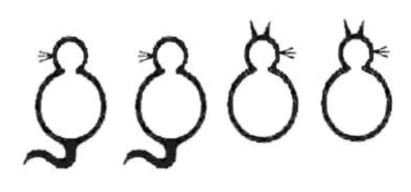
- Continuing to focus should result in the joining of the two images (shown below)
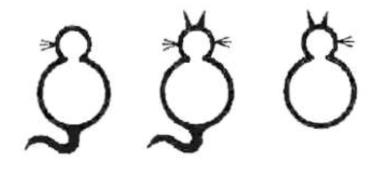
- The middle cat may initially look blurry, or features may disappear. With continued practice, this should become clear and all features are present.
Method for distance stereograms (for divergence weakness):
- Hold the stereogram card at arm’s length with one hand.
- Look in the distance.
- Imagine you are looking through the card, or you may cut the centre of the pictures out if needed.
- Move the card slowly towards you until the number of pictures increase, becoming double (this is normal and what we want to happen).
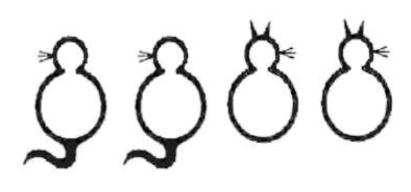
- Stop moving the card when the two centre pictures overlap.
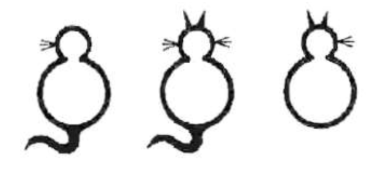
- Hold that position and concentrate on the card whilst continuing to look in the distance.
- Keep looking in the distance and make these pictures as clear as possible.
Buckets and Rings
The process for the buckets or rings is the same as the cats.
With the buckets, you should aim to see three buckets, and the middle one will look 3D.
- For convergence insufficiency exercises, it should feel as if you are looking into the bucket.
- For divergence weakness exercises, it should feel as if you are looking down onto the bottom of the bucket.
With the rings, you need to produce three sets of the rings.
- For convergence insufficiency exercises, the central set should have a 3D effect with the circle numbered 3 appearing behind the upper (number 1) and lower (number 2) rings.
- For divergence weakness exercises, the circle numbered 3 should appear in front of the upper (number 1) and lower (number 2) rings.
It is important with the rings to make the numbers in the centre of each ring very clear.
Will I strain my eyes by doing the exercises?
Not if you relax your eyes properly after each exercise. It is very important to relax your eyes after each exercise by looking into the distance or by closing your eyes for a few minutes.
Be aware
Your eyes may feel uncomfortable after the exercises, which is normal. Too much exercising and not enough relaxation may make the eyes feel even more uncomfortable.
Exercises prescribed:
_______________________________________________________________________________________________________________________________________________________________________________
How often to perform them:
_______________________________________________________________________________________________________________________________________________________________________________
Orthoptist’s name:
___________________________________
The exercises are only effective when carried out frequently. Please follow the directions given by your Orthoptist.
Who can I contact for further information and support?
 St Richard’s Hospital
01243 831499
St Richard’s Hospital
01243 831499

Southlands
01273 446077
Sussex Eye Hospital
01273 664872
Princess Royal Hospital
01444 441881
Ext. 68305
The information in this leaflet is for guidance purposes only and is in no way intended to replace professional clinical advice by a qualified practitioner.
Today’s research is tomorrow’s treatments. That’s why UHSx is proud to be a research-active Trust. Find out how you can get involved.
Visit our website www.uhsussex.nhs.uk/research-and-innovation/information-for-patients-and-public or scan the QR code: 