
Download and print as a PDF (268kB pdf)
What is this information about?
This information is about how to look after your scar after surgery or an injury. It tells you why a scar forms, what will happen to your scar over time, and how to protect and look after your scar.
Why have I been given this informtaion?
You have been given this information because you have, or will get, a scar. It is important to know what to do to look after your scar and keep your skin healthy.
Reading this information and sharing it with anyone living with you or looking after you, will help you to know what to expect. Keep it in a safe place so that you can refer to it when you need to.
Why do I have a scar?
Scars form as part of the body’s natural healing process after surgery, injury, or illness. When the skin is damaged, the body immediately begins repairing the area. As the wound closes, the body produces new collagen. Collagen is a strong, fibrous material that bridges the gap and strengthens the skin.
This newly formed collagen is organised in a different way to normal skin. Because of this, the repaired area often looks different from the surrounding skin. It forms a scar.
Why are my scars visible?
Mature (older) scars may show more if they are raised, indented, or if they are a different colour or texture to the rest of your skin.
Scars that cross wrinkles or natural lines on your skin will show more because they do not follow a natural pattern, so they do not look like a natural line.
Will my scar improve in appearance?
Over time, collagen that forms the scar is gradually remodelled (reshaped), and the scar becomes softer, flatter and paler. But it will never fully look like it did before the injury.
The location on the body, your age and skin type will affect the way a scar forms. Scars on older skin do not show so much. Scars on younger skin may over-heal, which means the scars may be larger and thicker.
The ways scars form and the way they mature is an ongoing process. Scars continue to grow and change as they recover. This may take up to eighteen months.
Why should I massage my scars?
Scar massage is a good way to reduce scar tissue build up and help make scars less noticeable.
Scar massage is one way of softening and flattening scars. It does several important things:
- Helps collagen to remodel (reshape) because of the pressure applied to the scar
- Helps to reduce itching
- Gives the scar moisture and flexibility
How do I massage my scars?
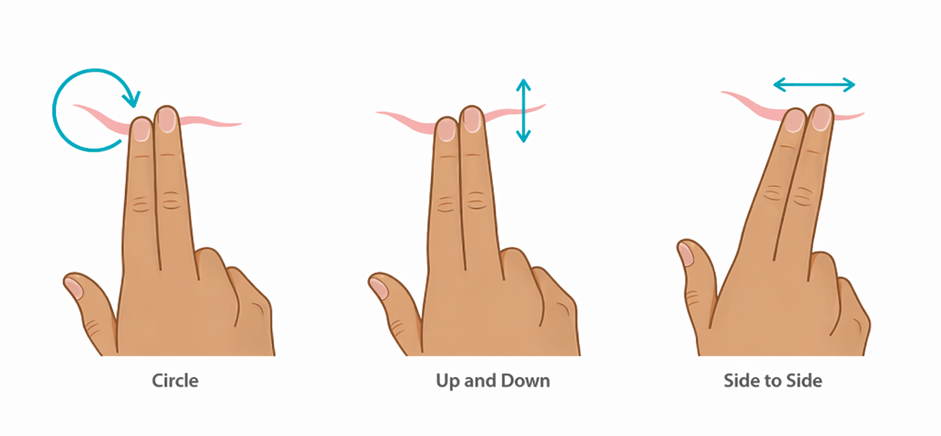
Use the pads or soft tips of your fingers to massage the scar and tissue around the scar. Massage in all three directions.
Circle
Using two fingers make small circles over the length of the scar and the skin surrounding it.
Vertical
Using two fingers massage the scar up-and-down.
Horizontal
Using two fingers massage the scar from side-to-side.
How much pressure should I apply?
You should apply as much pressure as you can tolerate. Begin with light pressure and progress to deeper and firmer pressure.
Massage lotion in, applying enough pressure to make the scar area lighten in colour or turn white.
How often should I massage my scar?
Massage should be done three times daily, for ten minutes each time.
We suggest you do this with your daily routine. For example, when you sit down to watch TV in the evening or straight after you brush your teeth.
How long should I massage my scar?
You should massage your scars as you have been told to do for at least six months after your surgery or injury.
Massaging for more than six months will not hurt your scars and may actually be helpful.
Are there any symptoms that mean I should stop massaging?
Stop massaging and contact your doctor if you experience any of the following:
- Redness
- Bleeding
- Scar feels warmer than the skin around it
- More pain than usual at the site of the scar
What else should I know about scars?
While your scars are healing, stay out of the sun.
Sun exposure may cause your scars to hyper-pigment (turn darker than the surrounding skin). Use suncream with an SPF of 30 or more and wear protective clothing at all times.
Keep your scars away from the sun for at least one year after your surgery. Scars do not have the same sun resistance as skin that has not been injured. Scars that burn because of sun exposure are likely to permanently darken and become more visible.
What lotion should I use?
- Use any moisturizing lotion that will keep your skin soft and supple.
- Do not use heavily perfumed lotions.
- Use lotion or cream that you have used before, and that agrees with your skin.
Who can I contact for further information and advice?
If you or your loved ones have any further concerns or queries, please do not hesitate to contact the plastic surgery team, Royal Sussex County Hospital. More information about the plastic surgery team can be found on our website.
For further information please contact us on the email below:

 Monday to Thursday
8:00 am to 4:30 pm
Monday to Thursday
8:00 am to 4:30 pm
Friday
8:00 am to 1:00 pm
The information in this leaflet is for guidance purposes only and is in no way intended to replace professional clinical advice by a qualified practitioner.
Today’s research is tomorrow’s treatments. That’s why UHSx is proud to be a research-active Trust. Find out how you can get involved.
Visit our website www.uhsussex.nhs.uk/research-and-innovation/information-for-patients-and-public or scan the QR code: 