
Dear Parents
Congratulations on your baby’s arrival. At UHSussex we are committed to supporting breastfeeding, and recognise that this is particularly important for sick and premature babies.
We will assist you to hand express your milk before, during or after labour and use a breast pump. Ideally, we would like your baby to have their first feed within 2 hours of birth.
It is perfectly normal to only get small amounts at first, and it may take a few days for your milk to come in. Any milk you can provide will be beneficial for your baby.
Whatever your long term feeding choice we do ask that while your baby is in the neonatal unit that you express your breast milk, as it is the only milk which helps to protect a premature baby’s delicate gut from developing a serious condition that can cause a baby to become very sick. It is also very important for term babies and will kick start a healthy gut microbiome.
Your milk will be given as medicine with every dose providing antibodies and goodness to help your baby get better, stay well, and thrive.
Babies learn to feed in their own time, but practice makes perfect.
Making milk for your baby
If your baby is not able to breastfeed yet, or if you are apart from your baby, it is important to start expressing your milk as soon as possible after birth.
Try to express your milk 8–12 times every 24 hours, including during the night.
Expressing at night between 1am and 5am is hormonally very important for milk production.
What if my baby is currently not having any milk or on very small amounts?
With a small baby, aim BIG! It’s important to look at the big picture and to pump as if baby would be at home with you. This is because the first few weeks are very important to build, increase and protect your supply for the long term.
Your body makes milk based on supply and demand. This means that the more often milk is removed from your breasts, the more milk your body is likely to make.
How much milk should I be making?
The amount of milk you produce can vary from person-to-person, and can differ depending on the time of day.
Once milk supply is established (around 2-3 weeks after birth), a common goal is to be producing 700–900 ml per day. If you’re not making this amount, don’t panic! Every drop counts! Make sure you check in regularly with your neonatal nurses and always ask if you are worried about your supply.
Don’t worry about the volumes of individual pump sessions. It’s the total daily output that matters. Compare daily totals to measure how your supply is increasing.
Should I be pumping every 3 hours?
Expressing should fit around your daily routine rather than becoming a fixed schedule. Varying the times you express mimics how your baby would feed at the breast and can help support your milk supply.
However, leave no longer than 5 hours between expressions at night, and no longer than 4 hours in the day. If you choose to have a 4–6-hour break between expressing sessions, you will need to express more often at other times of the day to reach the recommended number of expressions.
What if I have just given birth to multiples?
When you give birth to multiples, such as twins or triplets, your body can produce enough breastmilk to meet the needs of your babies. It may take time to build your milk supply, and you may need to express for longer or more often to help your body make enough milk.
How can I keep track of my expressing sessions?
We recommend keeping a log of your expressing times and your 24-hour volumes to discuss with your midwife/nurse each day. We can help troubleshoot problems quickly. You will find some pumping log pages at the back of this leaflet.
Example expressing routine:
- As soon as you wake up.
- After breakfast.
- After skin-to-skin cuddles with baby.
- After lunch.
- After an afternoon nap.
- After dinner.
- While relaxing in the evening.
- Before you go to bed.
- Once in the night between 1am and 5am.
Colostrum: Your Baby’s First Milk
What is colostrum?
The first milk your body makes is called colostrum. It is very special because it helps protect and nourish your baby.
Your body usually starts making colostrum from about 16 weeks of pregnancy. Therefore, if your baby is born early, you will still be able to produce colostrum. Please ask a member of staff if you would like help expressing it.
Colostrum is made in small amounts. Sometimes you may only see a few drops. Every drop of colostrum can make a difference to your baby’s health and development.
Why is colostrum so important for my baby?
Colostrum can:
- Help protect your baby from infections.
- Support your baby’s developing immune system (the body’s natural defence against illness).
- Coat and protect your baby’s stomach and intestines.
- Help keep your baby’s blood sugar at a healthy level.
- Provide important nutrients to support your baby’s brain, eyes and heart.
- Give your baby complete nutrition that is gentle and easy to digest.
When you have had your baby early, your body makes breastmilk that is specially designed to meet your baby’s needs. Compared with milk made for a full-term baby, it contains more protein, immune-boosting factors, and important minerals to help support your pre-term baby’s rapid growth and development.
What is the best way to collect colostrum for my baby?
Hand expressing is usually the best way to collect colostrum. Using a breast pump as well as hand expressing can help stimulate your breasts to make more colostrum and support your milk supply as it increases.
Hand expressing
Always wash your hands before collecting milk.
How do I hand express?
- Applying some warmth to the breast before expressing may help (hot flannels or a shower). Take your time, relax and think about your baby.
- Wash your hands before starting and then try some gentle breast massage and nipple rolling.
- Collect with 1ml oral syringes or a sterile container.
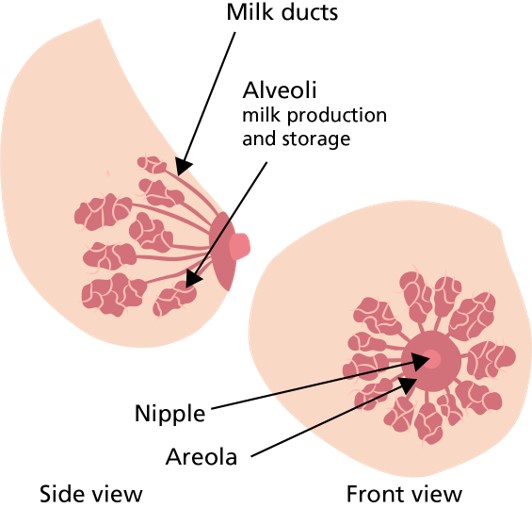
- Cup the breast using your thumb and index finger in a ‘C’ shape, about 2-3cms away from the base of the nipple. The location of your milk ducts varies in each woman, so your fingers may need to be further from/closer to the nipple.
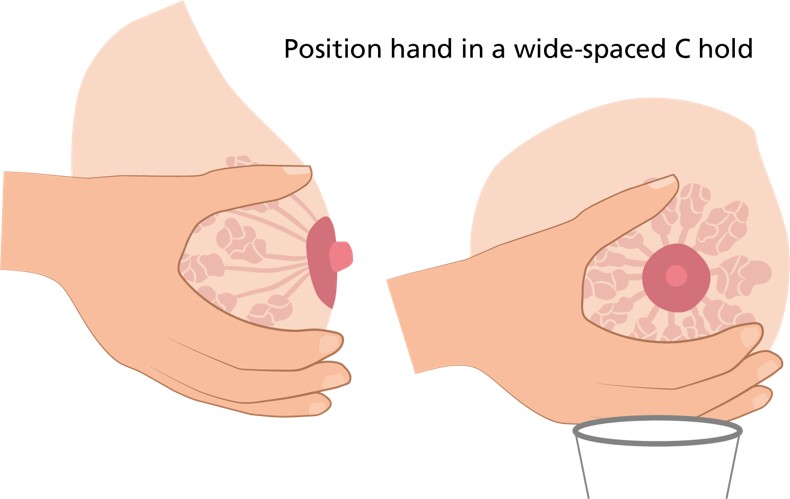
- Compress your finger and thumb together, this should not hurt. You may try gently pressing back towards your chest wall (whilst keeping the ‘C’ hold) first.
- Relax and repeat the action, developing a rhythm.
- Avoid sliding or dragging the skin or pinching the nipple.
- After a few minutes or after the flow of milk has stopped, rotate finger and thumb around to another position on the breast and express again.
- Once the flow of milk stops, move to the other breast and repeat above. Each breast should take around 5-10 minutes.
Watch the video below to learn more about hand expressing (skip to 02:19 for a demonstration of colostrum collecting):

Label your syringe with your name, the date and time that you expressed and give it to your nurse to be given directly to your baby. The neonatal unit will provide you with labels.
Thank you to Maidstone and Tunbridge Wells NHS Trust for allowing us to share their video.
Hand expressing is the most effective way to collect colostrum. However, combining hand expressing with using a breast pump after birth will stimulate and maximise your milk production.
Research supports using the pump after hand expressing as early as 2 hours after giving birth. Speak with your neonatal nurse or midwife about timing.
Using an electric breast pump
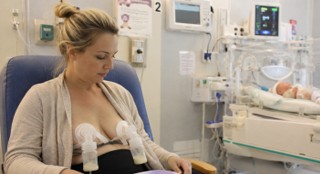
- Using a double electric breast pump can fire up your milk-making cells and maximises your long-term milk production.
- Expressing both breasts at the same time helps maximise your milk production. This is called ‘double pumping’
- You can use a nursing bra to hold the pump flanges in place or make your own “pump bra” to enable you to pump hands-free.
- Breast massage helps to stimulate your milk flow before pumping and ensures your breasts are well drained at the end of pumping.
- Research shows that ending a pumping session with hand expressing and/or doing breast compressions while pumping makes a significant difference in output and supply (up to 48% more milk!).
- Consider power pumping if your supply needs a boost, it mimics cluster feeding which is essential to increase supply. A common plan includes: Pump for 20 minutes, rest for 10 minutes, pump for 10 minutes, rest for 10 minutes, pump for 10 minutes. You may need to do this once or twice a day for 3-7 days in a row to see a change in milk supply.
Medela Symphony® pump instructions
- Use the gentle and stimulating INITIATE program from birth until your milk is ‘coming in’ as indicated by:
- Pumping 20ml or more from both breasts combined, during one pumping session
- If the milk has not ‘come in’ after 5 completed days, switch to the MAINTAIN program.
- The INITIATE program runs automatically for 15 minutes with stimulation, expression and pause phases. To get it started press the “Let-down” button within ten seconds of switching the pump on.
- Once your colostrum transitions to breast milk (or day 6 after birth even if your milk has not transitioned), use the MAINTAIN setting to drain your breast effectively.
- Set the maximum comfort vacuum. The drops on the display show the vacuum level. The more drops, the stronger the vacuum.
- In the MAINTAIN setting, the pump will automatically switch to the expression phase after two minutes. However, if the milk starts to flow sooner, press the Let-down button to change to the expression phase.
- Continue pumping until the breast feels well drained and soft all over (Medela recommends a pumping time of at least 15 minutes – if you are pumping for longer and finding your nipples are feeling sore, reduce the length of time spent pumping).
If using a different pump, always check the manufacturer instructions.
How do I choose the correct flange size?
The flange (sometimes called a breast shield) is the funnel-shaped part of the breast pump that fits over your nipple. Having the correct flange size is very important for both your comfort when expressing and for effective milk removal. A well-fitting flange can help maximise milk production and reduce discomfort.
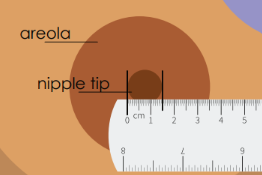
To determine the correct flange size, measure the width of the tip of your nipple only, not the base. Current evidence suggests that measuring the nipple tip provides a more accurate fit and can improve comfort and pumping effectiveness. Both your nipples should be measured as they may require different sizes.
Please note: Some manufacturers still recommend measuring the base of the nipple. However, more recent research indicates that this method does not provide the most optimal flange fit for many parents.

Breast massage techniques
- Gentle breast massage helps your milk to flow.
- Massage your breasts for a minute or so before expressing and then hand express a small amount of milk onto the nipple tip before applying the breast pump flange.
- Massage should feel comfortable, so remember to be gentle.
- The “dangle massage” technique involves using gravity to help prime your breasts. It is highly effective for triggering let-down, boosting milk output, and resolving stubborn clogs. It combines a forward-leaning stance with gentle massage, utilising the natural downward pull of gravity to move milk through the ducts. It can be useful to do this during expressing too.
- Massage during an expressing session is helpful at increasing your milk volumes and the fat content of your milk, as well as reducing time pumping. While pumping, use a combination of massage and breast compressions. A hands-free bra is helpful to allow both your hands to be available.
Different types of massage:
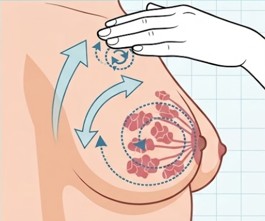
Gently massage in circular movements. Spiral inward towards the areola.
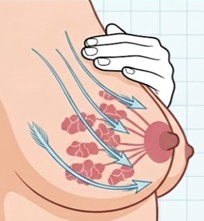
Lightly stroke from the chest wall towards the nipple.

Lean slightly forward. Gently massage and shake the breasts.
Kangaroo care
What is kangaroo care?
Kangaroo care is when you hold your baby skin-to-skin on your chest. It is a special way for you and your baby to spend time together while they are on the neonatal unit. Even though your baby is small and may need help from the neonatal team, your touch is still very important. Your baby knows your voice, your smell, and the feeling of being close to you.
Why is kangaroo care important?
Kangaroo care can help your baby by:
- keeping them warm and helping them feel safe and calm.
- helping their heart rate and breathing become more settled.
- supporting better sleep, growth and brain development.
- supporting breastfeeding and your milk supply.
Kangaroo care can also help you feel more connected with your baby and give you (and your partner) a special role in caring for them while they are in hospital.
When can I have kangaroo care with my baby?
The neonatal team will help you find the right time to start kangaroo care and make sure your baby is comfortable and safe. Even a short cuddle can be a positive experience for both you and your baby. However, there may be times when skin-to-skin cuddles are not possible. Your baby can still feel comforted by your gentle touch, ask a member of the neonatal team to show you how to give your baby a ‘hand hug’.
Every parent’s journey is different. If you have questions or feel unsure about holding your baby, please talk to your baby’s nurse, we are here to support you.

Progressing to suck feeds
If your baby is being tube fed, as they grow stronger and show signs of readiness, they will gradually progress to having feeds at the breast or bottle.
- Observe your baby for feeding cues. These may include stirring, turning their head to the side (rooting), sucking their hands or fingers.
- Learn how to give your baby milk by nasogastric tube while they are learning to feed responsively.
- Premature babies learn to feed first by ‘non-nutritive’ sucking on a dummy, finger or on a recently expressed breast. Express before skin-to-skin cuddles and let them explore from around 32-34 weeks, or when they are showing signs of readiness, this can be different for each baby.

To get ready for breastfeeding, watch this video demonstrating different breastfeeding positions and holds:

Safe storage of breastmilk on the neonatal unit
| Type of breastmilk | Storage time in fridge | Storage time in freezer |
| Fresh | 48 hours | 3 months |
| Frozen | If defrosted in the fridge – 24 hours once defrosted. If defrosted at room temperature, the breastmilk must be used straight away. | Same as above |
All breastmilk is stored in a designated lidded box inside locked fridges within the nurseries with the cot space number clearly displayed on the box.
All frozen breastmilk is stored in designated drawers in freezers, which are kept within a secure room. Each patient is allocated 2 drawers each – parents are asked to store some frozen milk at home where possible. Breastmilk can be taken home in a well-insulated cool bag with ice packs.
Please be aware, the storage of breastmilk on the neonatal unit may be different to on the postnatal ward and when you go home.
Scan the QR code below for information on how to store your breastmilk at home:

Pumping Log
Please print off the PDF version to fill in the form.
The information in this leaflet is for guidance purposes only and is in no way intended to replace professional clinical advice by a qualified practitioner.
Today’s research is tomorrow’s treatments. That’s why UHSx is proud to be a research-active Trust. Find out how you can get involved.
Visit our website www.uhsussex.nhs.uk/research-and-innovation/information-for-patients-and-public or scan the QR code: 