
Download and print as a PDF (218kB pdf)
What is this information about?
This information is about your child’s myopia, or short-sightedness. It explains what myopia is, what causes it, how it is treated, and what you can do to help your child.
It also explains what the treatment options are to slow down the rate that the myopia gets worse, although these are not available on the NHS.
Why have I been given this information?
You have been given this information because your child has been diagnosed with myopia.
You may have some questions and concerns about what this means for your child, and this information will give you more details to help you. You can share this with your child, and anyone else looking after them.
What is myopia?
Myopia is also known as near-sightedness or short-sightedness.
If you do not need glasses, the image you are looking at is focussed sharply on the retina at the back of the eye (picture A).
In a myopic eye the light is focussed at a point in front of the retina (Picture B). This means that the light that falls on the retina is blurred.

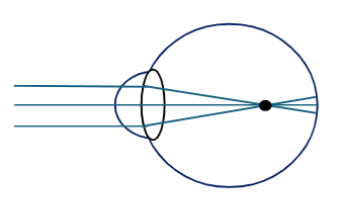
Glasses or contact lenses help to correct myopia by focusing the light on the retina.
If your child is myopic, it means they can see close objects easily, like reading a book or looking at a phone. Things at a distance, such as words on a whiteboard or on the TV, will look blurry.
What causes myopia?
Myopia can happen in any child, but several factors can make a child more likely to develop myopia. These factors include:
- family history
- ethnic background (especially East Asian or South Asian)
- environment (spending a lot of time indoors)
- spending a lot of time reading or doing work up close like using phones, tablets, laptop
- Some genetic conditions may mean a child is more likely to develop myopia.
What are the signs and symptoms?
If your child is myopic, they will have problems seeing things in the distance clearly without glasses or contact lenses. This means your child might have to move closer or squint (narrow their eyelids) to see further away objects clearly. But they will often be able to see things that are close to them.
Myopia can range from mild to severe. Your optometrist can detect it during a sight test.
It is less common for children to be myopic in the first years of life. It is typically only diagnosed in children from the age of 7 years old, although it can occur at any age.
How is myopia treated?
The blurred vision in myopia is usually easy to correct with standard glasses (or contact lenses or both).
Unless told otherwise by your health professional the glasses (or contact lenses) are to be worn all the time.
Wearing the correct glasses or contact lenses will not make the myopia worse.
Some adults with myopia may have laser surgery to correct the blurred vision. There are some treatments that may also slow down myopia during childhood. This is called myopia management. See below what can be done to slow down myopia progression.
Why can myopia get worse with time?
As your child matures, their eyes also grow. This natural process can make their short-sightedness get worse over time. When this happens, it is called myopia progression. Myopic children will probably wear glasses or contact lenses long-term.
What is wrong with myopia progression?
The higher your child’s prescription, the greater the risk there is of certain eye conditions when they are older. These conditions include glaucoma, cataracts, retinal detachment, and myopic macular degeneration.
What can I do to help my child?
Make sure that your child:
- wears their up-to-date spectacles and has regular sight tests
- spends at least 2 hours a day outside during daylight hours
- uses good natural lighting when reading or doing close work
- limits their time looking at screens
- take short breaks while doing reading or close work which can help with eye fatigue keeping the thought 20/20 in mind: 20 mins work, 20 seconds rest.
What can be done to slow down myopia progression?
There are no treatment options available on the NHS. Families can explore the following options either with their high street optician or in private practise.
These treatments do not cure or reduce myopia. They aim to slow down the rate at which it gets worse. When the eye stops growing, the myopia also stops progressing, therefore the treatments are only required during this period.
- Specialist glasses and contact lenses: these work by blurring the peripheral (side) vision and slowing eye growth while the central vision will stay clear.
- Rigid contact lenses worn overnight: This is also called orthokeratology. These lenses gently reshape the cornea (the transparent front part of the eye). They offer clear daytime vision without the need for glasses or contact lenses during the day.
- Atropine eye drops: these are low dose atropine eyedrops (most commonly 0.01% and 0.05%) which are used once a day at bedtime. They can help to slow down the rate at which your child’s short-sightedness progresses by temporarily relaxing the eye’s ability to focus.
Where can I look for further information and support?
For more information about short-sightedness, contact your local optician and visit websites such as:
Who can I contact for further information and support?
If you have any questions about your child’s short-sightedness, please call the orthoptic answerphone and a member of the team will aim to contact you as soon as possible.
 St Richard’s Hospital
01243 831499
St Richard’s Hospital
01243 831499

Southlands
01273 446077
Sussex Eye Hospital
01273 664872
Princess Royal Hospital
01444 441881
Ext. 68305
The information in this leaflet is for guidance purposes only and is in no way intended to replace professional clinical advice by a qualified practitioner.
Today’s research is tomorrow’s treatments. That’s why UHSx is proud to be a research-active Trust. Find out how you can get involved.
Visit our website www.uhsussex.nhs.uk/research-and-innovation/information-for-patients-and-public or scan the QR code: 