
Download and print as a PDF (380kB pdf)
What is this information about?
This information is about looking after yourself once you have had abdominal (tummy) surgery in Worthing or St Richard’s Hospital. It includes exercises to do and advice about getting back to your normal routine.
Why have I been given this information?
The aim of this information is to help you understand what you can do to support yourself when recovering from abdominal surgery.
What happens during abdominal surgery?
Abdominal surgery, also called a laparotomy, involves a large incision in your abdomen (tummy) to view the organs inside and repair any problems.
What complications might happen after this surgery, and what can I do to help prevent them?
Complications can happen after this type of procedure. These include:
- Pain.
- Infection.
- Blood clots.
- Difficulty taking a deep breath or coughing. This can lead to chest infections.
Research shows that after surgery, the earlier you get out of bed, start moving, eating and drinking, the quicker your recovery is, and your risk of complications will be lower.
What should I expect after surgery?
- You will be seen by someone from the pain team to make sure you have enough pain relief after your operation to control any pain.
- You will be encouraged to sit in a chair as soon as possible after your operation.
- You will be seen by a physiotherapist on the ward who will help you to start moving again, and teach you exercises to help with your breathing.
What exercises should I be doing after my surgery?
- Deep breathing exercises.
- Supported cough.
- Sitting out of bed the day after your surgery with help from a nurse or physiotherapist.
- Starting to walk early as possible with help from a nurse or physiotherapist.
- Bed and chair exercises.
You will find instructions about how to do these at the end of this information.
When can I get back to my usual activities?
- Walking
You should aim to get back to a routine which includes regular walking as soon as possible after surgery. Walking has been shown to improve wound healing and helps you to return to normal activities. Walking can help build your stamina and make your heart healthier.
A brisk 10-minute walk daily has lots of health benefits and will help you recover. It will also help with the fatigue (tiredness) you feel after your operation.
A little breathlessness while walking is normal. You should be able to walk and talk.
You can increase the distance and time of your walk as you feel able. Ideally build this up back to your normal (from before the operation) by a month. If you can, try to walk for 30 minutes 5 times a week.
- Lifting
It is important you do not lift anything heavy for at least six weeks from the date of your surgery to allow the laparotomy incision (wound on your tummy) to heal.
You should avoid any heavy lifting such as hoovering or lifting a large bag of groceries.
When lifting try not to bend from the waist. Instead, bend your knees, keep your back straight and your arms close to your body.
- Work
Most people return to work within 6 to 8 weeks of surgery. However, if your job requires heavy lifting then this can be longer, roughly 12 weeks.
- Driving
There is no legal guidance around how long you should wait until you return to driving after abdominal surgery. However, it is recommended to wait 4 to 6 weeks after surgery.
You must be able to carry out an emergency stop without hesitation, be able to wear a seatbelt, and look over your shoulder comfortably.
- Sex
There is no set guidance for when it is safe to return to sex. However, we recommend that you treat it like any other physical activity and build up gradually.
Think about positions that put less strain on your tummy.
- Exercise
To avoid complications such as a hernia, you should wait to return to some activities.
Please see below for examples of some exercises that you can return to after 6 and 12 weeks:
- 6 weeks: Jogging, light gardening (like watering or weeding), swimming, cycling (although you can return to cycling on a static bike before this).
- 12 weeks: Football, netball, heavy gardening.
What exercises should I do?
Deep breathing exercises and supported cough
After your operation it is important for you to complete breathing exercises sitting in an upright position in bed or in a chair. This will help you to get air to the bottom of your lungs and prevent mucus from building up.
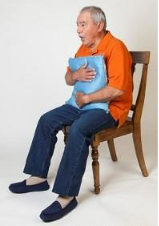
- Take a deep breath in through your nose, with a towel or pillow pressed against the painful area.
- Hold your breath for 3 seconds.
- Slowly breathe it out through your mouth.
- Repeat 3 to 4 times.
Repeat this cycle every waking hour.
Core 4 abdominal exercises
During these exercises it is normal to feel discomfort. Please stop if you feel pain.
1. Tummy tightening breathing
- Lie on your back, with a pillow underneath your head and your knees bent.
- Take a deep breath and exhale slowly. As you exhale, gently squeeze your lower tummy muscles.
- Hold for 3 to 5 seconds.
- Repeat 3 to 5 times.
- Repeat 2 to 3 times daily. You should feel a gentle tightening.
Avoid lifting your bottom or pressing your back into the bed.
To progress, complete on the floor without a pillow, hold a tighter squeeze. Hold for 10-15 seconds with 3 breaths.
2. Pelvic tilt
- Lie on your back, with a pillow underneath your head and your knees bent.
- Gently rock your pelvis up and flatten your back into the bed. You should feel gentle tightness in your tummy and bottom.
- Rock your pelvis back to the start and repeat 5 times.
- Repeat 2-3 x daily.
To progress, let your back arch and tighten your tummy more. Aim towards 20 reps.

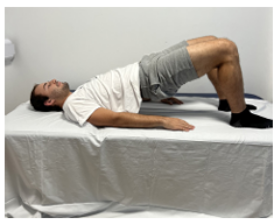
3. Hip lift or bridge
This exercise must not be introduced until 7 to 10 days after surgery and start with small, gentle movements.
- Gently tilt your pelvis and tighten your pelvic floor muscles.
- Lift your bottom off the bed slowly.
- Hold at the top, where it is still comfortable. Then slowly lower down, one vertebrae (bone in your spine) at a time.
- Repeat 3-5 times.
Progress to 10-15 times and lift higher as you feel more comfortable.
4. Knee rolls
This exercise must not be introduced until 7 to 10 days after surgery and to start with small, gentle movements.
- Lie on your back, with a pillow underneath your head and your knees bent.
- Place your arms to the side.
- Keeping your knees and ankles together, gently drop your knees to one side as far as comfortable.
- Then roll your knees using your tummy muscles, gently, to the other side.
- Keep your shoulders and head still throughout.
- Repeat 5 times.
To progress, aim towards 20 times.

Chair exercises
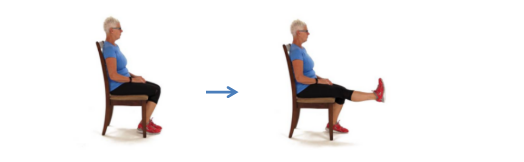
Bending and straightening the knee
Straighten one leg and hold for 5 seconds before slowly lowering down. Repeat 10 times on each leg.
Heel and toe raises
Lift both heels as high as possible off the floor then slowly lower and lift your toes as high as possible off the floor. Repeat 10 times.

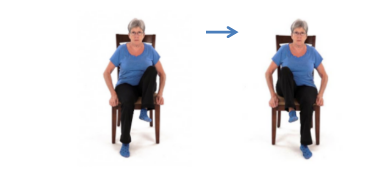
Seated marching on the spot
With your hip and knee bent raise one knee towards the chest, and then slowly lower to floor. Repeat 10 times on each leg.
Who can I contact for further information or advice?

This leaflet is intended for patients receiving care in Worthing and St Richard’s Hospital.
The information in this leaflet is for guidance purposes only and is in no way intended to replace professional clinical advice by a qualified practitioner.
Today’s research is tomorrow’s treatments. That’s why UHSx is proud to be a research-active Trust. Find out how you can get involved.
Visit our website www.uhsussex.nhs.uk/research-and-innovation/information-for-patients-and-public or scan the QR code: 