
Download and print as a PDF (378kB pdf)
What is this information about?
This information is about how to prepare your bowel and bladder for SABR (stereotactic radiotherapy) treatment, including your CT planning scan. It tells you:
- Why treatment preparation is so important
- When and how you need to prepare
- Ways to make this process easier.
Why have I been given this information?
Your oncologist (specialist cancer doctor) has decided that you would benefit from a course of SABR radiotherapy treatment to your prostate.
It is important to read and follow these instructions. This way, you are helping to make sure that:
- your treatment will not be delayed
- your treatment is as accurate as possible
- potential side effects are reduced.
What is SABR treatment?
SABR stands for stereotactic radiotherapy. SABR is a way of giving radiotherapy in a very focused way.
Where is my prostate gland?
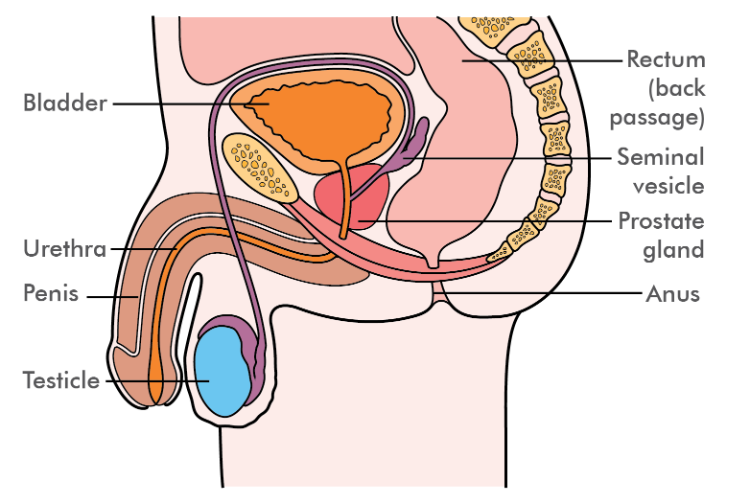
Your prostate gland is located directly below your bladder and in front of your rectum (bottom) as shown below.
Why is treatment preparation so important?
Radiotherapy treatment is designed to be extremely accurate. It will only target a certain area, which is decided by the oncologist.
It is important that the prostate gland is always in the same place.
The prostate sits very close to both the bladder and the rectum.
As both of these can vary in size depending on how full they are, this can then change the position of the prostate gland.
The following preparation will help to make sure that the bladder and rectum are the same size every day: this is with your bladder comfortably full and rectum empty. This keeps the prostate gland in a steady position.
You will need to do some preparation for:
- your CT planning scan
- your radiotherapy treatment days
- your non-treatment days.
What bowel and bladder preparation do I need to do?
To make sure you have an empty bowel, you will be given a box of micro-enemas during the prostate group information session or asked to pick them up a few days before your CT planning scan appointment.
A micro-enema is a medication that is inserted into your bottom to release any faeces (poo) or gas.
Bowel and bladder preparation schedule
Preparation for CT planning scan
- Two days before CT planning scan:
- each night for two nights, use one micro-enema, two hours before bedtime.
- CT planning scan day:
- use one micro-enema, two hours before appointment
- empty your bladder (have a pee) and then drink 500ml water (four cups), 40 minutes before your appointment in the department.
Preparation for radiotherapy treatment
- Two days before radiotherapy starts:
- each night for two nights, use one micro-enema, two hours before bedtime.
- On each radiotherapy treatment day:
- use one micro-enema, two hours before appointment
- empty your bladder (have a pee) and then drink 500ml water (four cups), 40 minutes before your appointment. You can do this at the department if you prefer.
On non-treatment days (between treatments)
- Use one micro-enema, two hours before bedtime.
What can I do to make this process easier?
There are a few small changes you should make to help prepare for treatment.
- Keeping well hydrated (drinking enough) throughout the day will help to make sure that the water you drink fills your bladder effectively. From today, please aim to drink between 1.5 to 2 litres of water, squash or similar daily.
- Reducing bowel gas is important to give an emptier rectum. Bowel gas (flatulence) is a natural part of the digestion process. Everyone has gas, which is expelled through burping or from the back passage.
Too much gas in the treatment area can make it difficult to treat you and cause delays in your treatment so it is important to reduce this. The best ways to do this are:
- Eat slowly, chew food well and do not talk while eating.
- Avoid constipation.
- Reduce foods that can cause gas such as cabbage, corn, brussels sprouts, onions and beans. Make sure they are well cooked to reduce the gas production.
- Reduce any foods that contain artificial sweeteners known as sugar alcohols like sorbitol and xylitol.
- Take small sips rather than gulps when drinking.
- Avoid chewing gum or sucking boiled sweets.
- Avoid fizzy drinks including carbonated water, soft drinks, lager and beer.
- Try to keep active: walking or even stretching helps to move gas through the intestine more easily.
- It is important to eat regularly. Missing meals can cause excess gas to form.
It may be helpful to keep a food and drink diary to identify if any foods are causing gas and to help you make sure that you are drinking the required amount daily (1.5 to 2 litres).
If you struggle to drink the required amount of fluid daily, try and build this up slowly until you have your CT planning scan.
What can I do if I struggle to hold my bladder for 40 minutes after drinking?
You may want to practice holding your bladder for 40 minutes after drinking four cups of water.
Empty your bladder and then drink four cups of water and hold. If you are struggling, then try and slowly build the amount of time you can hold until you find the maximum time you can hold comfortably before emptying.
What happens if the CT planning scan shows that there is too much poo or gas in my bowel?
Sometimes your planning CT scan may show you have too much poo or gas in your bowel. If this happens, we will need to reschedule you CT scan for a few weeks.
Will I have a chance to ask questions before I have the treatment?
Yes. You will receive a letter in the coming weeks to invite you to attend a group presentation about radiotherapy preparation. If you do have any questions, please write them down and a member of staff will answer them on the day.
Who can I contact for further information or advice?
If you have queries about your appointments, please call:
 Radiotherapy Reception SCC (Brighton)
01273 664901
Radiotherapy Reception SCC (Brighton)
01273 664901
For queries regarding symptoms or medication please call your Macmillan CNS team:
Brighton
01273 067800

Eastbourne
0300 1314523
Worthing
0190320111
Ext. 84716
For queries regarding radiotherapy preparation please wait for your presentation appointment or call CT:
01273 696955
Ext. 64836
Useful National Contacts
Macmillan Cancer Support
0808 808 0000
Prostate Cancer UK
0800 074 8386
This leaflet is intended for patients receiving care in Brighton and Hove.
The information in this leaflet is for guidance purposes only and is in no way intended to replace professional clinical advice by a qualified practitioner.
Today’s research is tomorrow’s treatments. That’s why UHSx is proud to be a research-active Trust. Find out how you can get involved.
Visit our website www.uhsussex.nhs.uk/research-and-innovation/information-for-patients-and-public or scan the QR code: 