
Download and print as a PDF (235kB pdf)

What is this information about?
This information is about proximal humerus (upper arm bone) fracture.
It tells you:
- How to look after your child when they go home from hospital with a proximal humerus fracture
- How long this fracture is likely to take to heal
- What follow-up treatment your child might have
- Who to contact if you need further help and support
What is a proximal humerus fracture?
This is a break to the top of the upper arm bone.
Does your child have a fracture or a break?
If you child has a fracture, it means they have a broken bone. ‘Fractured bone’ and ‘broken bone’ both mean the same thing.
How long is it likely to take for my child’s injury to heal?
This usually takes about 6 to 12 weeks for proximal humerus fracture to heal. Younger children are likely to recover faster as fractures heal more quickly in this age group.
Your child should have good movement (although it may still be a bit sore) by 2 to 4 weeks post injury. Please contact the Virtual Fracture Clinic if your child does not regain good shoulder movement by week 4 after their injury.
Will smoking or vaping slow down healing?
Yes. Smoking slows healing so if your child smokes or vapes they should try to stop or cut down. This is most important in the first 2 weeks after injury.
What should I so if my child is in pain after my proximal humerus fracture?
If your child is in pain, use pain killers that you buy from a pharmacy or shop or that A&E have given you for them to take. Follow the dose instructions on the packet. If they are struggling with pain speak to your GP or pharmacist.
A child is often in more pain on the second night after the injury than the first one. They may find it more comfortable to sleep propped up on pillows.
Using a cold pack may help with pain and swelling in the first few days. You can use an ice pack or bag of frozen peas wrapped in a damp towel. Make sure the ice is not in direct contact with the skin.
Was the sling that my child was fitted with in A&E the best type for a proximal humerus fracture?
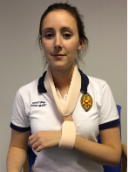
The best type of sling for your child’s proximal humerus fracture is a ‘collar and cuff’ sling (shown below). Wearing this type of sling should mean that your child is as comfortable as they can be and that their injury heals as well as possible.
Do
- Contact the Virtual Fracture Clinic if your child was, or you think they may have been, fitted with a different type of sling. We will arrange a new appointment to fit them a collar and cuff sling.
Why was my child fitted with a collar and cuff sling?
A collar and cuff sling allows your child’s shoulder to rest and keeps it in the best position to help it to heal. Make sure that you do not place pillows below your child’s elbow to prop up the arm.
The lower loop of your collar and cuff sling should have enough space to allow your child to remove their hand from the sling.
When should my child be wearing a collar and cuff?
Your child should use the sling for 2 to 4 weeks. It may be useful to wear it for 4 weeks at school to remind others to be careful. Take it off to wash and dress. Your child does not have to wear the sling at night. Young children (3 years old and under) may not want to wear a sling at all, and this is alright.
What should I do if my child is struggling with the collar and cuff sling?
Do
- Contact the Virtual Fracture Clinic. We can give you advice or arrange for your sling to be changed if needed.
Will I have further (follow up) appointments?
No. You child will not need to have a follow up appointment as this injury heals well. However, if your child does not regain good shoulder movement 4 weeks after their injury, or you have any questions during their recovery, please contact Virtual Fracture Clinic.
What should my child do from week one to week three after proximal humerus fracture injury?
- Your child should use a collar and cuff sling for the first 2 weeks. Take it off to wash and dress.
- They do not need to wear the sling at night but may find it more comfortable to do so.
- Your child may find it more comfortable to sleep propped up on pillows.
- They should rest arm for the first 24 to 72 hours (1 to 3 days). However, it is important that they keep moving around.
- Encourage your child to move their fingers, wrist and elbow whilst wearing the collar and cuff sling, so they do not get stiff. This should be done gently, without causing too much pain.
- You can put cold packs (ice pack or frozen peas wrapped in a damp towel) to the sore area for up to 15 minutes. Do this every few hours to help with pain relief if they find this helps.
- Take the arm out of the sling to wash and dress.
Be aware
The ice must never be in direct contact with the skin.
What should my child do from week three to week six after proximal humerus fracture injury?
- Use the collar and cuff sling at school to remind others to be careful.
- They do not need to wear the collar and cuff sling at home if no longer are in pain.
- They can start using their injured arm to write, draw, or play computer games if they are comfortable to do so.
- Continue to avoid heavy lifting and loading for 4 weeks after their injury.
When can my child go back to doing sports or other high impact activities?
- Your child should avoid high impact activities for 4 weeks if your child is 3 years old or younger and for 6 weeks if they are older than 3 years of age.
High impact activities include things such as:
- Using a trampoline
- Riding a bike or scooter
- Playing sports such as football or basketball
- PE classes
- Most types of dances
- Gymnastics.
There is a small increased chance that your child may get an injury from doing high impact activities for up to 12 weeks. Most children can return to PE and full sports at 6 weeks after their injury.
How do I contact the Virtual Fracture Clinic?
Working hours: Monday to Friday 8.30am to 4.30pm. We aim to respond to messages within 24 hours during these times. At times you may receive a call outside of these hours.
 Worthing
01903 205 111
Ext. 86312
Worthing
01903 205 111
Ext. 86312
St Richard’s
01243 788 122
Ext. 35503

This leaflet is intended for patients receiving care in Worthing and St Richard’s Hospitals.
The information in this leaflet is for guidance purposes only and is in no way intended to replace professional clinical advice by a qualified practitioner.
Today’s research is tomorrow’s treatments. That’s why UHSx is proud to be a research-active Trust. Find out how you can get involved.
Visit our website
www.uhsussex.nhs.uk/research-and-innovation/information-for-patients-and-public or scan the QR code: 