
Download and print as a PDF (798kB pdf)
What is this information about?
This information is for parents or carers of children who have been told their child has pseudostrabismus.
It explains:
- what pseudostrabismus is
- how to tell it apart from a true squint (strabismus)
- what causes it
- what to expect over time
- when to seek advice
Why have I been given this leaflet?
You have been given this leaflet because my child has been seen by the eye team and may have pseudostrabismus.
This leaflet explains what that means and what to expect.
What is pseudostrabismus?
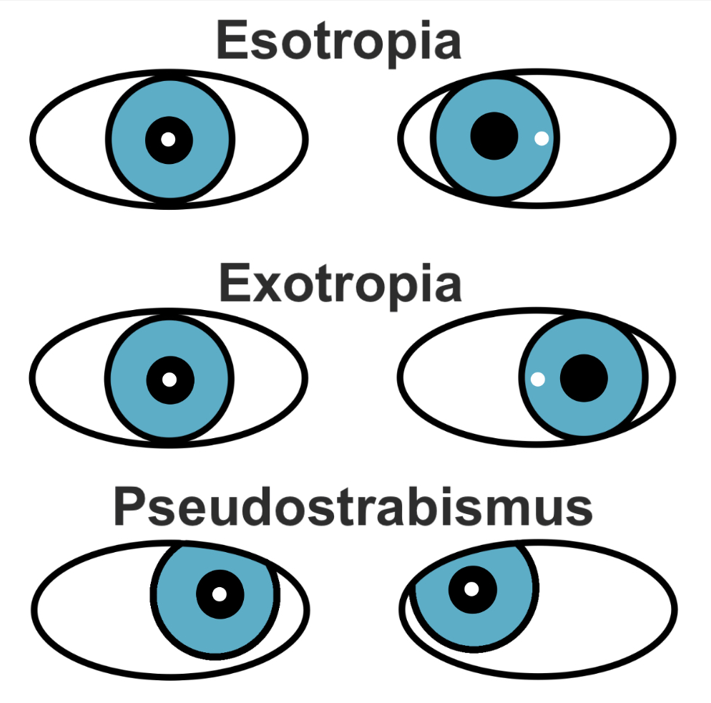
Pseudostrabismus means the eyes only look like they are turning, but they are actually straight and working together.
This is different from true strabismus, where the eyes really are misaligned.
In pseudostrabismus, your child’s eyes might look like they’re turning in or out, but they are healthy and in the right position.
What will I notice in my child’s eye?
You might notice that one of your child’s eyes looks like it’s turning inwards or outwards especially when looking to one side or in photos.
This is most often an inward turning appearance and is common in younger children.
Even though it looks like a squint, the eyes are straight.
What should I look for at home?
I can try a simple check using a light:
If I shine a light in both eyes, I should see the reflection in the same place on each pupil.
If the reflections are in different places, it could mean a real squint.
Looking at photos can also help me see how the eyes are aligned.
What causes pseudostrabismus?
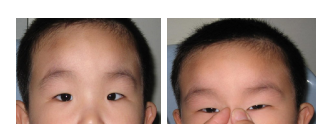
It’s caused by the shape of my child’s face. This might include:
- a flat or wide bridge of the nose
- extra skin folds near the nose (called epicanthus)
- a small space between the eyes
- differences in eyelid position or eye shape
These features can give the illusion that one eye is turning, when in fact both eyes are straight.
Types of appearance:
Pseudoesotropia – Eye looks like it turns inwards.
Pseudoexotropia – Eye looks like it turns outwards.
Why is it important to tell the difference from real strabismus?
Real strabismus can cause problems with vision and how the eyes work together.
It can lead to lazy eye or loss of binocular vision (not using both eyes as a pair).
Pseudostrabismus does not cause any harm and doesn’t affect vision or eye development.
Is pseudostrabismus common?
Yes, it is very common in babies and young children.
Many children grow out of it as their face shape changes and the bridge of the nose develops.
How is it tested?
An orthoptist will test your child’s vision by:
- checking each eye’s sight
- watching how both eyes move together
- looking for signs of real strabismus
Be aware
if your child has pseudostrabismus now, it doesn’t mean they will (or won’t) develop a true squint in the future.
The orthoptist may advise follow-up appointments to check that everything continues to develop normally.
Will my child need treatment?
No. Pseudostrabismus does not need any treatment.
As my child grows, the bridge of the nose will usually become more defined, and the appearance of the eyes turning will fade.
In some cases, depending on face shape, ethnicity, or genetic conditions, this appearance may last into adulthood—but it will not affect eye health.
Who can I contact for advice?
If I have questions or want to speak to the Orthoptic Team, I can call:
 St Richard’s Hospital
01243 831499
St Richard’s Hospital
01243 831499
Southlands Hospital
01273 446077
Sussex Eye Hospital
01273 696955
Where can I find more information?
Helpful advice and videos about children's eye conditions
Our Trust website
The information in this leaflet is for guidance purposes only and is in no way intended to replace professional clinical advice by a qualified practitioner.
Today’s research is tomorrow’s treatments. That’s why UHSx is proud to be a research-active Trust. Find out how you can get involved.
Visit our website www.uhsussex.nhs.uk/research-and-innovation/information-for-patients-and-public or scan the QR code: 