
Download and print as a PDF (264kB pdf)

What is this information about?
This information is about foot stress fracture.
It explains:
- What a stress fracture is and how stress fractures can be caused
- The signs and symptoms of a stress fracture and how stress fractures are diagnosed
- The things that can make it more likely that someone will get a stress factor (risk factors for stress fracture)
- How long it may take for your stress fracture to heal
- What treatment you may have
- How to look after yourself when you go home from hospital with a foot stress fracture
- What you can do to help heal and strengthen your foot
- When you may be able to return to work and doing sports
- Who to contact if you need further help and support.
What is a stress fracture?
Stress fractures happen when something puts too much stress on your bone. They are sometimes called ‘overload’ or ‘overuse’ injuries.
Stress fractures are often tiny cracks in the bone and people may get many of these over times. Sometimes stress fracture may just cause inflammation (swelling, heat and pain), but it can lead to a full break in the bone.
What causes stress fractures?
Stress fractures are usually caused by often over-using the same part of your body.
Our bodies make new bone material all the time to renew and strengthen our bones. If we overwork a bone this may not happen quickly enough to cope with the stress that the bone is under, and a stress fracture can happen.
Our bones are made to cope with forces and loads, but if the load is a lot more than the bone is used to coping with, it can cause a stress fracture.
What things might cause a bone to be over-loaded and suffer a stress fracture?
There are many things that can cause bone overload. Some of the more usual ones include:
- Doing an activity that you have not done before, have not done for a long time or that is not usual for you
- Doing more of an activity rapidly
- Wearing different footwear
- Doing a lot less of an activity for a period of time and then starting your usual activity again
- Having an eating disorder or health condition that means your bones are not so strong.
The amount and type of activity which is ‘too much’ and can overload a bone is different for everybody and can change at different stages of life.
What are the signs and symptoms of a foot stress fracture?
If you have a foot stress fracture you may have:
- A dull pain in your foot. This is likely to increase with activity or when you put weight on your foot and get better when you rest or avoid the activity.
- Foot swelling.
- Increased pain if you press directly on the bone that has the stress fracture.
Where in my foot is my stress fracture likely to be?
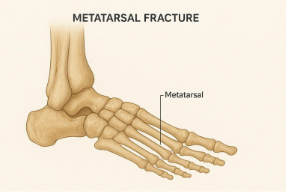
Most stress fractures happen in the metatarsal bones of the foot (the long bones at the front of the foot). Sometimes they happen in other bones of the foot or leg. This information is only about stress fractures of the foot.
How is stress fracture of the foot diagnosed?
Your healthcare professional can usually tell whether you have a stress fracture from what you tell them about your symptoms and how they started.
Will I have X-rays and what might they show?
- We will sometimes do an X-ray to check if there is a clear break to the bone.
- Some people can be diagnosed as having a stress fracture without the need for an X-ray.
- Not all stress fractures show on an X-ray as they may just be due to small changes in the bone which cannot be seen in the X-ray image.
- Sometimes an X-ray taken weeks after your first X-ray may show changes which could not be seen on the previous X-ray.
- Even if you have had one X-ray, you may not need repeat X-rays. If a new X-ray or scan would not change the way we manage your fracture or the advice that we give, you do not need to have one.
- You may have a repeat X-ray if we think your fracture is unstable (the broken bone pieces may move out of line).
Do I have a fracture or a break?
If you have a fracture, it means you have a broken bone. ‘Fractured bone’ and ‘broken bone’ both mean the same.
How long will it take for my stress fracture to heal?
t usually takes between 6 weeks to 6 months for a foot stress fracture to heal. It may take a year to get back to high impact activities. High-impact activities are activities that involve jumping and jolting movements, where both feet can be off the ground at the same time. For example, running, football, skipping with a rope or tennis.
Will smoking or vaping slow down my healing?
Yes. Smoking slows healing so if you smoke or vape try to stop or cut down. This is most important in the first 2 weeks after your injury. If you would like help to stop smoking talk to your GP or visit Quit smoking – NHS for further information.
What things (risk factors) make it more likely that a person will get a stress fracture?
Things which can make it more likely that a person will get a stress fracture include:
- Eating disorders
- Doing high impact sports or work, especially repetitive jumping, running long distances, walking caring heavy loads or on very uneven ground
- Increasing activity levels, especially if people are eating less
- Athletes changing their training regimes
- Problems absorbing (taking in) vitamins and minerals from their usual food
- Being post-menopausal (having been through the menopause)
- Having low bone density
- Having a health condition that makes the bones less dense over time (osteopenia).
What can I do to help my foot stress fracture to heal?
Do
- Try to reduce the load on your foot (putting weight on your foot). There are various ways to do this. The best ways will be different for different people.
- As well as doing less of the activities that caused the fracture, some people may need to wear an orthopaedic boot or rigid sole shoe, use crutches, or both. Other people can wear their usual footwear but may need to adjust what activities they do and how much activity they do.
- Stop, or do much less of, the activity that led to your fracture.
- Keep moving your foot and ankle to stop them from getting stiff.
- Do some light exercise that does not cause you pain.
What should I do if I am in pain after my foot stress fracture?
You may have foot pain for up to 6 months after your injury.
If you are in pain, take your usual pain killers or pain killers given to you in the emergency department. Follow the dose instructions on the packet. If you are struggling with pain, do speak to your GP or pharmacist.
Try using cold packs (ice pack or frozen peas wrapped in a damp towel) for short-term pain relief. Apply cold packs to the sore area for up to 15 minutes, every few hours. Be aware, the ice must never be in direct contact with your skin.
Wearing a rigid sole shoe or an orthotic boot, using crutches (or both) for a short period of time may make your fracture feel less painful.
What activities can I do?
If your stress fracture was sports related, think about what may have been involved in overloading your bone. For example, your technique, footwear, or intensity of training.
It may be better for you to do lower impact sports such as swimming, cycling or walking (on even ground) while you are recovering.
When I can return to work and sport after my stress fracture?
If you no longer have symptoms, you can slowly return to lower impact sports after 6 weeks. Increase one aspect of your sport at a time. For example, your time, speed, agility, power, balance, or coordination. Only try to increase these by about 10% each session.
What should I avoid when I have a stress fracture?
- Pushing through pain when returning to your sports or activities.
- Doing more of several activities at the same time. Build them up one at a time.
- Returning to sport or activity too soon.
- Any other activities, movements or positions that make your symptoms worse.
When can I return to work after my stress fracture?
If your work means that you have to put weight on your foot for most of the time you may need a gradual return to your usual work. For example, you may need to do fewer hours or light duties at first. Speak with your employer about this and ask your GP if you need further advice.
As your symptoms improve you can build up to doing your usual role.
Will I have further (follow up) appointments?
No. We do not usually follow up people with this type of injury. However, if after 6 weeks you are:
- Still experiencing a lot of pain and swelling
- Struggling to walk and move around without your boot or rigid sole shoe
please contact the Virtual Fracture Clinic for further advice.
When can I start driving?
You can return to driving when:
- You are no longer using your boot or rigid sole shoe
- You can walk comfortably
- You can safely deal with all emergency situations without being in pain or hesitating. For example, you must be able to stop the car quickly and in full control and safely avoid obstacles
- You are covered by your insurance company.
Be aware
Always try driving in a safe place first.
How can I get a note for work?
Please contact the Virtual Fracture Clinic.
What do I do with my ankle boot or rigid sole when I no longer need them?
Do not
- Return boots or shoes to the hospital. We are unable to reuse them.
How do I contact the Virtual Fracture Clinic?
Working hours: Monday to Friday 8.30am to 4.30pm. We aim to respond to messages within 24 hours during these times. At times you may receive a call outside of these hours.
 Worthing
01903 205111
Ext. 86312
Worthing
01903 205111
Ext. 86312
St Richards
01243 788122
Ext. 35503

This leaflet is intended for patients receiving care in St Richard’s Hospital and Worthing Hospital.
The information in this leaflet is for guidance purposes only and is in no way intended to replace professional clinical advice by a qualified practitioner.
Today’s research is tomorrow’s treatments. That’s why UHSx is proud to be a research-active Trust. Find out how you can get involved.
Visit our website www.uhsussex.nhs.uk/research-and-innovation/information-for-patients-and-public or scan the QR code: 