
Download and print as a PDF (558kB pdf)
Information to help you to choose your implant and about your operation
What is this information about?
This leaflet explains bone conduction and middle ear hearing implants. It can help you to understand:
- what bone conduction and middle ear hearing implants are
- how a hearing implant can help you hear
- the different implants available at UHSx
- the steps you will go through before and after getting an implant (your implant ‘journey’).
- what happens during your operation
- the appointments you will have after your operation
- problems that can happen during or after your operation (complications and side-effects)
- where you can get more help and who to contact if you have questions.
Why have I been given this information?
You have been given this because a hearing implant may help with your hearing loss.
Reading this information will help you learn:
- about different types of implants
- which implant might be best for you
- what happens during your operation
- what happens after your implant is fitted.
What is a hearing implant and how can it help?
A hearing implant is a device placed through or under the skin during an operation. It helps sound travel through to your inner ear.
It cannot cure hearing loss, but it can make hearing easier.
How are hearing implants different from hearing aids?
- Hearing aids make sounds louder. They increase the amount of sound that travels through your ear. This means the sound seems louder to you (the sound is amplified).
- Hearing implants send sound through the skull or the tiny bones in the ear. This helps sound travel around the part of the ear that is not working well. You may be offered a hearing implant if you are suitable for one and hearing aids do not give enough benefit or if you are unable to wear them for any reason.
Be aware:
• Hearing aids or hearing implants do not ‘cure’ your hearing loss.
• Some people may be able to have an operation to help fix the cause of their hearing loss. You can talk with your ENT specialist about whether this may be an option for you. This will depend on what is causing your hearing loss.
Hearing aids and hearing implants are not a ‘quick-fix’ for hearing problems. It takes time and practice to get the most benefit from them.
What types of hearing implants are available?
There are 3 main types of hearing implants we offer:
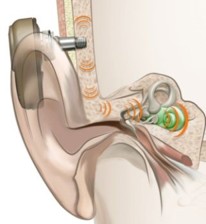
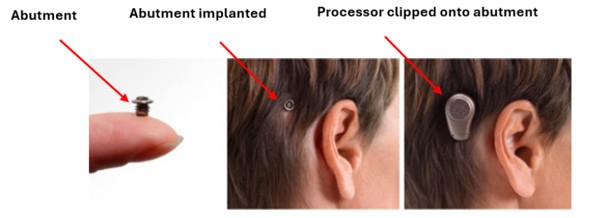
Percutaneous bone conduction implant.
- This implant uses a small titanium screw.
- The screw is fixed into the bone of your skull.
- A small part of the screw stays outside the skin. A sound processor clips onto the screw.
- The sound processor changes sound into tiny vibrations which get picked up as sound in the inner ear.
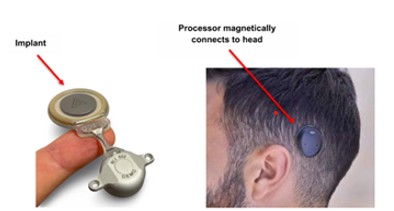
Transcutaneous bone conduction implant
- This implant includes a magnet under the skin. Nothing sticks through the skin.
- The sound processor sits on top of the skin and is held in place by the magnet.
- The processor sends sound to the magnet. The magnet turns the sound into vibrations that travel through the bone to inner ear.
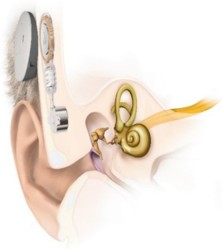
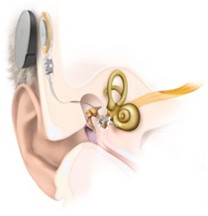
Middle ear implant
- This implant also uses a magnet under the skin. Rather than sending vibrations through the head, a tiny vibrator is clipped onto one of the small bones inside the ear.
- It helps these bones move so that you can hear sound.
- Middle ear implants may be right for you if your hearing differs a lot between your ears. It can send sound to one ear without affecting the other.
How do I choose the best hearing implant for me?
The best implant depends on:
- your type of hearing loss
- your hearing test results
- your medical history
- your daily activities and personal preference.
Your audiologist and ENT doctor will help you decide which option is most suitable for you.
You can use the table below to compare the function and features of the implant options.
Comparison of hearing implant options
| Type | Oticon Ponto 5 (Mini / Super Power) | MED-EL Samba 2 Bonebridge | MED -EL Samba 2 Soundbridge |
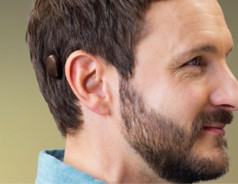 | 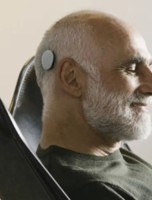 | 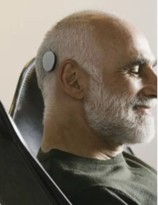 | |
| Implant type | Percutaneous (abutment) bone conduction. Small screw fixed in the skull and sticks outside the skin.  | Transcutaneous bone conduction. Full implant is under your skin.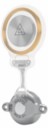 | Transcutaneous middle-ear. Implant fully under the skin with a magnet and attached to middle ear bones. 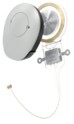 |
| What you will see | A small part sticks out through the skin. | Nothing sticks out. You may feel a small bump. | Nothing sticks out. You may feel a small bump. |
| External processor | Clips onto the screw.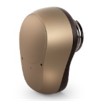 | Held in place by a magnet on the skin. | Held in place by a magnet on the skin. |
| Colours | Choose 1 of 5 colours to match your hair colour. | Comes with 5 changeable covers. You can buy extra from the maker. | |
| How it attaches | Clips firmly onto the screw. Size 26 by 19 by 11mm. | Held in place by magnet strength, which can be adjusted. Size 36 by 30 by 10mm. | |
| How secure it is | Very secure. Unlikely to fall off unless knocked. Can be clipped to your clothes. | As it is held on with a magnet it can move or fall off more easily. Clips or holders are advised. You are likely to need post-fitting appointments to adjust the magnet strength to the right level for you. | |
| Placement on head | Behind and slightly above the ear. Exact placement depends on your head. | Behind and slightly above the ear. Exact position depends on your head, but we will try to place it in your preferred place if you have one. Talk with your surgeon about this. | |
| Future upgrades | Abutment can work with devices from other companies as well as Oticon so you may be able to switch implants if needed. | Will work with newer MED-EL sound processors but not those from other companies. | |
| Battery life | About 4 to 5 days depending on whether 312 (Ponto 5 Mini) or 675 (Ponto 5 Super Power) battery is used. | About 5 days. 675 battery. | |
| Water resistance | Higher protection (IP57 means good protection against dust and water splashes). | Lower protection (IP54 means some protection from dust and splashes). | |
| MRI scans | Safe under certain conditions. May affect head scan images. If you need regular MRI scans, please ask your implant team for further information. | Safe under certain conditions. May affect scan images more and need to be removed if you develop a condition that means you need MRI scans of your head. If you need regular MRI scans, please ask your implant team for further information. | |
| Bluetooth and streaming | Uses 2.4 GHz Bluetooth Low Energy. Direct streaming with iPhone and iPad devices. Indirect streaming with Android devices (via the Connect Clip). | Indirect streaming with iPhone and Android devices (via the Samba 2 Go streamer). | |
| Phone app | Oticon Companion app lets you change volume, programmes, check battery and “Find my hearing aid”. Live Listen function with iPhone. | Samba 2 Remote app lets you change volume, programmes, and check battery level. | |
| Accessories | You will get a voucher for either a remote control or a remote streamer (Oticon Connect Clip). The Connect Clip can be used: as a remote microphone to stream from any Bluetooth device to make hands-free phone calls. | You will get a Samba 2 Go streamer. It can stream from any Bluetooth device and be used for hands-free phone calls. It can be used: to stream from any Bluetooth device to make hands-free phone calls. | |
| Loop and FM systems | Can connect using an extra ‘Edumic’. Oticon may provide this for you upon request. | Needs a Samba 2 Go device to connect to FM. You will need to buy an external neck-loop attachment for this so that you can connect to a loop. | |
| Sound quality | Similar to the trial device. Often louder and more direct. | Often quieter but still clear. Takes time to get used to. | May sound more natural and clearer. |
| Hearing experience | Sound may be heard in one or both ears. | Sound may be heard in one or both ears. | Sound is heard mainly in the implanted ear. |
What is the usual journey for receiving a hearing implant?
1) Referral.
- You must be referred (sent) to the Audiology Implant Service by a healthcare professional who thinks an implant might be an option for you. This is often an ENT doctor (doctor who is a specialist in the ears, nose and throat) or an audiologist.
2) Hearing checks and Assessment.
You will meet an audiologist in the Audiology Implant Service.
They will:
- ask about your hearing
- ask about your health
- test your hearing.
If a hearing implant may help, you will be given a demo device to try.
3) 2-week trial.
- You will wear a bone conduction hearing aid, fitted to a headband, for at least 2 weeks. Try to wear it as much as you can during your normal activities. This helps you learn what hearing with an implant may be like.
4) Team review.
- The team will talk with you about how the trial went.
- You will have more checks of your hearing while you’re wearing it to find out how well it’s working for you.
- You will also meet an ENT doctor to talk about the operation. Together you will decide whether an implant is the right choice as well as discuss any other options that may help your hearing.
5) Your operation
- The implant is fitted in hospital. Most people go home the same day.
Processor fitting.
- This will be done around 2 to 3 months after your operation to allow for your screw or magnet to embed properly. We will set up the processor so it’s right for you and give you information about how to use it.
6) Audiology follow-up.
- You will have an appointment after you’ve been using your implant for around 6 to 8 weeks. This is to check how well it is working for you and make any adjustments if required.
What happens if I am due to have an implant but change my mind and no longer want it?
You do not have to have the implant if you decide for any reason that you no longer want to have it. Just tell us at any time beforehand. We can talk with you about different options.
Your operation
How long might I have to wait for my operation?
This depends how long the waiting list is. After you have had your first appointment with the audiology implant team it is likely to be about 8 months to 1 year before you have your operation. To check where you are on the waiting list please email: [email protected]
Will I need a scan before I have my operation?
Some people do need to have a scan. Our team will decide if you need one and tell you if you do.
Should I bring any glasses, helmet or head gear that I wear often with me when I come in for my operation?
Yes, please do bring any of these in with you. This helps us to place your implant so that you can still wear them after your implant is fitted.
What happens when I have my hearing implant operation?
How long your operation takes, what type of anaesthetic we give you and what we do in the operation depends on the type of implant.
We will give you:
- a local anaesthetic – you remain awake, but the anaesthetic medication numbs the area so you feel no pain. You may feel some pressure or movement.
OR
- a general anaesthetic – you are asleep during the operation, feel no pain and are unaware of what is happening.
Can anything go wrong after the operation?
Most people recover very well after their operation. Sometimes there can be problems, just like with any operation.
These may include:
For all the types of implant:
- swelling
- bruising
- bleeding
- infection
- numbness around the implant area
- a small scar behind the ear.
For percutaneous implants very occasionally, the screw may not join to the bone as well as expected and can become loose.
There is a very small chance that you may get:
- a leak of the fluid that surrounds the brain
- meningitis. This is a serious medical emergency caused by swelling of the membrane that protects the brain and spinal cord
- weakness in the muscles of your face. This may make parts of your face droop. It may get better or go away over time or it may not.
If you have had a MED-EL Samba 2 Soundbridge (middle ear implant)
There is a small chance of:
- hearing becoming worse
- ringing or buzzing sounds in the ear (tinnitus)
- dizziness or spinning feelings (vertigo).
Your healthcare team will talk through these risks with you before surgery.
Be aware,
please ask your audiologist or surgeon before your operation if you would like further information about side effects, including any that there may be a greater chance of you getting because, for example, of your medical history.
Who should I contact if I have concerns after my operation?
If you have concerns about your abutment or the site of your operation please contact the ENT department:
 01273 696955
Ext. 63484
If you have any problems with your processor please contact the Audiology department between 8am and 5pm:
Text:
07551 360721

Do the companies that make the implants used by UHSx provide further information about them?
Yes. Visit their websites for further information.
Oticon
Other NHS Trusts may provide implants made by other companies.
Who can I contact if I have any questions or concerns after I have read this information?
Please contact: the Audiology Department
Sussex House, Abbey Road, Brighton BN2 1ES
Text
07551 360721

This information is available for use across all UHSx sites. However, the hearing implant service is based only at the Royal Sussex County Hospital. No other UHSx sites deal with assessing suitability for implants and fitting them. ENT consultants from other sites or the Audiology service at Worthing Hospital may share this information with you if they think a referral to the implant service may be right for you.
The information in this leaflet is for guidance purposes only and is in no way intended to replace professional clinical advice by a qualified practitioner.
Today’s research is tomorrow’s treatments. That’s why UHSx is proud to be a research-active Trust. Find out how you can get involved.
Visit our website www.uhsussex.nhs.uk/research-and-innovation/information-for-patients-and-public or scan the QR code: 