
Download and print as a PDF (272kB pdf)
Information for patients
Dietetics department
What is this information about?
This information is about your low fibre diet. It explains:
- what dietary fibre is
- why you may need to have a low fibre diet (a diet which is low in dietary fibre) if you have certain health conditions
- what you should do when you are ready to return to your usual diet.
It gives you suggestions for foods from different food groups which you can have while you are on your low-fibre diet. It also tells you which foods to avoid.
What is dietary fibre?
Dietary fibre is found in foods such as wholegrain cereals, fruit and vegetables. When you eat these foods, your intestine cannot digest some tough, fibrous, parts of them. This is the dietary fibre they contain.
Because you cannot digest it, it passes through your body in your poo (stools). It makes your poo bulkier and adds weight to it. This is usually a good thing as it:
- makes it easier to pass out of your body when you have a poo
- helps you to avoid constipation (having dry, hard, poos that can be difficult or painful to pass)
Why might I need a low fibre diet?
A low fibre diet can help if you have diarrhoea (thin, watery poos) caused by health conditions including:
- diverticular disease
- IBS (irritable bowel syndrome)
- IBD (inflammatory bowel disease.
Having a low fibre diet if you have one of these, or some other conditions, can rest your bowels. This can mean that you are less likely to have diarrhoea or make your diarrhoea less severe.
How long might I have to be on a low fibre diet for?
How long people should stay on a low fibre diet for is different for everyone. As your bowel has a rest and your symptoms get better you should slowly be able to return to your usual diet.
Be aware,
do not continue to avoid higher fibre foods once your symptoms have gone away and you no longer need to avoid them.
What foods are suitable, and which should I avoid, while I am on my low fibre diet?
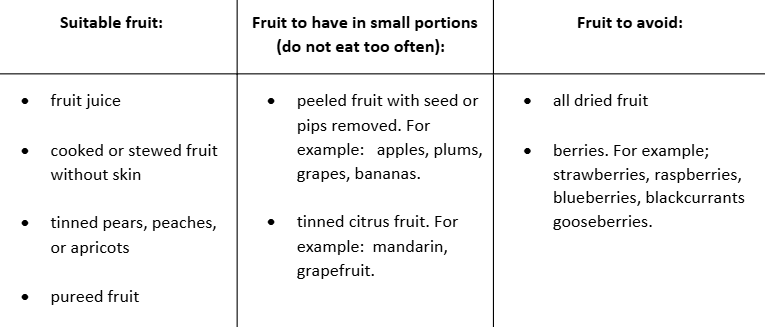
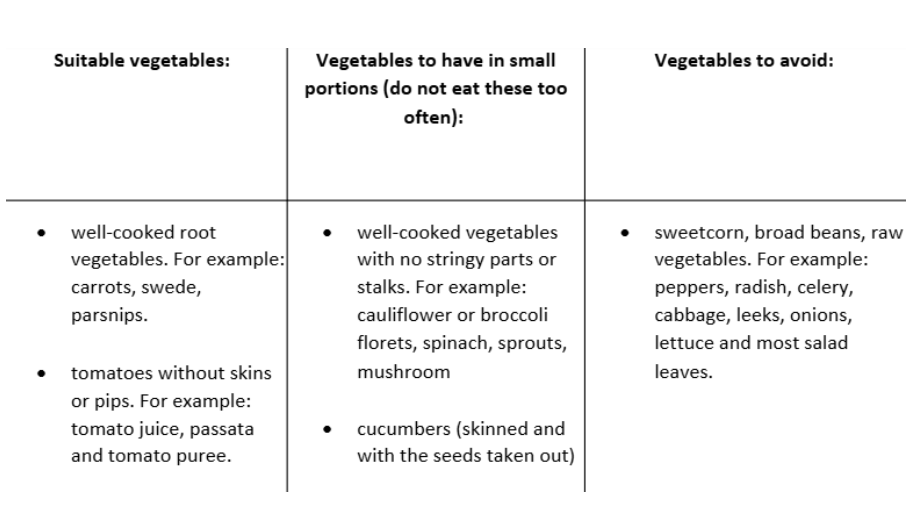
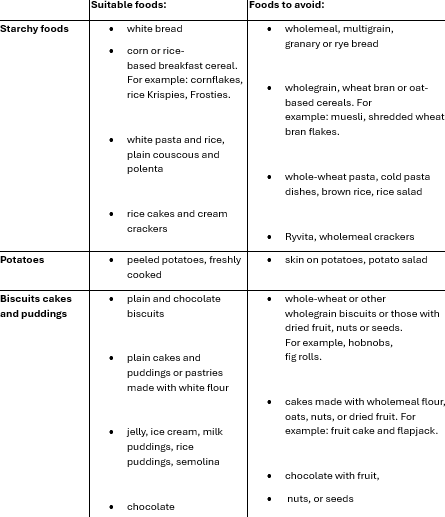
The table below shows which foods are suitable and which to avoid while you are on your low fibre diet.
Be aware,
while you are on your low fibre diet avoid having more than 2 pieces of fruit and 2 portions of vegetables a day.
Do
- peel fruit and vegetables. Avoid eating any pith, seeds or pips.
Who can I contact for further information and advice?
If you would like further information or advice after you have read this information, please contact your Dietetics department:
 Princess Royal Hospital, Haywards Heath
01444 441881
Ext. 68313
Princess Royal Hospital, Haywards Heath
01444 441881
Ext. 68313

Royal Sussex County Hospital, Brighton
01273 696955
Ext. 64290
St Richard’s Hospital
01243 831498
Worthing Hospital
01903 286779
The information in this leaflet is for guidance purposes only and is in no way intended to replace professional clinical advice by a qualified practitioner.
Today’s research is tomorrow’s treatments. That’s why UHSx is proud to be a research-active Trust. Find out how you can get involved.
Visit our website www.uhsussex.nhs.uk/research-and-innovation/information-for-patients-and-public or scan the QR code: 