

Businessman Laurence Penn, 59, from Thakeham, was one of the first Covid-19 patients in the country to be put in an induced coma in Worthing Hospital’s intensive care unit. Today, he dedicates his time supporting research efforts and giving back to the NHS he credits with saving his life.
Before the pandemic, Laurence led a very active and adventurous life. He enjoyed cycling, cross-fit training and Jui Jitsu and travelled the world for work. But everything changed in March 2020, when he fell ill following a work trip abroad.
Laurence recalls: “My wife and I had been out for a walk up the hills, and I just remember thinking it was really hard to climb those hills. I was knackered but I pushed it to the back of my mind. When I got home, I was exhausted and woke feeling drained, and confused, with an irritable cough. I went to bed where I stayed for nine days, getting worse and I just couldn’t catch my breath.”
Laurence was rushed to Worthing Hospital by ambulance and was rapidly escalated to critical care suffering with severe respiratory failure. It was decided he should be placed in an induced coma to save his life.
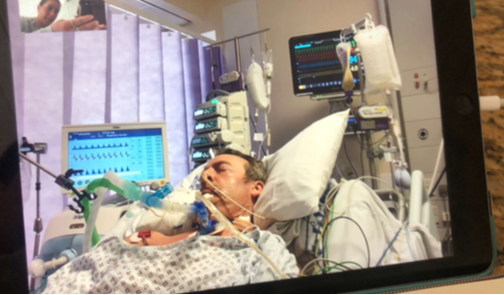
Laurence said: “When I got to hospital, I thought I would be out in a couple of days. But my decline was rapid, and my wife didn’t even get a chance to speak to me before it happened. The team were under massive pressure to make some horrible decisions.”
Dr Luke Hodgson, Intensive Care and Respiratory Consultant, was part of a team caring for Laurence. He explains: “It was an unprecedented situation in early 2020. It was unclear at the time how many people we would have to look after, how long they would require critical care, what the chances of survival would be and what treatments, other than supportive care, would work.”
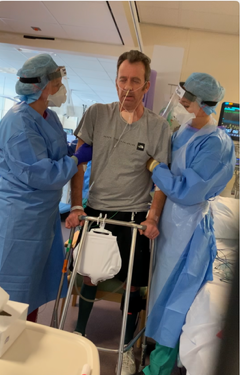
Laurence spent 29 days in a coma, but after almost 50 days in hospital, he was able to go home and endured a long journey to recovery.
He had lost more than two stone during his hospital stay. His vocal cords were damaged, and he could hardly speak; a result of the equipment placed down his throat and into his lungs to help him breathe whilst in a coma. He also couldn’t walk properly from the profound muscle weakness – a common effect after being critically ill.
Laurence said: “After waking up, I was in a bit of a state. I didn’t know myself at all and that carried on at home where I fully realised how banged up I was. I knew I had a mission to get back to where I was.”

Exactly one year after he was placed in a coma, through sheer determination, Laurence cycled the 106-mile South Downs Way Challenge with two friends raising £11,000 in support of our dedicated charity, My University Hospitals Sussex.
Laurence said: “After my recovery, I realised how lucky of an escape I had, and I just wanted to give back. When I had a catch up with the team, I told them thank you for keeping me alive. In ICU, you feel like you’re in the F1 of care. I met so many incredible people. I will be thankful forever more.”
Laurence didn’t stop at fundraising. After attending a follow-up clinic run by Dr Hodgson, he was enrolled into a research study run across Kent, Surrey and Sussex looking at patients who had been critically ill with Covid.
The study observed patients’ recovery using smart watches and provided support through a remote multi-disciplinary team, finding that with extra support there was a significant increase in physical activity in patients a year after their admission.
Laurence has since become a Research Champion as part of the National Institute for Health and Care Research (NIHR) and was even asked to be a judge for the research category for the Nursing Times Awards.
Now back to peak fitness, Laurence’s typical week includes a 50-80 miles cycle, a couple badminton sessions, walking the dog and hitting the gym.
Dr Hodgson said: “Laurence’s recovery has delighted a lot of staff who looked after him on critical care and later, on Beacon ward. He had a rocky road to recovery. However, like many others he was determined to get better. He has also been a great advocate for research nationally, having taken part in studies during the pandemic which showed steroids were beneficial. His passion for research is great, as we know that participation in research is the way to continue to work out ways to improve the care we deliver.”
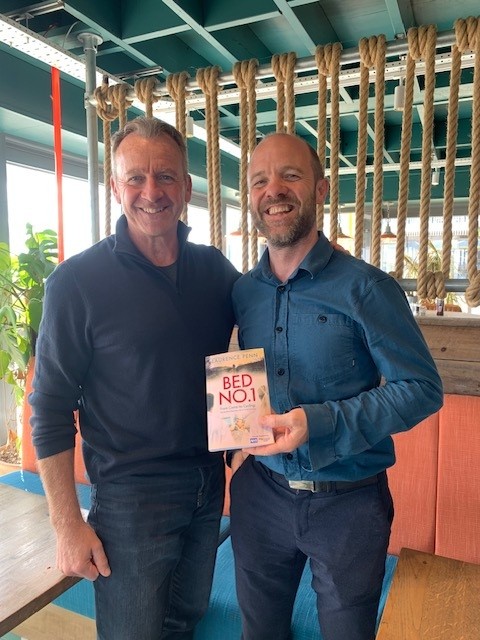
Laurence has since written a book, Bed No.1 From Coma to Cycling: The Resilient Recovery of a Covid Survivor, telling the story of his battle with Covid-19 and the people who helped him fight the virus, with all proceeds going to our dedicated charity.
Laurence said: “It took me five years to get this point. I was lucky enough to get Luke and others to contribute to the book, offering perspectives from nurses, respiratory consultants, physiotherapists, giving readers real insight into how their daily lives were turned upside down.”
More information about the book is available at www.bednumberone.com where orders can also be placed online.